Indo-Pacific Security Strategy: Washington’s Asian Outlook and Sri Lanka’s Geo political Maneuvers

By Leo Nirosha Darshan
COLOMBIO: In international geopolitics, the Asia-Pacific region, and specifically its core – the Indian Ocean – has drawn unprecedented attention from global superpowers. Serving as the heartbeat of world trade and maritime supply chains, the Indian Ocean region has emerged as a vital security flashpoint in the ongoing superpower competition.
In this context, amid the volatile security environment in the Middle East and Washington’s strategic recalibration toward the Asia-Pacific, recent high-level diplomatic and defense visits by two top U.S. officials to Sri Lanka have triggered significant international interest.
The United States is moving forward with key strategies aimed at counteracting instability in the Middle East, mitigating threats to global shipping in the Red Sea, and balancing China’s expanding military and economic footprint in the Asia-Pacific.
As a direct component of this strategy, General Kevin Schneider, Commander of U.S. Pacific Air Forces, and S. Paul Kapoor, U.S. Assistant Secretary of State for South and Central Asian Affairs, recently concluded official visits to Sri Lanka to expedite bilateral security and maritime domain awareness agreements.
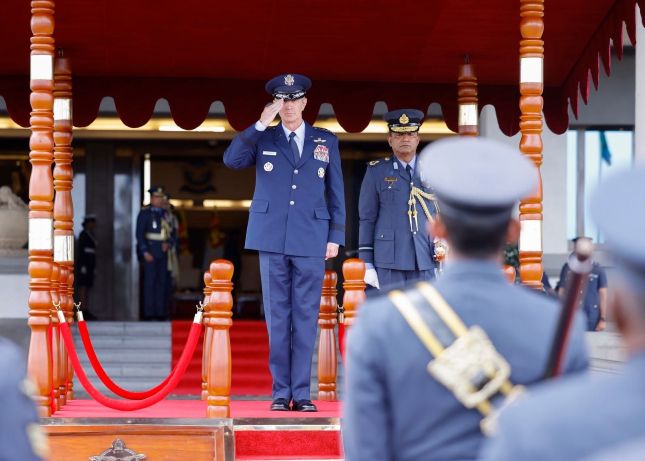
A prominent manifestation of this strategic Indo-Pacific maneuver is the official handing over of ten Texas-built helicopters to the Sri Lanka Air Force. The high-level defense ceremony, held at the Ratmalana Air Force Base, was jointly spearheaded by Sri Lankan President Anura Kumara Dissanayake, General Kevin Schneider, and Assistant Secretary Paul Kapoor.
Fully transferred to Sri Lanka under the United States’ critical Excess Defense Articles (EDA) program, these helicopters were previously utilized by the U.S. Navy for aviation training. Now integrated into the Sri Lanka Air Force, these aircraft will form the backbone of the country’s modernized training fleet.
Furthermore, officials stated that this transfer will significantly bolster Sri Lanka’s aerial and maritime domain awareness capabilities, enhancing maritime surveillance and critical search-and-rescue operations during humanitarian disasters.
Speaking at the event, U.S. Pacific Air Forces Commander General Schneider remarked: “These aircraft will support the modernization of Sri Lanka’s air force capabilities and train the next generation of pilots.
More importantly, this stands as a powerful symbol of the partnership between our two nations, reaffirming our shared commitment to peace, security, and prosperity across the region.”
Satellite Communication Framework
Parallel to aerial cooperation, Washington has also extended support to upgrade the Sri Lanka Navy’s maritime surveillance and defense capabilities. Aboard the SLNS Gajabahu docked at the Colombo Port, Assistant Secretary of State Paul Kapoor officially announced the provision of an upgraded satellite communications technology framework for the Sri Lanka Navy’s Offshore Patrol Vessels (OPVs).
Valued at approximately $4 million, this communications suite is manufactured by world-class defense tech firms. The U.S. delegation was received at the venue by State Minister of Defense (Retired) Major General Aruna Jayasekera and Navy Commander Vice Admiral Kanchana Banagoda.
This new satellite technology enables reliable voice and data transmission even when Sri Lankan naval vessels operate in deep-sea regions hundreds of miles away from the coastline. This ensures real-time connectivity with headquarters, aerial assets, and other naval vessels.
Defense analysts note that this framework will vastly improve Sri Lanka’s capacity to respond to maritime emergencies, intercept vessels engaged in smuggling or illicit activities, and guarantee the safety of international shipping lanes.
Emphasizing the strategic significance of these developments, Assistant Secretary Kapoor stated bluntly: “When Sri Lanka’s maritime domain is secure, global trade routes remain open, and commerce flows uninterrupted.
The Indian Ocean can then remain a secure highway for the prosperity of the entire region, rather than becoming an arena of coercion by any single power. This is a matter of direct strategic importance to the United States.”
The U.S. ‘Asia Outlook’ and Sri Lanka’s Neutrality
Behind these substantial U.S. military and diplomatic investments lies a long-term geopolitical strategy to balance Beijing’s strategic dominance in the region, established through Belt and Road Initiative (BRI) projects such as Sri Lanka’s Hambantota Port and the Colombo Port City.
The visit of General Kevin Schneider—who commands over 46,000 U.S. airmen in the Pacific—signifies far more than a routine military exchange. His discussions with top Sri Lankan defense officials regarding cybersecurity, joint military exercises, and air defense underscore Washington’s acute focus on the island nation.
As Middle Eastern war clouds and South China Sea tensions reshape the global order, the United States has positioned Sri Lanka as a vital node in its Indo-Pacific strategy.
The satellite communication technology and air defense helicopters provided to the island not only upgrade Sri Lanka’s national defense capabilities but also exponentially elevate its geostrategic significance in Washington’s Asian outlook.
In this competitive arena of global powers, how Sri Lanka protects its sovereignty and neutrality while contributing to regional peace and economic stability remains the defining question of current geopolitical dynamics.