South Asia’s Energy Security: Three Nations Trapped on a Single Path


‘Sri Lanka, with its small economy and already weakened foreign exchange reserves, is facing this crisis. The fuel queuing system and the four-day government work week have returned to effect. Fears have arisen among the people that the long queues and power outages of 2022 might return.’
By Leo Nirosha Darshan
COLOMBO: In January 2026, many believed that South Asia’s energy map was moving toward a new dawn. Everything reflected a smooth environment: a gas surplus in Pakistan, the arrival of the first shipment from Bangladesh’s historic 15-year supply deal with Qatar Energy, and the steady economic progress of Sri Lanka, which was recovering from its 2022 sovereign debt crisis. However, within the next seven weeks, the situation turned upside down.
The complete closure of the Strait of Hormuz in early March, followed by Qatar Energy’s declaration of ‘Force Majeure’ at Rass Laffan—the world’s largest liquefied natural gas (LNG) terminal—plunged South Asian nations into a dark age. The very contracts signed to ensure energy security have today become an economic trap for these countries.
South Asia’s energy demand has long been structured around a dependence on Persian Gulf nations. According to 2025 statistics, Pakistan, India, and Bangladesh received the lion’s share of their total LNG imports from Qatar and the UAE. Specifically, Pakistan imported more than 90 percent of its crude oil from this region. As for Bangladesh, 95 percent of its total energy needs depend on imports.
The currently intensified Iran-Israel-US conflict and the resulting global energy crisis have taught a crucial lesson. The 2026 crisis has demonstrated with precision how massive a structural failure it is to concentrate a region’s entire supply through a single maritime route.
South Asia’s dependence on LNG was not accidental; it was the result of deliberate policy decisions made to escape past crises. When Bangladesh’s domestic gas capacity depleted, spot market prices for LNG skyrocketed in 2022.
As Pakistan neared a nationwide shutdown and Sri Lanka lost its entire foreign exchange reserves, these nations were prompted to seek a “secure” path.
When the Russia-Ukraine war broke out in 2022, European nations tilted the global LNG market in their favor. At that time, South Asian countries struggled, unable to buy gas at high spot market prices.
To escape this, governments employed the strategy of long-term contracts to ensure supply and stabilize prices. That logic seemed reasonable then. When the spot market price rose to $70 per million British Thermal Units (MMBtu) in 2022, long-term contracts appeared to be a blessing.
However, those agreements failed to account for one vital aspect: whether the route for the contracted cargo was safe. Today, with the Strait of Hormuz closed, the contracts on hand have turned into mere pieces of paper. According to ‘Gas Outlook’ predictions, Sri Lanka, Bangladesh, and Pakistan will be the most severely affected economically in the world due to this supply route blockage.
The Current Plight of the Nations
In June 2023, the 15-year agreement Bangladesh signed with Qatar was viewed as a great achievement. However, when Qatar suspended supplies just seven weeks after the first shipment arrived, it dealt a massive blow to Bangladesh.
With Qatar’s production capacity affected by 17 percent due to Iranian attacks, Reuters reports that it may take up to five years to normalize. As a result, Bangladesh has now closed all universities, imposed several restrictions to save electricity, and initiated military action to prevent hoarding. The country is currently struggling to buy gas in the spot market at prices three times higher than pre-war levels.
Pakistan’s situation is slightly different but equally dangerous. Pakistan, which had surplus gas until last January, faced a shortage overnight when the war broke out.
According to a study by the Institute for Energy Economics and Financial Analysis (IEEFA), Pakistan is likely to have 177 excess cargoes in contracts it must fulfill until 2032. The financial liability for this exceeds $5.6 billion at current prices.
Pakistan is struggling, unable to use the gas or exit the contracts. Since supply to the fertilizer sector has been halted, this has also called the country’s food security into question.
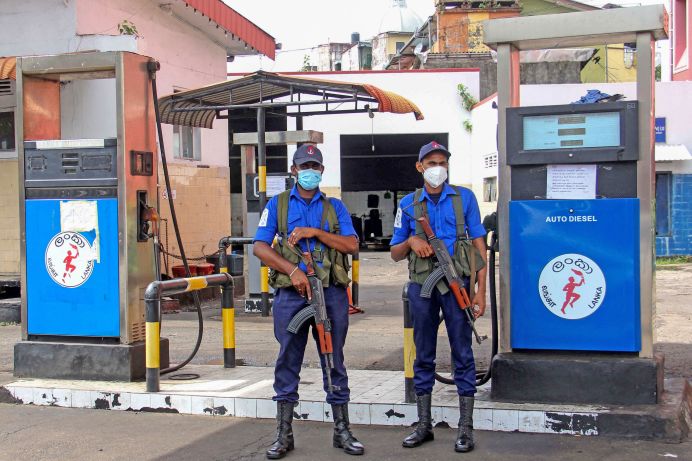
Sri Lanka, with its small economy and already weakened foreign exchange reserves, is facing this crisis. The fuel queuing system and the four-day government work week have returned to effect. Fears have arisen among the people that the long queues and power outages of 2022 might return.
Even after supply chain disruptions became so evident, South Asian countries are planning to expand LNG terminals and pipeline projects worth approximately $107 billion.
According to a report by Global Energy Monitor, Bangladesh and Pakistan plan to double their current import infrastructure. Many warn that investing billions more in a structure that relies solely on a volatile passage like the Strait of Hormuz is equivalent to suicide.
Therefore, the only way to escape this crisis is to reduce energy imports and turn toward domestic resources. Pakistan’s solar power expansion serves as an excellent example. The reason Pakistan’s power sector is somewhat resilient during the current crisis is its investment in solar energy.
According to IEEFA calculations, every gigawatt of solar power saves Pakistan approximately $3 billion in import costs over 25 years. Most importantly, sunlight does not need to come through any foreign port or block able straits. This directly ensures a nation’s energy sovereignty.
In contrast, countries like Bangladesh, which did not invest sufficiently in renewable energy, are now paying a heavy price. Thus, this shift is not just a debate about climate change; it is a strategic decision regarding a nation’s national security and economic self-reliance.
The steady hope and enthusiasm that existed in January 2026 are gone. The bitter realities of March have opened the eyes of South Asian governments. This sudden shock has highlighted how dangerous it is to depend on a single sea route.
The energy security strategies South Asian governments develop in the post-2026 period will determine whether this region remains equally vulnerable to the next disruption or emerges as a strong, self-reliant economy. The best solution offered by this crisis is to reduce the obsession with imported gas and move toward natural resources like sun and wind.
The 2026 crisis has once again loudly proclaimed that energy security does not lie in contract papers; it lies in the electricity produced on a nation’s own soil.