BRICS 2026: In New Delhi, India Tests the Shape of a New World Order
The declaration expressed “deep concern” over the escalation in West Asia and called for “maximum restraint”

By Gunjeet Sra
NEW DELHI: With 11 full members and a growing circle of partner countries, BRICS has outgrown its original identity as a club of emerging economies. At the 2026 summit in New Delhi, the larger question was whether this increasingly unwieldy coalition could turn its growing economic and political weight into influence.
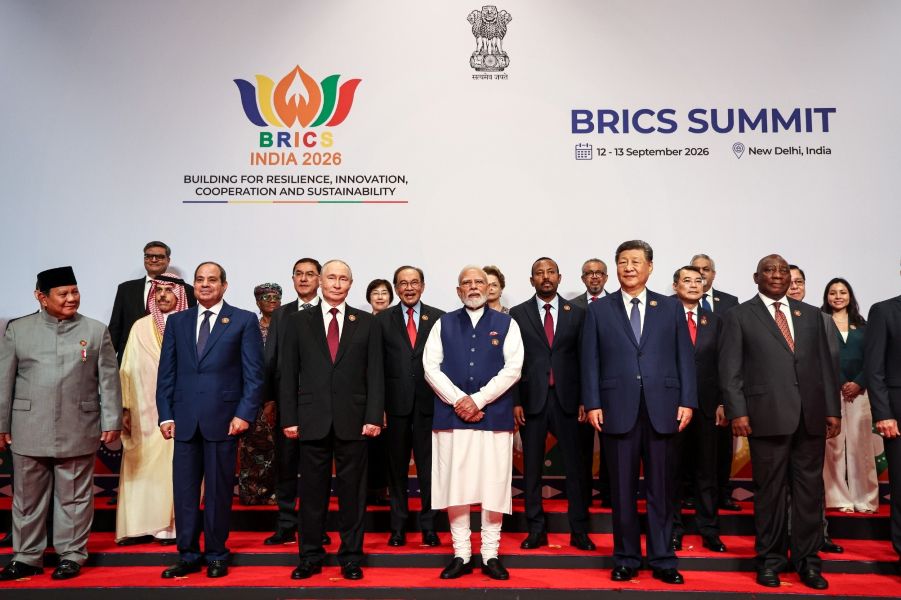
For a few days in September, New Delhi became the diplomatic meeting ground for a world that is increasingly difficult to organise into neat camps.
The 18th BRICS Summit brought together the expanded grouping of 11 full members—Brazil, Russia, India, China, South Africa, Egypt, Ethiopia, Iran, the United Arab Emirates, Saudi Arabia and Indonesia, alongside a wider circle of partner countries, at a moment when the international system is being pulled in several directions at once.
The war in Ukraine continues to divide Russia from the West, the conflict in West Asia has unsettled an already fragile region, the United States and China remain locked in strategic competition and trade, technology, finance and supply chains have increasingly become instruments of geopolitical power.
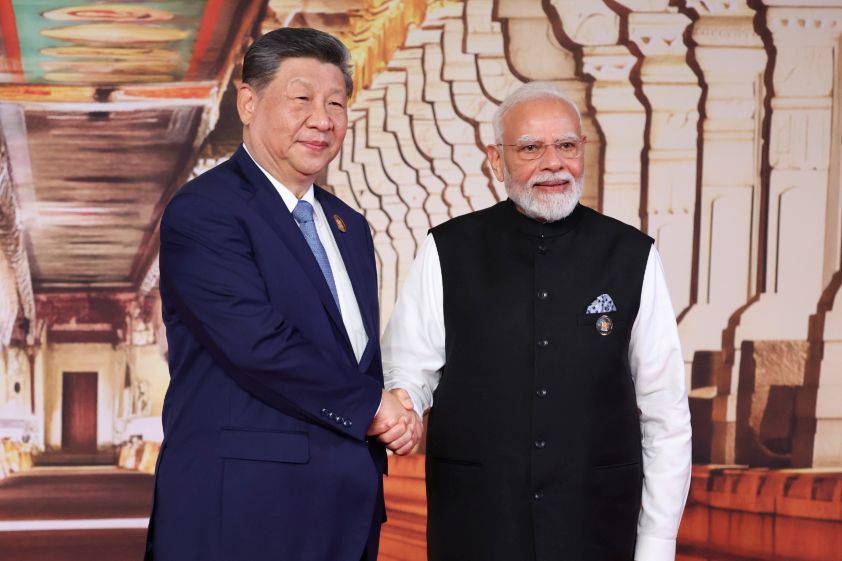
For India, the most consequential presence in New Delhi was perhaps the one that carried the longest history, Chinese President Xi Jinping, returning to India for the first time in seven years. Xi’s visit was significant not because it represented a dramatic reconciliation with New Delhi but precisely because it did not.
His return came after the 2020 Galwan Valley clash transformed the India-China relationship, turning a complicated partnership marked by competition and cooperation into one increasingly defined by military deployments, diplomatic mistrust and strategic suspicion. The two countries had spent years attempting to stabilise the situation along the Line of Actual Control while political engagement remained limited.
That Xi was once again sitting across the table from Prime Minister Narendra Modi therefore represented something more cautious and perhaps, more consequential than a diplomatic reset. It was an attempt to make rivalry manageable.
The Modi-Xi meeting on the sidelines of the summit was consequently watched for what it revealed about the future of the relationship. The language from both sides suggested an acknowledgement that neither country can afford an endlessly deteriorating relationship.
China has an interest in a more stable external environment as it navigates tensions with Washington, uncertainty around trade and supply chains and instability across several regions. India, meanwhile, has no interest in allowing its relationship with its largest neighbour to remain permanently frozen, particularly when New Delhi is attempting to position itself as an independent pole in a more fragmented world.
Diplomacy rarely advances through dramatic declarations alone. More often, it advances through the restoration of habits– leaders meeting, military channels remaining open, trade continuing and disagreements being discussed before they become crises.
That is what the current India-China moment appears to be about. The objective is not to eliminate competition but it is to make competition predictable enough that it does not repeatedly spill into confrontation.
This is also where BRICS becomes more important. It is one of the few international spaces in which India and China have a compelling reason to remain in the same room. They do not have to agree about the global order to cooperate on some of its institutions. They do not have to trust each other strategically to recognise that there are areas in which their interests overlap.
In that sense, BRICS offers something increasingly rare, a mechanism for countries to work together without first resolving all their differences.
A Very Different BRICS
The organisation Xi and Modi met under is very different from the BRICS that first emerged as an acronym for Brazil, Russia, India and China. South Africa joined in 2010, followed by a major expansion that brought Egypt, Ethiopia, Iran, the UAE, Saudi Arabia and Indonesia into the grouping.
The result is a BRICS that is geographically broader, economically more diverse and politically more complicated. Its strength lies precisely in that diversity, but so does its weakness. These countries do not share a political system, security architecture or single geopolitical outlook.
Some maintain close relations with Washington, others regard American power with deep suspicion. Some are dependent on Western markets and institutions, while others are actively building alternatives. Their relationships with Russia, China, Europe and the United States vary considerably. India and China are perhaps the clearest illustration of this contradiction.
They are strategic competitors. They are also partners in BRICS. The ability to accommodate that contradiction is what gives the organisation its particular character. BRICS is not a military alliance, a political union or a conventional economic bloc. It is increasingly a platform through which countries that disagree about the international order can nonetheless negotiate how much influence they should have over it.
That distinction is essential. External Affairs Minister S. Jaishankar described the summit as having forged consensus despite a “very polarised world” and the conflict in West Asia.
India has used its BRICS presidency to advance an argument that has become central to its foreign policy, the Global South should no longer be treated as a collection of countries to whom the established powers listen only when convenient. The argument is not simply about representation. It is about agency.
Who determines the rules governing artificial intelligence? Who controls access to capital? Who carries the cost of climate adaptation? How secure are food and energy supplies? What happens to developing economies when geopolitical conflicts disrupt trade routes, financial systems or supply chains?
These are questions that increasingly determine the economic and political futures of countries far beyond the traditional centres of power. India wants those countries to have a larger role in answering them. BRICS provides New Delhi with one of the platforms through which it can make that case.
Consensus, carefully constructed
The most revealing achievement of the New Delhi summit may have been what BRICS chose not to say. The 11-member bloc managed to adopt a joint declaration despite deep divisions over the wars in Iran and Ukraine, but it did so through the language of diplomatic generalisation.
On the conflict involving Iran, the declaration expressed “deep concern” over the escalation in West Asia and called for “maximum restraint”, but stopped short of naming the United States, Israel, Iran or the Gulf states.
This was not an accidental omission. Iran is a member of BRICS, so is the UAE, which has found itself on the opposite side of the conflict. A stronger statement assigning responsibility would almost certainly have made the carefully assembled consensus more difficult to sustain.
That India was able to shepherd the declaration through those divisions is therefore a significant diplomatic achievement but it also exposes the limits of what BRICS can realistically become.
The organisation can keep countries with sharply different strategic interests around the same table but only if the language is sufficiently broad for each of them to recognise something of their own position in it. Consensus, in other words, is possible but often at the price of specificity.
The contrast with the previous year’s declaration was revealing. In 2025, BRICS had condemned the US and Israeli war on Iran in considerably stronger terms. By 2026, the language has become deliberately more general, reflecting the changed circumstances and the widening divisions within the grouping.
In May, BRICS foreign ministers had themselves failed to agree on a joint statement over the Iran conflict. The New Delhi declaration therefore represented not the disappearance of those differences but India’s ability to find a formulation that could accommodate them.
The same calculation was visible in the language on Ukraine. The declaration called for disputes to be resolved through dialogue, consultation and diplomacy without naming the war itself, while criticising unilateral sanctions that are not authorised by the UN Security Council.
For Russia, which has been subject to extensive Western sanctions since its invasion of Ukraine, that language carries obvious significance.
For India and several other members, however, it offers a way of resisting unilateral coercive measures without signing on to Moscow’s broader interpretation of the war.
The declaration also called for the protection of civilian infrastructure and peaceful nuclear facilities operating under International Atomic Energy Agency safeguards, language that could be read as an indirect criticism of attacks on Iranian nuclear facilities without explicitly assigning responsibility.
The result was a diplomatic document built as much around what could be left unsaid as what could be agreed. Yet the picture was not uniformly cautious.
On Palestine, BRICS adopted considerably more explicit language, expressing firm opposition to the forced displacement of Palestinians and attempts to alter the geography or demography of the occupied Palestinian territory.
It called for an end to Israel’s war in Gaza, unhindered humanitarian access, support for UNRWA and full UN membership for Palestine, while reiterating support for a two-state solution and a sovereign Palestinian state based on the 1967 borders, with East Jerusalem as its capital.
That contrast is important. It shows that BRICS is capable of political positions that go beyond generic appeals for restraint when its members find sufficient common ground. This is also perhaps the clearest way to understand the politics of the expanded BRICS. It is not a coalition whose members have discovered a common geopolitical worldview, it is a coalition learning to construct areas of agreement around their disagreements.
The Iran war was therefore an unusually revealing test. The fact that BRICS survived the disagreement and produced a declaration matters. So does the fact that it could not agree on a more direct attribution of responsibility.
Both things are true at the same time and that contradiction sits at the heart of what BRICS is becoming.
India’s Global South Moment
India has used its BRICS presidency to advance an argument that has become central to its foreign policy, the Global South should no longer be treated as a collection of countries to whom the established powers listen only when convenient. The argument is not simply about representation. It is about agency.
Prime Minister Narendra Modi described BRICS as having reached a “coming of age” moment and called on the Global South to become a “rule-shaper” rather than merely a rule-taker.
It is a revealing formulation because it captures the larger ambition behind India’s BRICS presidency.
New Delhi is not merely asking for developing countries to be given more seats around an existing table, it is arguing that they should have a greater role in deciding how the table itself is designed.
The China Paradox
Beijing has long advocated a global order less dominated by the United States and Western institutions. China’s economic reach, diplomatic networks and growing influence across the developing world give it considerable resources with which to advance that vision. India shares part of the diagnosis.
It does not, however, necessarily share China’s preferred destination.
New Delhi wants a multipolar world, but it does not want American predominance to be replaced by Chinese predominance. It wants the Global South to acquire greater agency, but does not want that agency to become an extension of Beijing’s geopolitical ambitions.
This is the quiet tension running through India’s BRICS strategy. Although India wants strategic autonomy, it does not seek strategic isolation.
It wants to be able to work simultaneously with Washington, Moscow, Beijing, Europe, Japan and countries across the developing world without being compelled to choose one camp permanently. That makes the Modi-Xi meeting particularly revealing.
India and China do not have to resolve their strategic rivalry before they can cooperate in selected areas. In fact, the very existence of that rivalry makes mechanisms for managing it more important. The India-China relationship may therefore offer a useful metaphor for BRICS itself–cooperation without convergence, engagement without reconciliation.
The Economics of It All
The debate around BRICS has increasingly moved beyond political symbolism to the question of economic power. The grouping has explored ways to expand trade in national currencies, develop alternative payment mechanisms and reduce vulnerability to financial systems dominated by the West.
This has generated frequent speculation about whether BRICS could eventually create a common currency capable of challenging the dollar. The reality is less dramatic and more interesting.
Countries do not necessarily need to replace the dollar to reduce their dependence on it. They can create alternatives alongside it.
For India, this distinction is particularly important. New Delhi remains deeply integrated with Western economies and financial markets and has no interest in destroying the system from which its own economic expansion benefits.
What it wants is greater room to manoeuvre. If trade can be settled more easily in national currencies, if alternative payment systems become more viable, and if developing countries have greater protection against geopolitical financial pressure, they gain strategic options.
The objective is therefore not necessarily to overthrow the dollar, it is to ensure that the dollar is not the only option.
The question of trade made the contradiction even clearer. The BRICS declaration criticised unilateral tariff and non-tariff measures that distort global trade and opposed sanctions imposed without United Nations Security Council authorisation.
The language was particularly relevant at a moment when several BRICS members, including India, China and Russia, have faced US tariffs or sanctions of varying kinds. Yet once again, the grouping stopped short of turning its criticism into an explicit confrontation with Washington.
The United States was not named. That restraint was strategically useful to India. New Delhi has deep and growing economic and technological ties with the United States and cannot afford to treat BRICS as an anti-American alliance. The same is true, in different ways, for several other members whose economies remain deeply connected to Western markets.
This is why Modi’s insistence that “BRICS is not against anyone” matters. India wants BRICS to challenge the inequalities of the existing international system without turning the organisation into a new geopolitical bloc defined primarily by opposition to the West.
The distinction is subtle but fundamental. For BRICS, the harder work begins after the declarations. Its credibility will ultimately depend on whether its growing membership can produce practical cooperation in trade, finance, technology and development, rather than simply a larger forum for expressing dissatisfaction with the existing system.
For India, that makes the summit less a moment of arrival than an opportunity to build. Its influence will depend on what it can make of the space BRICS has created, whether it can turn representation into leverage, consensus into cooperation, and its growing weight into a more consequential voice in the institutions that shape the global economy.