Putin in Delhi and India’s Art of Strategic Balance
Instead of signalling a return to old alliances, the visit offered a case study in how middle powers pursue autonomy in a fractured global order.

By Gunjeet Sra
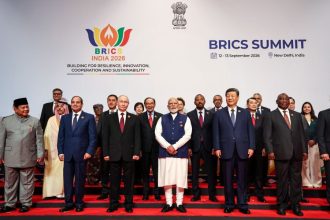
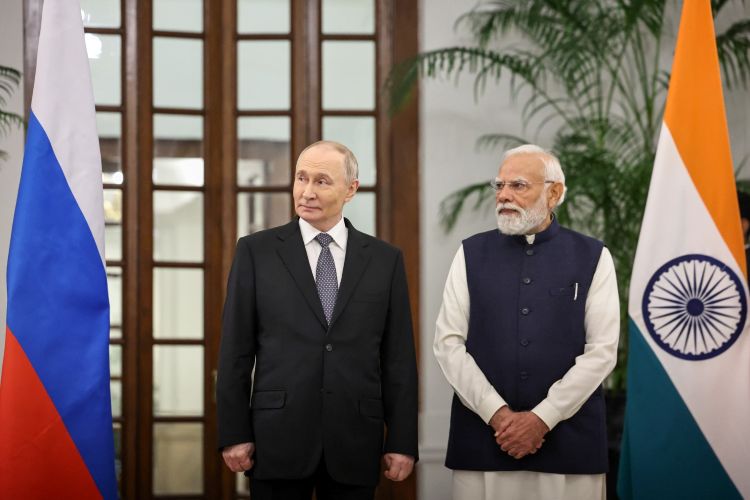
NEW DELHI: When Prime Minister Narendra Modi greeted Vladimir Putin with a public embrace in New Delhi, the symbolism was intentional. At a time when engagement with Russia has become diplomatically costly for much of the world, India chose visibility over ambiguity. The message was not alignment, but continuity.
Putin’s visit carried little expectation of breakthrough agreements. Its purpose was political signalling: to reaffirm a working partnership and to demonstrate that New Delhi retains agency in how and with whom it conducts foreign policy.
That logic shaped the visit’s structure. The carefully managed optics, the restrained language of the joint statements, and the emphasis on long-term economic frameworks over immediate gains reflected a relationship being maintained, not reinvented.
There was reassurance in the rituals. A ceremonial welcome at Rashtrapati Bhavan, a wreath at Mahatma Gandhi’s memorial at Raj Ghat and extended talks at Hyderabad House, all meant to signal that India and Russia still share a comfort with slow, leader-led diplomacy, even as global alignments grow more brittle.
Yet beneath the choreography lay a pragmatic exchange. Russia, constrained by sanctions and political isolation in parts of the world, is seeking dependable markets and recognition beyond the transatlantic sphere. India, confronting energy volatility and strategic uncertainty, is intent on preserving flexibility. Both are wary of rigid alliances and resistant to moral absolutes in foreign policy.
The language of the visit reflected that realism. India and Russia set a target of US$100bn in bilateral trade by 2030, revived discussions on a Eurasian Economic Union free trade agreement, unveiled a long-term economic cooperation programme, pledged uninterrupted oil supplies and expanded talks on nuclear energy, pharmaceuticals, agriculture, manufacturing and a commitment to zero tolerance towards terrorism.
For Moscow, India represents scale and continuity, an economy large enough to matter and independent enough to resist political pressure. For New Delhi, the relationship is framed within its long-held doctrine of strategic autonomy: engagement without alignment, cooperation without constraint.
Even so, the limits of the partnership were evident. Trade remains heavily skewed towards energy. Defence cooperation, once the axis of bilateral ties, now carries the weight of legacy.
One decision, however, carried longer-term implications. During the visit, Putin inaugurated the India arm of the state-funded Russia Today (RT) network, establishing what is now the broadcaster’s largest overseas operation, with a major studio in Delhi and a staff of more than 100.
RT India plans to produce several daily English-language news programmes, presenting itself as a counterweight to what it describes as western-dominated global media narratives. The launch coincided with the signing of five media cooperation agreements between India’s public broadcaster, Prasar Bharati, and Russian media entities.
For India, the expansion widens the media ecosystem but also introduces a foreign state-backed outlet closely aligned with Moscow’s strategic messaging. For Russia, India offers a large and relatively open audience at a time when its access to western media markets has sharply contracted.
In an era where narrative power increasingly shapes diplomacy, the media dimension of the visit may outlast many of the formal agreements.
The historical depth of India–Russia relations remains important. The Soviet Union’s support during wars, its role at the UN security council and its contribution to India’s industrial base continue to inform public and political memory.
But the post-2022 international order has altered the relationship’s foundations. India is now Russia’s largest oil customer, an arrangement rooted more in economic pragmatism than ideological affinity. At the same time, sanctions have disrupted defence supply chains and deepened Russia’s strategic convergence with China.
India’s foreign policy today is defined by careful calibration. It buys American aircraft and Russian energy, participates in Quad initiatives while sustaining ties with Moscow, and speaks for the global south while anchoring itself within the G20.
Putin’s visit was an expression of that approach. It allowed India to demonstrate continuity without exclusivity, engagement without endorsement. Russia departed with reassurance; India retained room to manoeuvre.
In a world growing less tolerant of nuance, that capacity to balance patiently and publicly may be India’s most valuable strategic asset.