From Political Changes to Economic Growth, from Wars to Disasters: Asia’s Defining Year 2025 (VII)

The year 2025 in Asia was shaped by impressive economic performances, historic turning points, lingering tensions between neighbors, high-stakes elections, waves of protest, the change of governments, cautious diplomatic breakthroughs among certain states, and relentless natural disasters with deep scars for peoples and countries.
THE AsiaN, founded on Asia Journalist Association’s network of journalists, is highlighting through articles written by its members the major issues that defined 2025 across Asia’s regions and countries. – Editor’s note”.

A Stronger India, A Fractured Moment What 2025 Revealed- and What Awaits in 2026
By Gunjeet Sra
Editor in Chief of sbcltr, India
NEW DELHI: India entered 2025 confronting a paradox: expanding international influence alongside intensifying domestic contestation. Elections reaffirmed mandates in some regions while eroding trust in institutions in others.
Diplomatic channels that had been largely frozen since the pandemic and successive border crises were cautiously reopened, even as long-standing regional rivalries refused to soften. Climate shocks punctured assumptions about resilience, while culture and sport offered brief moments of relief within an increasingly polarised public sphere.
2025 was not a year of dramatic rupture but one of cumulative pressure. Decisions taken and tensions exposed during the year will continue to shape India’s strategic and political choices in the near future. The following developments best capture that recalibration and the pressures they are already placing on the year ahead.
Electoral Integrity Controversy and the Questioning of Democratic Process
One of the most concerning developments of 2025 was the escalation of allegations regarding electoral irregularities. Opposition leader Rahul Gandhi accused authorities of systematic manipulation of voter rolls, selective deletions, and administrative bias in recent elections.
These claims triggered sustained street protests, repeated disruptions in Parliament, and a growing number of legal challenges questioning the transparency and independence of electoral institutions.
Although no final judicial determination has yet been reached, the controversy has already altered the political climate. As India moves into 2026, electoral administration is likely to face heightened scrutiny, including increased judicial oversight and stronger demands for procedural transparency.
The Election Commission has begun a special intensive revision of voter lists. This issue is likely to intensify further as political campaigns foreground process-related grievances, signalling a shift toward a more adversarial and legalistic democratic environment rather than one grounded in procedural consensus.
The Delhi Assembly Election and the Remaking of Urban Political Calculus
The February 2025 Delhi assembly election marked a decisive realignment in the national capital. The Bharatiya Janata Party’s emphatic victory ended 27 years of political exclusion in Delhi and brought to a close a prolonged period of governance by the Aam Aadmi Party, which had once positioned itself as a disruptive alternative between the Indian National Congress and the BJP. Voter disillusionment with civic breakdown, pollution, and administrative gridlock played a decisive role in the party’s decline.
The implications of the Delhi result extend well beyond the capital. As India approaches 2026, the outcome is likely to influence how national parties approach urban governance across other metropolitan centres. Delhi may serve as a template for emphasising service delivery, law and order, and administrative coherence, while compelling regional parties to reassess leadership structures and accountability in cities where elections are approaching.
Bihar’s Landslide Verdict and the Consolidation of Coalition Politics
The Bihar assembly elections in late 2025 delivered one of the most decisive mandates in the state’s recent history, returning the National Democratic Alliance—led by Nitish Kumar and the BJP—with an overwhelming majority. The scale of the victory reinforced the appeal of political stability in a state long associated with fractured mandates and coalition volatility.
Looking ahead to 2026, Bihar’s verdict is likely to strengthen the NDA’s confidence in coalition continuity as an electoral asset. It may also embolden the government to accelerate infrastructure development, welfare delivery, and administrative reforms, projecting Bihar as a model of stable governance. For the opposition, the result underscores the need for sustained organisational rebuilding rather than short-term electoral mobilisation.
India–China Thaw and the Limits of Pragmatic Engagement
A notable diplomatic development in 2025 was the cautious thaw in India–China relations. Following talks in New Delhi, the two sides agreed to resume selected direct flights suspended since 2020, reopen designated border trade points, and encourage limited economic engagement. These measures did not resolve the core boundary dispute but marked a shift away from a complete diplomatic freeze.
As India enters 2026, the thaw is expected to produce modest economic and logistical effects, particularly in trade and business travel. Strategically, it reflects an effort by both sides to stabilise relations without conceding core positions. The durability of this engagement will depend on border management and broader regional geopolitics, but it has already reduced the immediacy of escalation risks.
Legislative Confrontation: The Waqf (Amendment) Act, 2025
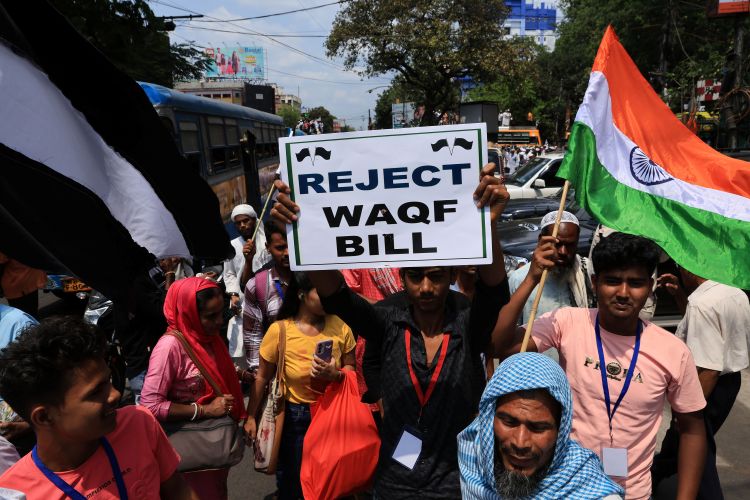
The passage of the Waqf (Amendment) Act in 2025 emerged as one of the most polarising legislative actions of the year. The law restructured the governance of waqf properties, increased state oversight, and altered the composition of waqf boards. Supporters framed the legislation as a measure to enhance transparency and reform, while critics argued that it infringed upon minority religious autonomy.
Waqf properties are assets permanently donated by a Muslim individual for religious, charitable, or public welfare purposes under Islamic law. Once designated as waqf, the property cannot be sold or transferred, and its income is intended to support mosques, schools, graveyards, hospitals, or assistance to the poor.
As India moves toward 2026, the Act is likely to remain a focal point of legal and political contestation. Constitutional challenges are expected to proceed through the courts, and state-level implementation could trigger localised protests, particularly where waqf land carries significant commercial value. The episode highlights how legislative reform in India is increasingly intertwined with identity politics and federal tensions.
Environmental Crises and the Exposure of Governance Vulnerabilities
Environmental stress emerged as a defining feature of 2025. Flash floods in Uttarakhand caused widespread damage, once again raising concerns about unchecked development in ecologically fragile Himalayan regions. In Punjab, severe flooding disrupted agriculture and rural livelihoods, while in the national capital, New Delhi’s air quality crisis deepened, with prolonged episodes of hazardous air quality extending beyond the winter months.
These events are likely to shape policy debates in 2026, particularly around disaster preparedness, urban planning, and climate adaptation. Judicial intervention, administrative reviews, and public pressure may intensify, but the year also exposed the limits of reactive governance. Environmental resilience is poised to become a more central political issue, even as long-term solutions remain uncertain.
Defence Modernisation and Strategic Positioning
India’s defence posture continued to evolve in 2025, with progress on major procurement agreements, co-production initiatives, and indigenous manufacturing programmes. Deals with Western partners, particularly France, reinforced India’s efforts to diversify defence suppliers and deepen strategic partnerships beyond legacy dependencies.
Looking toward 2026, these decisions are expected to translate into clearer strategic signalling through joint military exercises, technology transfers, and planned inductions. Defence industrial policy is likely to gain prominence as both a security and economic instrument, aligning military preparedness with manufacturing growth and export ambitions.
Media, Information Power, and Foreign Influence
The launch of a major Russia-backed international broadcaster’s India arm during a high-profile state visit in late 2025 highlighted the growing contest over narrative influence. The expansion reflects how global powers increasingly view Indian audiences as strategically significant.
In 2026, this development is likely to sharpen debates over media regulation, foreign influence, and editorial independence. While India’s pluralistic media environment is unlikely to be fundamentally altered, policymakers may revisit regulatory frameworks governing state-backed international broadcasters as information warfare becomes a more explicit feature of geopolitics.
India–Pakistan Tensions and the Persistence of a Hostile Equilibrium
Relations between India and Pakistan in 2025 remained defined by fragility rather than engagement. Cross-border incidents, militant activity, and diplomatic sparring prevented any substantive thaw, even as the 2021 ceasefire broadly held. Dialogue channels remained minimal and largely transactional.
As India looks toward 2026, this pattern is likely to persist. The absence of structured engagement reinforces a security-first posture, limits regional cooperation in South Asia, and keeps Kashmir central to India’s internal and external security calculations. The bilateral relationship appears set to remain frozen rather than resolved.

A Unifying Moment: India’s Women’s World Cup Victory
Amid political polarisation, India’s women’s cricket team winning the ICC Women’s World Cup in November 2025 provided a rare moment of national cohesion. The victory reshaped public perceptions of women’s sport and professional athletics in India.
Its effects are expected to unfold in 2026 through increased investment in women’s sports infrastructure, expanded grassroots programmes, and heightened commercial sponsorship. Beyond sport, the triumph offers India a valuable soft-power asset, reinforcing narratives of social progress and inclusion.