Natural Disasters: Tsunamis
The goal is not to stop the wave, but to ensure people are out of its path when it arrives

By Dr. Hassan Humeida
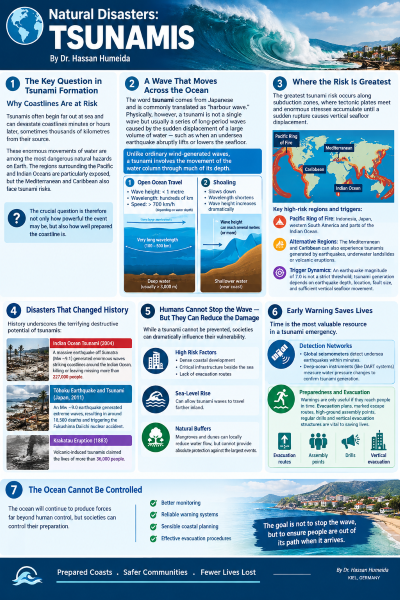
KIEL, GERMANY: The Key Question in Tsunami Formation: Why Coastlines Are at Risk: Tsunamis often begin far out at sea and can devastate coastlines minutes or hours later, sometimes thousands of kilometres from their source.
These enormous movements of water are among the most dangerous natural hazards on Earth. The regions surrounding the Pacific and Indian Oceans are particularly exposed, but the Mediterranean and Caribbean also face tsunami risks.
The crucial question is therefore not only how powerful the event that triggers a tsunami may be, but also how well prepared the coastline is.
A Wave That Moves Across the Ocean: The word tsunami comes from Japanese and is commonly translated as “harbour wave.” Physically, however, a tsunami is not a single wave but usually a series of long-period waves caused by the sudden displacement of a large volume of water—such as when an undersea earthquake abruptly lifts or lowers the seafloor.
Unlike ordinary wind-generated waves, a tsunami involves the movement of the water column through much of its depth:
- Open Ocean Travel: In deep water, a tsunami may be barely noticeable with a wave height of less than a metre and a wavelength extending for hundreds of kilometres, yet it can travel at speeds exceeding 700 kilometres per hour depending on water depth.
- Shoaling: As the tsunami enters shallower water, it slows down while its energy remains constant, causing the wavelength to shorten and the wave height to increase dramatically. Near the coast, water can rise several metres—or, in exceptional cases, much higher.
Where the Risk Is Greatest: The greatest tsunami risk occurs along subduction zones, where tectonic plates meet and enormous stresses accumulate until a sudden rupture causes vertical seafloor displacement.
Key high-risk regions and triggers include:
- The Pacific Ring of Fire: One of the world’s major tsunami-risk regions, alongside Indonesia, Japan, western South America, and parts of the Indian Ocean.
- Alternative Regions: The Mediterranean and Caribbean can also experience tsunamis generated by earthquakes, underwater landslides, or volcanic eruptions.
- Trigger Dynamics: An earthquake magnitude of 7.0 is not a strict threshold; tsunami generation depends on earthquake depth, location, fault size, and sufficient vertical seafloor movement.
Disasters That Changed History – History underscores the terrifying destructive potential of tsunamis:
- Indian Ocean Tsunami (2004): A massive earthquake off Sumatra (Mw ~9.1) generated enormous waves striking coastlines around the Indian Ocean, killing or leaving missing more than 227,000 people.
- Tōhoku Earthquake and Tsunami, Japan (2011): An Mw ~9.0 earthquake generated extreme waves, resulting in around 18,500 deaths and triggering the Fukushima Daiichi nuclear accident.
- Krakatau Eruption (1883): Volcanic-induced tsunamis claimed the lives of more than 36,000 people.
Humans Cannot Stop the Wave—But They Can Reduce the Damage: While a tsunami cannot be prevented, societies can dramatically influence their vulnerability. Dense coastal development, critical infrastructure located directly beside the sea, and a lack of evacuation routes severely increase casualties. Furthermore, sea-level rise can allow tsunami waves to travel farther inland. While natural coastal ecosystems like mangroves and dunes can locally reduce water flow, they cannot provide absolute protection against the largest events.
Early Warning Saves Lives – Time is the most valuable resource in a tsunami emergency:
- Detection Networks: Global seismometers detect undersea earthquakes within minutes, while deep-ocean instruments (like DART systems) measure water pressure changes to confirm tsunami generation.
- Preparedness and Evacuation: Warnings are only useful if they reach people in time. Evacuation plans, marked escape routes, high-ground assembly points, regular drills, and vertical evacuation structures are vital to saving lives.
The Ocean Cannot Be Controlled: The ocean will continue to produce forces far beyond human control, but societies can control their preparation. Better monitoring, reliable warning systems, sensible coastal planning, and effective evacuation procedures can dramatically reduce the human cost. The goal is not to stop the wave, but to ensure people are out of its path when it arrives.