Natural Disasters: Desertification and the Spread of Deserts
Desertification is a warning the balance between people, water, vegetation, and soil is past sustainable limits

By Dr. Hassan Humeida
KIEL, GERMANY:
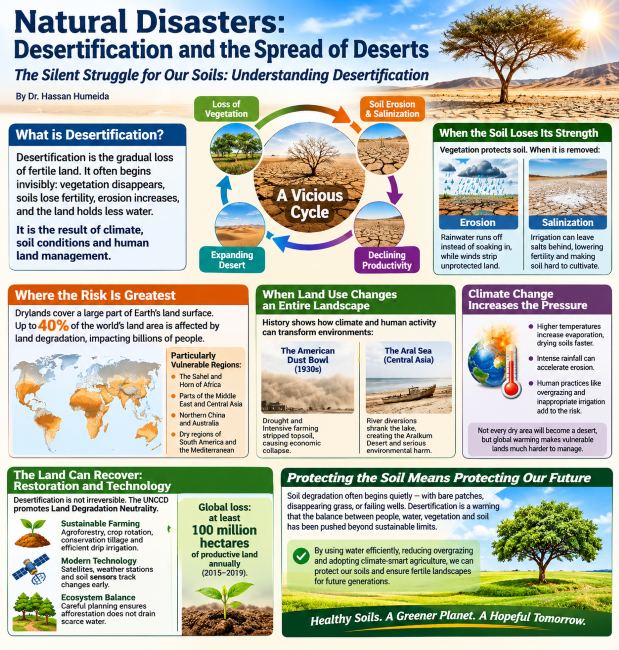
The Silent Struggle for Our Soils: Understanding Desertification: Desertification does not begin with sand dunes slowly moving across the landscape. More often, it starts almost invisibly: vegetation disappears, soils lose fertility, erosion increases, and the ground becomes less capable of storing water.
In dry regions, this gradual degradation threatens agriculture, ecosystems, and the livelihoods of millions of people. Far from being a purely natural process, desertification is the result of complex interactions between climate, soil conditions, and human land management.
Healthy soil is a living system that stores water, provides nutrients, and supports plants through roots, organic matter, and countless water-absorbing pores. When this system is damaged, the consequences extend far beyond individual fields.
When the Soil Loses Its Strength: Vegetation acts as a vital shield, protecting soil from heavy rain and strong winds while root systems bind particles together. If vegetation is cleared through overgrazing, deforestation, or intensive agriculture, the balance breaks down:
- Erosion: Rainwater runs across the surface instead of penetrating, washing away fertile topsoil, while strong winds strip unprotected dry land.
- Salinization: Irrigated agriculture can leave behind dissolved salts as water evaporates, lowering agricultural productivity and making soil difficult to cultivate.
While aridity indices and climate factors establish basic regional dryness, soil type, vegetation cover, and human land use ultimately determine vulnerability.
Where the Risk Is Greatest: Drylands cover a substantial part of the Earth’s land surface. According to the United Nations Convention to Combat Desertification (UNCCD), land degradation affects up to 40% of the world’s land area and directly impacts billions of people.
Particularly vulnerable regions include:
- The Sahel and the Horn of Africa
- Parts of the Middle East and Central Asia
- Northern China and Australia
- Dry regions of South America and the Mediterranean
Desertification is not confined to developing nations; parts of Europe also experience soil erosion, water stress, and declining soil quality due to unsustainable land management.
When Land Use Changes an Entire Landscape – History illustrates how climate variability and human activity can combine to transform environments:
- The American Dust Bowl (1930s): Years of drought combined with intensive cultivation and grassland removal stripped away fertile topsoil, causing economic collapse and mass migration.
- The Aral Sea (Central Asia): Extensive river diversions for cotton irrigation since the 1950s and 1960s caused the lake to shrink dramatically. The exposed seabed (Aralkum Desert) released salt and residues, creating widespread environmental and health crises.
These events demonstrate that how water and land are managed can be just as crucial as the amount of natural rainfall available.
Climate Change Increases the Pressure: While natural climate variability and droughts stress soils, human practices like overgrazing and inappropriate irrigation amplify these vulnerabilities. Climate change adds another layer of pressure: higher temperatures increase evaporation, intensifying water stress and drying out soils more quickly during dry spells. Intense rainfall events then accelerate erosion on unprotected ground.
While not every dry area will automatically become a desert, global warming makes already vulnerable landscapes significantly harder to manage.
The Land Can Recover: Restoration and Technology: Desertification is not necessarily irreversible. The UNCCD promotes Land Degradation Neutrality, aiming to avoid, reduce, and reverse land degradation. However, the global scale of loss remains vast, with the world losing at least 100 million hectares of productive land annually between 2015 and 2019.
Effective restoration and monitoring strategies include:
- Sustainable Farming: Agroforestry (combining trees and crops), diverse crop rotations, conservation-oriented tillage, and efficient drip irrigation.
- Modern Technology: Satellites, weather stations, and soil sensors track vegetation health, moisture, and land-cover changes to catch degradation early.
- Ecosystem Balance: Careful planning ensures that afforestation projects do not consume scarce water resources in natural dry ecosystems.
Protecting the Soil Means Protecting Our Future: Soil degradation begins quietly—with bare patches, disappearing grass, or failing wells. By the time a landscape visibly resembles a desert, the process has often been underway for decades.
Desertification is a warning that the balance between people, water, vegetation, and soil has been pushed past sustainable limits. Protecting our soils through efficient water use, reduced overgrazing, and adapted agriculture ensures that fertile landscapes can continue to support future generations.