Surviving the Extreme: How Affected Groups Defy Climate Change
If the planet warms by 2 or 3 degrees Celsius, the most robust crops will wither

By Dr. Hassan Humeida
KIEL, GERMANY: The climate crisis is breaking over us with full force, but it does not hit us all equally. When heatwaves shatter records, storms devastate coastlines, or droughts tear the soil apart, certain population segments—the so-called vulnerable target groups—stand defenseless on the front lines. For them, it has long ceased to be about abstract climate debates and is now about very concrete, everyday survival strategies. A look at those affected shows how necessity becomes the mother of invention, and where the limits of adaptation lie.
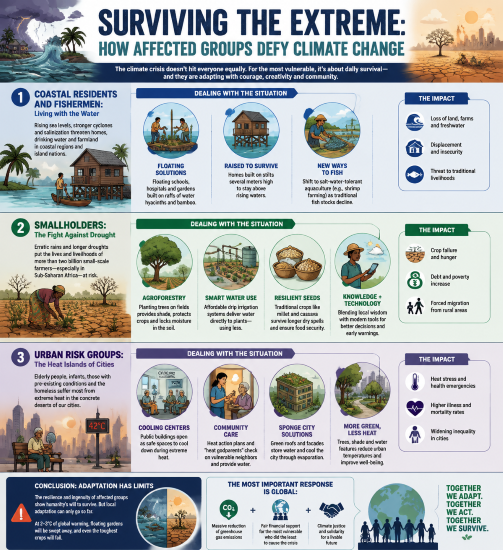
1. Coastal Residents and Fishermen: Living with the Water:
In regions like South Asia or small island nations, rising sea levels coupled with fierce tropical cyclones pose a daily threat. Entire village communities are losing their drinking water and farmland due to the salinization of soils.
- Dealing with the Situation: Instead of giving up, people are adapting to the wet reality. In Bangladesh, aid organizations and locals build floating schools, hospitals, and gardens on rafts made of water hyacinths and bamboo. Houses are raised on stilts several meters high. Fishermen are increasingly switching to salt-water-tolerant aquaculture (such as shrimp farming) as traditional fish stocks dwindle due to warming oceans.
2. Smallholders: The Fight Against Drought:
For the more than two billion people worldwide who depend on small-scale farming—particularly in Sub-Saharan Africa—the failure of rainy seasons is a death sentence for their harvests.
- Dealing with the Situation: The affected target group responds by returning to forgotten knowledge and modern technology. In African countries, farmers are increasingly relying on agroforestry: trees are intentionally planted on fields to provide shade for crops and retain moisture in the soil. Furthermore, affordable drip irrigation systems and resilient, traditional seed varieties like millet or cassava, which can survive for months without water, are becoming well-established.
3. Urban Risk Groups: The Heat Islands of Cities:
In the concrete deserts of megacities—both in the Global South and in Europe—older people, infants, those with pre-existing conditions, and the homeless suffer the most during extreme heatwaves. The lack of nighttime cooling in urban areas leads to acute heat stress and a sharply increased mortality rate.
- Dealing with the Situation: Here, organizational and structural measures are increasingly taking effect. Cities are setting up “cooling centers” in public buildings where vulnerable people can cool off during the day. In countries like Germany, heat action plans and volunteer “heat godparents” help by checking on elderly neighbors on hot days and providing them with water. Architecturally, the concept of the sponge city is being pushed forward: roofs and facades are consistently greened to store water and actively lower ambient temperatures through evaporation.
Conclusion: Adaptation Has Limits:
The creative and resilient approach of the affected groups demonstrates humanity’s indomitable will to survive. However, these local adaptation strategies must not obscure the fact that the limits of tolerance will soon be reached. If the planet warms by 2 or 3 degrees Celsius, floating gardens will be washed away and even the most robust crops will wither.
Therefore, the most crucial way to deal with extreme weather remains a global one: the massive reduction of greenhouse gases and fair financial support from wealthier countries for the exact target groups that contributed the least to the crisis, but are paying the heaviest price for it.