India’s Voter-List Crisis: The Fight Over Who Gets to Vote
The opposition’s response has moved beyond street protests to the country’s highest constitutional offices

By Gunjeet Sra
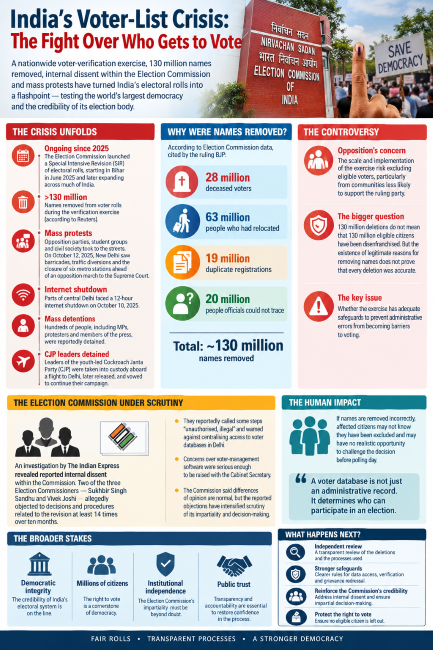
NEW DELHI: An investigation revealing repeated internal objections within India’s Election Commission has triggered nationwide protests, mass detentions and a confrontation over the poll body’s independence.
With more than 130 million names removed during a nationwide voter-verification exercise, the dispute is testing the safeguards that underpin the world’s largest democracy.
On Monday, October 12, New Delhi woke to barricades, traffic diversions and the closure of six metro stations as police tightened security ahead of an opposition march to the Supreme Court. The restrictions followed a weekend of escalating protests against the Election Commission’s revision of India’s electoral rolls.
Parts of central Delhi experienced a 12-hour internet shutdown on October 10, while hundreds of people, including Members of Parliament and members of the press, were reportedly detained. The Commission’s headquarters remained under heightened security as the dispute spilled from political institutions into the streets.
Among those detained were leaders of the youth-led Cockroach Janta Party (CJP), taken into custody aboard a flight arriving in Delhi as they travelled to join the demonstrations. Released the following day, they vowed to continue their campaign.
At a press conference on Sunday, the movement’s leaders accused the government of “pushing the country towards a civil war”, escalating the rhetoric surrounding a controversy that has grown from a dispute over voter registrations into a wider confrontation over democratic accountability and the right to protest.
At the centre of the crisis is Chief Election Commissioner Gyanesh Kumar, whose resignation is being demanded by the opposition Congress party, the All-India Students’ Association (AISA) and the CJP.
Their immediate grievance is the Election Commission’s Special Intensive Revision, or SIR, a nationwide exercise intended to verify voter registrations and remove ineligible entries. Their larger concern is that a process designed to protect electoral integrity may itself be excluding eligible citizens.
The controversy intensified after The Indian Express reported on September 25 that two of the three Election Commissioners, Sukhbir Singh Sandhu and Vivek Joshi, had formally objected to decisions and procedures associated with the revision at least 14 times over ten months.
The Commission has defended its decisions as lawful and denied favouring any political party. But the reported internal dissent has intensified scrutiny of an institution whose credibility depends on its perceived impartiality.
According to Reuters, approximately 130 million names have been removed from electoral rolls during the verification exercise. The Commission’s data, cited by the ruling Bharatiya Janata Party (BJP), attributes the deletions to deaths, relocation, duplicate registrations and people officials could not trace.
The opposition argues that the scale and implementation of the exercise risk excluding eligible voters, with potentially serious consequences for communities less likely to support the ruling party.
The distinction matters,130 million deletions do not mean that 130 million eligible citizens have been disenfranchised. But neither does the existence of legitimate reasons for removing names establish that every deletion was accurate.
The central question is whether the exercise has adequate safeguards to prevent administrative errors from becoming barriers to voting.
The investigation that exposed cracks within the Election Commission
The Indian Express investigation revealed a reported rupture inside the Commission. Sandhu and Joshi objected to decisions they said were taken without their knowledge, including procedures for adding voters and deleting names.
According to the newspaper, the two described certain steps involving new voter registrations as “unauthorised, illegal” and warned against centralising access to voter databases in Delhi in ways that bypassed state-level officials.
Concerns over voter-management software were reportedly serious enough for them to approach the Cabinet Secretary.
The objections are significant because they came from within the institution supervising SIR, rather than solely from opposition parties challenging it. The report raised questions about decision-making, the security and administration of electoral data, and whether internal dissent received adequate consideration.
The Commission has said that differences of opinion are normal in institutional deliberations. Disagreement among commissioners does not, by itself, establish electoral manipulation. But the reported objections demand a substantive response: how were the decisions made, what safeguards governed access to voter data, and how were disputed registrations verified?
A voter database is not merely an administrative record. It determines who can participate in an election. If names are removed incorrectly, the affected citizens must know that they have been excluded and have a realistic opportunity to challenge the decision before polling day.
Transparency is therefore central not just to the accuracy of the rolls, but to public confidence in the process.
What 130 million deletions mean
SIR began in Bihar in June 2025 before expanding across much of India. Electoral rolls must be updated as voters die, move, register more than once or become ineligible. The controversy concerns the scale of this exercise and the consequences for people whose names are mistakenly removed.
Reuters reported that the BJP cited Election Commission data identifying around 28 million deceased voters, 63 million people who had relocated, 10 million duplicate entries and 30 million people officials could not trace. These rounded figures account for the approximately 130 million deletions reported.
The categories, however, are not interchangeable. Removing a deceased voter’s entry after verification is different from deleting the name of a living person who was absent when officials visited an address.
Migrant workers, people living in informal housing, elderly citizens and those with inconsistent documentation may face particular difficulties proving their eligibility or correcting an error.
The Commission says officials must record reasons for deleting names. People missing from draft rolls can apply for inclusion before the final lists are published, and those whose applications are rejected can appeal. Voters excluded from final rolls can also challenge their removal or apply for fresh registration.
Such remedies are meaningful only if citizens know their names are missing, can access the necessary documentation and receive a decision in time to vote. Opposition parties say wrongful deletions and cumbersome appeals prevented voters in states including Bihar and West Bengal from participating in elections.
They further allege that minorities, including Muslim voters, are disproportionately affected. The BJP and the Commission deny political bias.
Those claims require evidence beyond the overall deletion figures. Establishing whether the exercise has systematically favoured one party would require scrutiny of the geographical and demographic distribution of removals, the reasons recorded, the outcomes of appeals and the number of eligible voters wrongly excluded.
The scale of the revision makes that scrutiny essential; it does not, on its own, prove deliberate manipulation.
Congress had also raised concerns about electoral rolls before the current controversy, including questions in 2024 over an increase in registered voters in Maharashtra between the Lok Sabha and state assembly elections.
Even though the earlier dispute concerned additions rather than the present wave of deletions, it forms part of a continuing argument over the transparency of electoral data and the Commission’s willingness to explain significant changes to voter lists.
From Rashtrapati Bhavan to the Supreme Court
The opposition’s response has moved beyond street protests to the country’s highest constitutional offices. An INDIA bloc delegation met President Droupadi Murmu at Rashtrapati Bhavan to submit a memorandum alleging electoral manipulation and the wrongful removal of voters.
It accused Prime Minister Narendra Modi, Home Minister Amit Shah and Kumar of deliberately manipulating the process.
Rahul Gandhi said the President had asked the delegation to provide evidence supporting its allegations. The opposition said it would return with evidence. The meeting did not establish the truth of the claims, but it underscored how far the controversy has escalated: the opposition is now framing the dispute as a threat to the credibility of the electoral system itself.
On October 12, Gandhi, the Leader of the Opposition in the Lok Sabha, and Mallikarjun Kharge, his counterpart in the Rajya Sabha, sought a meeting with Chief Justice of India Surya Kant to discuss “vote chori”, or vote theft, and SIR.
The CJI declined the request, indicating that related matters were already sub judice and should be pursued through formal judicial proceedings. The INDIA bloc then proceeded with its planned march to the Supreme Court, demanding Kumar’s resignation, a halt to SIR and a return to paper ballots.
A capital under lockdown
The CJP’s protests brought the dispute into direct confrontation with the Delhi Police. The youth-led movement grew out of earlier demonstrations over education, government-school infrastructure and employment. Its name followed a controversy in which the Chief Justice of India likened some unemployed young people to “cockroaches”.
On Saturday, October 10, CJP leaders Abhijeet Dipke, Saurav Das and Ashutosh Ranka were detained after their plane landed in Delhi. They were released the following day by a magistrate’s court on the condition that they would not engage in a breach of the peace for one year, police said.
The leaders argued that the condition did not prevent peaceful protest, pointing to Jantar Mantar as a designated demonstration site.
Media reports state around 7,000 protesters were detained and released on Saturday, with hundreds more detained on Sunday. The repeated detentions continued throughout centra Delhi over the weekend where police and paramilitary personnel outnumbered demonstrators.
Activist and AISA president Neha Bora was also detained on both days. Several Members of the Parliament were also detained. The restrictions extended beyond the protesters. At least 45 metro stations were closed on Saturday, railway services were disrupted and internet access was curtailed in central Delhi. As of today, six metro stations remained closed, with traffic restrictions and diversions along more than 20 stretches.
The measures disrupted the movement of people far beyond the demonstrations. Such restrictions require scrutiny not only of their legality but also of their necessity and proportionality. Reports of journalists being detained while covering the protests raise a further concern, the public’s ability to observe and document the state’s response to dissent.
On Sunday, the Supreme Court held a special hearing over complaints about shutdowns and detentions. According to the BBC, it directed authorities to restore internet services and ensure that metro and rail services operated normally unless there was a disturbance to public order.
It also said that people’s free movement should be permitted and that there should be no illegal detention.
After his release, Dipke vowed that the CJP would not retreat. The movement said it would seek permission for another peaceful protest and threatened a fresh demonstration if the police did not provide a date within 24 hours. The detentions may have disrupted its immediate mobilisation, but its leaders have made clear that they intend to continue.
The CEC, the law and accountability
The controversy has revived questions about the Election Commission’s independence and the legal protections afforded to its leadership. The Chief Election Commissioner and Other Election Commissioners Act, 2023, changed the statutory process for appointing commissioners.
The selection committee comprises the Prime Minister, a Union Cabinet minister nominated by the Prime Minister and the Leader of the Opposition in the Lok Sabha, or the leader of the largest opposition party where there is no formally recognised Leader of the Opposition.
This differs from the interim arrangement established by the Supreme Court in March 2023, which included the Prime Minister, the Leader of the Opposition and the Chief Justice of India. The 2023 law excluded the CJI, leaving the government with two of the three places on the selection committee.
Critics argue that this gives the executive disproportionate influence over appointments to a body responsible for overseeing elections in which the government itself is a contestant.
The government can point to Parliament’s authority to legislate on appointments. The unresolved issue is whether the selection process provides sufficient independence and public confidence.
Section 16 of the 2023 Act has drawn separate criticism. It bars courts from entertaining or continuing civil or criminal proceedings against a current or former CEC or Election Commissioner for acts, things or words committed, done or said in the discharge or purported discharge of official duties.
Critics say the provision risks weakening accountability, supporters argue that commissioners need protection from retaliatory litigation.
The test ahead
The Election Commission has defended SIR as necessary to ensure accurate electoral rolls. Amid the backlash, it announced changes on September 26, including home visits by officials to collect documents and extensions to verification deadlines in some states.
The effectiveness of these measures will depend on whether they are implemented consistently and whether eligible voters can correct errors before polling.
At least seven states, including Uttar Pradesh, are scheduled to hold elections in 2027. Reuters reported, citing local media, that 13% of names were deleted in Uttar Pradesh following the start of verification in October 2025. That figure should not be confused with the proportion of eligible voters wrongly excluded, but it underscores the importance of transparent, state-wise data ahead of major elections.
The Commission’s most credible response would be to publish clear explanations of deletions, enable independent scrutiny of disputed cases and ensure accessible, timely appeals. It must also address the internal objections reported by The Indian Express, rather than relying solely on the assertion that differences of opinion are normal.
The opposition, meanwhile, must substantiate its allegations of deliberate partisan manipulation with evidence that can withstand scrutiny.
The crisis is ultimately about more than the number of names removed. It concerns whether the institution responsible for administering India’s elections can demonstrate that every eligible citizen has a genuine opportunity to vote, and whether errors or disputed decisions can be challenged and corrected before polling day.
As crucial state elections approach, public confidence will depend less on competing declarations of innocence or wrongdoing than on the transparency of the process itself.
A democracy of nearly a billion voters cannot eliminate every clerical error. It must, however, ensure that those errors do not become a barrier between a citizen and the ballot box.