
The Face of Asia in the Digital Era
It may be time for AJA and AsiaN to organize a global conference on global warming

By Eddy Suprapto
Presidium of the Professional Society for Democracy
JAKARTA: As the 21st century unfolds, the landscape of Asia is defined by competition for regional political influence and rapid technological advancement.
Economically, Asia is arguably the fastest-growing region, outpacing areas that had previously surged ahead. Asia is projected to become a key engine of global economic growth in the future, particularly within the era of globalization.
Several observations can be made regarding this evolution: the global economy is currently undergoing a structural shift, with Asia emerging as a new engine of growth. The region boasts the fastest growth rate compared to other parts of the world. Consequently, Asia must inevitably prepare itself to serve as a vital driver of the global economy in the years to come.
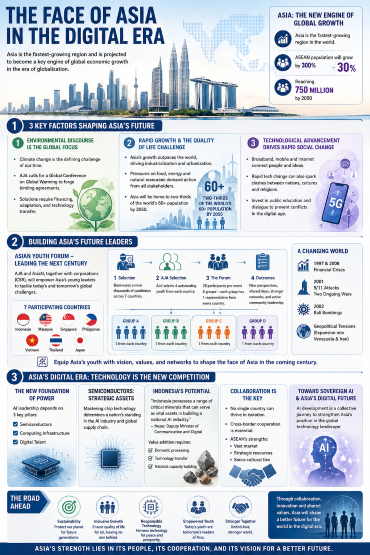
Whether one likes it or not, the engine of Asia’s economic growth will be concentrated primarily in Southeast Asia—commonly known as ASEAN. Projections indicate that ASEAN’s population will grow by 30%, reaching 750 million by 2050.
This high rate of population growth makes ASEAN a significant and crucial player in the future global economy. There are at least three key factors that the people of Asia must consider to navigate these rapid changes.
First, future global attention will focus on environmental discourse. Second, Asia is experiencing rapid growth—outpacing global growth—necessitating a focus on ensuring future quality of life. Finally, technological advancements—particularly in broadband, mobile telephony, and the internet—will foster new tools for interaction and communication, driving rapid social change.
The Asia Journalists Alliance (AJA) has spent recent years discussing environmental issues, recognizing them as a primary concern for Asia—and a critical matter for individuals, corporations, and governments alike.
Following a past environmental meeting in Seoul where AJA hosted environmentalist Jane Goodall, it may be time for AJA and AsiaN to organize a global conference on global warming, inviting representatives from nations and corporations to forge binding agreements on the issue.
Addressing environmental concerns—particularly global warming—is essential for the planet’s sustainability and requires reaching binding agreements.
In seeking solutions to global warming, both developed and developing nations face shared challenges regarding financing, adaptation, and technology transfer that must be resolved. Consequently, Asian societies must inevitably play a role in efforts to resolve these various issues.
A second factor that Asian societies must consider is the region’s rapid growth relative to the rest of the world. This rapid growth drives an acceleration of industrialization and urbanization across Asia, which in turn significantly impacts the availability of food, energy, and natural resources. Consequently, active participation from various stakeholders is required to address these issues.
In contrast, however, this rapid growth is not accompanied by a rise in the productive-age population—particularly in East Asian nations like Japan and South Korea. As a result, the region faces a future shortage of a productive workforce.
By 2050, Asia will be home to two-thirds of the global population aged 60 and older—a challenge that demands a solution. Given this demographic profile, governments in the region—particularly in East Asia—are focusing closely on the threat posed by a shrinking productive-age workforce, specifically regarding its impact on economic competitiveness, healthcare security, and the food supply.
A third factor requiring attention is the rapid pace of global technological advancement. It is believed that these technological developments—particularly in the fields of information and communication—will precipitate clashes between nations, cultures, and religions, including within ASEAN.
Consequently, there is a need for active engagement by individual Asian nations, especially those in ASEAN, in developing public education programs aimed at preventing such conflicts.
Some time ago, an international forum was held—initiated by a corporation as part of its Corporate Social Responsibility (CSR) efforts—bringing together outstanding young people from seven Asian countries: Indonesia, Malaysia, Singapore, the Philippines, Vietnam, Thailand, and Japan. During this forum, these young Asians brainstormed ideas and concepts intended to provide solutions to current and future global challenges.
A Changing World
The world has undergone significant changes over the past century. During the event, participants will discuss a range of issues affecting Asia. The goal of this gathering for Asian youth is not merely to focus on material gains, but rather to cultivate individuals capable of becoming Asia’s future leaders. If AJA and AsiaN succeed in organizing this Asian youth forum, it will shape the face of Asia in the coming century.
Asia is poised to play a pivotal role in the future; however, it must be acknowledged that the region still lacks individuals with the necessary leadership capabilities. For the Asian region, it would be highly beneficial for AJA and AsiaN to partner with major corporations to champion future Asian youth leadership.
Leveraging corporate CSR initiatives, businesses across the seven participating countries would screen thousands of candidates. AJA would select four participants from each country, resulting in a total of 28 participants per event. These participants would subsequently be divided into four groups, with each group comprising one representative from every country.
This forum will produce a generation of young people with new perspectives and mental abilities, having undergone a process of merging ideas and issues from various perspectives. Participants in this training are expected to actively participate in developing the communities in which they live. AJA and AsiaN will have a network across countries, which will undoubtedly be a distinct advantage for them in their development.
However, much work remains to be done by the people of Asia and the world to make various improvements in welcoming the digital age.
These three programs are not enough. Asia and the world have experienced major events such as two financial crises (1997 and 2008), the World Trade Center attacks in September 2001, which sparked two ongoing wars, and the 2002 Bali bombings, which exposed the violent and extremist side of ASEAN. America’s expansion into Venezuela and Iran demonstrates a different world. We must be prepared for the uncertain future, especially in Asia.
Asia’s Digital Era
In the digital era, technological competition has become critical. The semiconductor industry and artificial intelligence development, in particular, cannot rely solely on technology; they require an ecosystem encompassing human resources, computing infrastructure, and semiconductor supply chains.
The development of sovereign AI must be underpinned by the strengthening of the entire industrial value chain—spanning semiconductors, computing infrastructure, and digital talent. Consequently, mastering chip technology has become a strategic factor, as it determines a nation’s standing in the AI industry and the global technology supply chain.
Intensifying geopolitical competition has driven nations to race to secure the advanced technologies, semiconductors, and critical minerals that form the foundation of the AI industry. Chips and semiconductors are truly strategic assets for countries seeking to enter the AI industry and integrate into the global AI supply chain.
According to Indonesia’s Deputy Minister of Communication and Digital, Nezar, “Indonesia possesses a range of critical minerals that can serve as vital assets in building a national AI industry.”
However, value addition will not be achieved if mineral processing remains dependent on other countries. Therefore, Indonesia needs to foster collaboration that facilitates technology transfer and enhances national capacity, ensuring that the development of the semiconductor industry yields greater economic benefits.
Ultimately, no single country can survive and thrive in isolation during the current digital era; collaboration is essential to mutually strengthen one another and maximize value creation through knowledge transfer.
Developing the digital industry requires cross-border cooperation, particularly within Asia and ASEAN. The AI supply chain is highly interconnected, making it impossible to build in isolation. ASEAN possesses strengths—such as a vast market, strategic resources, and close socio-cultural ties—that can serve as the foundation for establishing a regional AI cluster.
Fundamentally, AI development must be viewed as a collective journey toward the future of Asia’s digital economy. Through the concept of “Sovereign AI,” Asia can strengthen its position in the global technology landscape, thereby enhancing its role in shaping the world’s future.


