ASEAN, Europe Seek Joint Response to AI Disinformation at Cambodia Symposium
Germany and Switzerland co-organize international forum in Phnom Penh; former journalist and Cambodian information minister leads discussions, AJA President Sophal Chhay joins panel

Editor’s Note: This article examines the significance of international cooperation in restoring trust in digital information, against the backdrop of Cambodia’s persistent problems with online scam operations. It draws on reports and materials from the ASEAN Secretariat, Cambodia’s Kampucheathmey, Malaysia’s Bernama, Vietnam News Agency, Amnesty International, and sources at the symposium held in Phnom Penh on November 4–5, 2026.
By Lee Sang-ki
Former President of Asia Journalist Association Publisher of The AsiaN
PHNOM PENH: ASEAN and European partners discussed ways to strengthen international cooperation against artificial intelligence (AI)-generated disinformation and deepfakes in Cambodia, a country that has drawn international scrutiny over organized online scam operations and human trafficking.
The discussions reflected growing concerns that advances in digital technology are increasing the risks of online crime and information manipulation, underscoring the need for coordinated efforts to restore public trust and protect citizens.
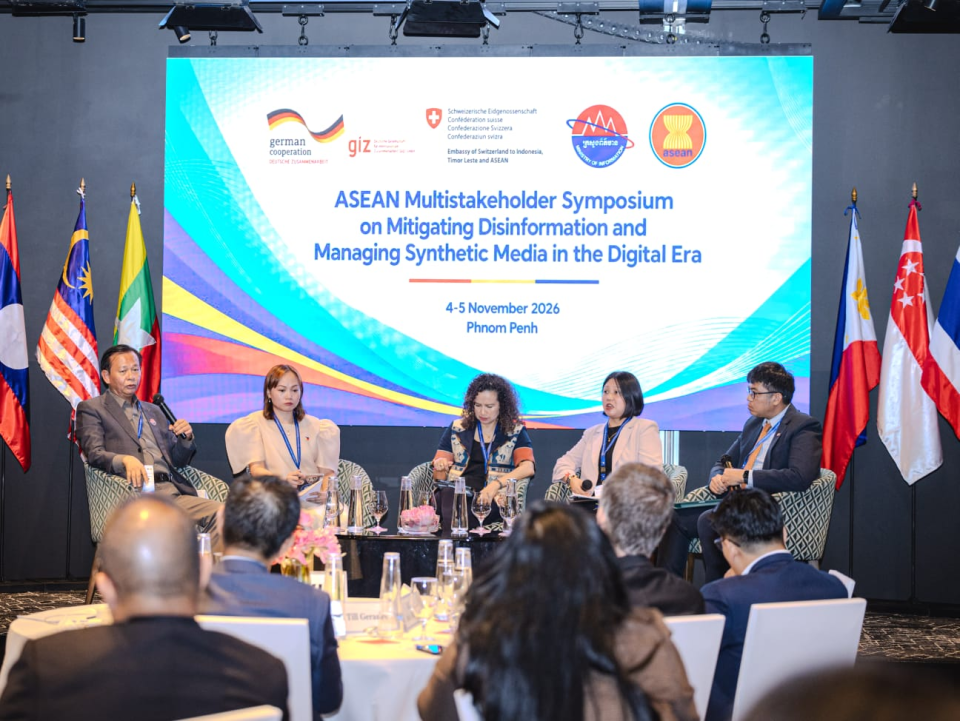
The ASEAN Multistakeholder Symposium on Mitigating Disinformation and Managing Synthetic Media in the Digital Era concluded on November 5 after two days of discussions in Phnom Penh.
The event was jointly organized by Cambodia’s Ministry of Information and German and Swiss partners, including the German Federal Foreign Office, the Deutsche Gesellschaft für Internationale Zusammenarbeit (GIZ), and Swiss diplomatic and development cooperation institutions.
Participants included representatives of ASEAN member states, journalists, academics, civil society organizations, and technology companies.
The symposium’s location was particularly significant. Cambodia has been identified in recent years as a major hub for organized online scam operations.
In a report published in June 2026, Amnesty International documented cases of trafficking victims being confined in scam compounds and forced to participate in fraudulent activities. The organization reported that numerous facilities continued operating despite government crackdowns. In October, it also raised allegations concerning links between certain private security companies and politically influential figures.
The Cambodian government, meanwhile, has emphasized its large-scale enforcement operations and efforts to dismantle criminal networks.
Although online fraud and disinformation are distinct issues, they are increasingly interconnected as AI-generated images, voices, and videos can be exploited to deceive victims and facilitate scams.
The symposium focused not on investigating or prosecuting scam operations themselves, but on strengthening fact-checking, media literacy, digital platform accountability, and international cooperation.
Cambodian Minister of Information Neth Pheaktra, who presided over the event, is a former journalist. He previously served as managing editor of the Khmer-language edition of The Phnom Penh Post and worked in public affairs at the Extraordinary Chambers in the Courts of Cambodia (ECCC), commonly known as the Khmer Rouge Tribunal.
He later served as spokesperson for the Ministry of Environment before being appointed Minister of Information in 2023.
Pheaktra warned that disinformation and AI-generated synthetic content could undermine public trust and facilitate fraud and exploitation.
He stressed the importance of expanding access to reliable information, improving media and information literacy, promoting responsible conduct by digital platforms, and strengthening international cooperation.
German Ambassador to Cambodia Silke Röfer and Reto Grüninger, head of the Swiss Cooperation Office in Cambodia, also participated in the opening proceedings.
ASEAN Secretary-General Kao Kim Hourn delivered a prerecorded message calling for sustained cooperation among governments, media organizations, researchers, civil society, and technology companies to safeguard the integrity of information.
Sophal Chhay, president of the Asia Journalist Association (AJA), also participated in a panel discussion.
A Cambodian journalist who has been active in promoting cooperation among media professionals across Asia, Chhay’s participation highlighted the growing importance of journalistic fact-checking and cross-border cooperation in an era of rapidly expanding digital information flows.
Participants discussed joint research initiatives, stronger media education programs, and closer cooperation with technology companies. The development of research materials and podcasts aimed at raising public awareness was also proposed as part of future collaboration.
The significance of the symposium, however, lies not simply in the holding of another international conference, but in what follows.
A central question is whether Cambodia can take effective action to address online crime and restore trust in digital information, and whether cooperation between ASEAN and European partners can translate into concrete policies and stronger protection for citizens.
Equally important is ensuring that efforts to combat disinformation do not become instruments of government information control or restrictions on freedom of expression.
In the digital era, public trust cannot be restored through technological verification alone. It also depends on transparent governance, independent journalism, and the protection of civil liberties.
Only when these principles are upheld can international cooperation contribute meaningfully to a safer and more trustworthy information environment.