Natural Disasters: Dry Spells and Droughts
Drought gives us more warning than many other natural disasters

By Dr. Hassan Humeida
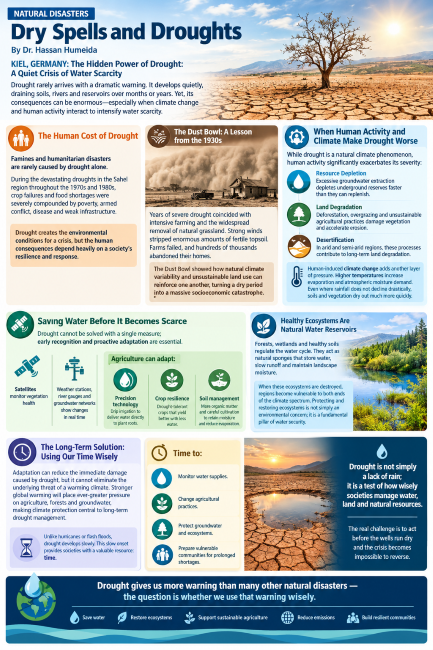
KIEL, GERMANY: The Hidden Power of Drought: A Quiet Crisis of Water Scarcity: Drought rarely arrives with a dramatic warning. It develops quietly, draining soils, rivers, and reservoirs over months or years. Yet, its consequences can be enormous—especially when climate change and human activity interact to intensify water scarcity.
The Human Cost of Drought: Famines and humanitarian disasters are rarely caused by drought alone. During the devastating droughts in the Sahel region throughout the 1970s and 1980s, crop failures and food shortages were severely compounded by poverty, armed conflict, disease, and weak infrastructure.
Drought creates the environmental conditions for a crisis, but the human consequences depend heavily on a society’s resilience and response.
The American Dust Bowl of the 1930s serves as another powerful historical example. Years of severe drought coincided with intensive farming and the widespread removal of natural grassland. As a result, strong winds stripped enormous amounts of fertile topsoil from the land. Farms failed and livelihoods collapsed, forcing hundreds of thousands of people to abandon their homes.
The Dust Bowl demonstrated how natural climate variability and unsustainable land use can reinforce one another, turning a dry period into a massive socioeconomic catastrophe.
When Human Activity and Climate Make Drought Worse – While drought is a natural climate phenomenon, human activity significantly exacerbates its severity:
- Resource Depletion: Excessive groundwater extraction depletes underground reserves faster than they can replenish.
- Land Degradation: Deforestation, overgrazing, and unsustainable agricultural practices damage vegetation and accelerate erosion.
- Desertification: In arid and semi-arid regions, these destructive processes contribute to long-term land degradation.
Human-induced climate change adds another layer of intense pressure. As noted by the IPCC, global warming alters the balance between water supply and water loss. Even in regions where annual rainfall does not decline drastically, higher temperatures increase evaporation and atmospheric moisture demand. Consequently, soils and vegetation dry out much more quickly during dry spells.
Saving Water Before It Becomes Scarce: Drought cannot be solved with a single measure; early recognition and proactive adaptation are essential. Satellites monitor vegetation health, while weather stations, river gauges, and groundwater networks reveal how water resources are shifting in real time.
Agriculture, being highly vulnerable, offers significant opportunities for adaptation:
- Precision technology: Using drip irrigation to deliver water directly to plant roots, minimizing waste.
- Crop resilience: Planting drought-tolerant crops that yield better results with limited water.
- Soil management: Increasing organic matter in soils and using careful cultivation methods to retain moisture and reduce evaporation.
Healthy Ecosystems Are Natural Water Reservoirs: Technological solutions are only part of the answer. Forests, wetlands, and healthy soils play a crucial role in regulating the water cycle. They act as natural sponges that store water, slow runoff, and maintain landscape moisture.
When these ecosystems are destroyed, regions become vulnerable to both ends of the climate spectrum—a degraded soil absorbs less water during a storm and holds less moisture during a drought. Protecting and restoring ecosystems is not simply an environmental concern; it is a fundamental pillar of water security.
The Long-Term Solution: Using Our Time Wisely: Adaptation can reduce the immediate damage caused by drought, but it cannot eliminate the underlying threat of a warming climate. Stronger global warming will place ever-greater pressure on agriculture, forests, and groundwater, making climate protection central to long-term drought management.
Unlike hurricanes or flash floods, drought develops slowly. While this slow onset is dangerous, it provides societies with a highly valuable resource: time.
- Time to monitor water supplies.
- Time to change agricultural practices.
- Time to protect groundwater and ecosystems.
- Time to prepare vulnerable communities for prolonged shortages.
Drought is not simply a lack of rain; it is a test of how wisely societies manage water, land, and natural resources. The real challenge is to act before the wells run dry and the crisis becomes impossible to reverse. Drought gives us more warning than many other natural disasters—the question is whether we use that warning wisely.