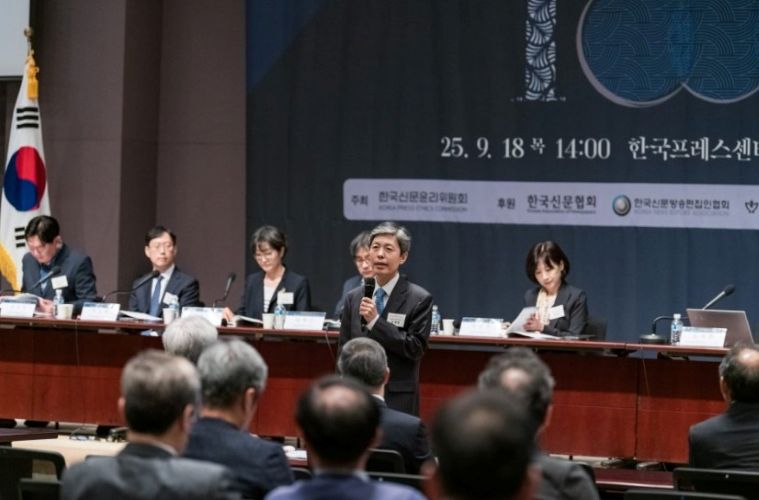
Former Supreme Court Justice Kim Jae-hyung and Professor Kweon Tae-sang propose practical guidelines based on an empirical analysis of court rulings, offering newsrooms a framework for balancing press freedom with personality rights
Who is a public figure?
A president or member of parliament clearly qualifies. But what about a business executive, celebrity, athlete or YouTuber with millions of followers? And how far should the media be allowed to go in reporting on their spouses, children or partners?
These are not questions unique to South Korea. Newsrooms everywhere confront the same tension between the public’s right to know and an individual’s rights to reputation, privacy and dignity. In the age of social media, where an ordinary person can become internationally known almost overnight, the boundary has become even harder to draw.
Two South Korean legal scholars have proposed a framework that deserves attention beyond Korea.
Kim Jae-hyung, professor at Seoul National University School of Law and a former justice of the Supreme Court of Korea, and Kweon Tae-sang, professor at Ewha Womans University School of Law, published a 60-page study, “Criteria for Determining the Unlawfulness of Personality Rights Infringements Arising from Media Coverage of Public Figures,” in the August 2026 issue of Justice, a journal published by the Korean Legal Center.
What makes their work particularly useful for journalists is that it does not stop at legal theory. The authors examine court decisions empirically and statistically, then translate their findings into practical guidelines that journalists can consider before publication.
A public figure is not simply a famous person
The researchers begin by changing the question.
Instead of asking simply, “Who is a public figure?” they ask why reporting on certain people should be treated differently from reporting on private individuals.
They define public figures broadly as people about whom there is a substantial public interest in reporting, considering their social position, role and influence.
They then identify three principal factors for determining public-figure status: *voluntariness, public relevance and fame*.
These factors are not intended as a mechanical checklist. They interact. The stronger and more numerous the factors, the greater the justification may be for giving freedom of expression wider scope.
Of particular significance is the distinction between public relevance and mere fame.
A politician exercising governmental authority and a famous actor discussing family life may both be widely known, but the public interest in scrutinizing them is not necessarily the same. Likewise, an influencer with millions of followers does not automatically surrender all rights to privacy simply by being famous.
That distinction has relevance far beyond Korea.
What the courts actually show
Another strength of the research is its use of empirical evidence.
Using court-decision data analyzed by Korea’s Press Arbitration Commission, the study found that in defamation cases from 2021 through 2023, public figures obtained at least a partial victory in 77 of 193 cases, or 39.8 percent. Private individuals prevailed in 73 of 143 cases, or 51 percent.
The difference was even greater in damages claims: public figures succeeded in 31.3 percent of cases, compared with 50 percent for private individuals.
The numbers suggest that Korean courts already tend to allow broader freedom of expression when reporting concerns public figures.
But this does *not* mean that anything may be reported about someone once that person is classified as a public figure.
Public-figure status is only one consideration.
The proposed framework also asks courts — and journalists — to consider the public interest of the information itself, the benefits of publication versus the harm inflicted on the individual, urgency and timeliness, the reliability of sources, and the form and manner in which the information is reported.
Turning a courtroom test into a newsroom question
This is where the Korean proposal becomes particularly relevant internationally.
Courts usually make these judgments *after* publication. An article is published, a person claims that reputation or privacy has been violated, and a judge subsequently weighs freedom of expression against personality rights.
Kim and Kweon propose moving those questions upstream — into the newsroom before publication.
A reporter or editor could ask:
- Why is this person subject to public scrutiny?
- Does this particular information genuinely serve the public interest?
- Does the social value of publication outweigh the harm to the individual?
- Are the sources sufficiently reliable?
- Could the same information be reported in a less intrusive way?
None of these questions is uniquely Korean.
They can be asked by a reporter investigating a politician in Seoul, a corporate executive in New York, a celebrity in Tokyo, an athlete in Paris or an influencer in New Delhi.
Not a restriction on press freedom
The term “reporting guidelines” can sound like another set of restrictions on journalists. The logic of this proposal, however, points in a different direction.
A clear and reasonable framework can strengthen press freedom by helping journalists explain why intrusive reporting is justified.
Kim has spent decades examining the tension between freedom of expression and personality rights from several different positions — as a judge, legal scholar, Supreme Court justice and chairman of the Korea Press Ethics Commission.
His engagement with the public-figure question dates back more than three decades. In 1995, while serving as a judge, he wrote the judgment in a case involving the novel The Rose of Sharon Has Bloomed, whose fictional narrative drew upon the life of Korean physicist Lee Whiso. The decision has been described as the first Korean judgment to use the concept of a “public figure” or “public person.”
More than 30 years later, the media environment has changed radically.
Political leaders and senior officials are no longer the only people capable of exercising enormous public influence. Business leaders, athletes, entertainers, creators and influencers can command audiences larger than those of traditional newspapers or broadcasters.
At the same time, YouTube channels and social-media accounts can perform functions once largely reserved for professional news organizations.
The central question is therefore increasingly not simply who is a journalist, but *what responsibility accompanies the act of communicating information to a mass public*.
From a Korean guideline to a global newsroom tool
Legal systems differ. The constitutional protection of speech, defamation law and privacy rules in South Korea are not identical to those in the United States, Europe, Japan, India or elsewhere.
The Korean framework should therefore not simply be transplanted into another legal system.
Its underlying reasoning, however, travels well.
People who voluntarily exercise significant public influence should generally face greater scrutiny. Fame alone should not erase privacy. The public value of information should be weighed against the harm caused by publication. Source reliability and reporting methods should matter.
These are not uniquely Korean principles. They are questions at the heart of responsible journalism.
And in the age of AI and social media, the issue is becoming global. Once information is published, it can cross borders within seconds. Journalists are no longer the only actors capable of causing enormous reputational harm — or exposing wrongdoing of enormous public importance.
The guidelines proposed by Kim and Kweon could therefore be examined by news organizations, journalism schools, press councils and journalists’ associations outside Korea, adapted where necessary to their own laws and professional traditions.
They could also provide a useful starting point for an international discussion about common principles for reporting on public figures.
Ultimately, the most important question for a journalist before publication may be surprisingly simple:
Not “How famous is this person?” but “Why does the public need to know this?”
A newsroom that can answer that question persuasively is in a stronger position both to defend press freedom and to respect human dignity.
A reporting framework developed in Korea need not remain a Korean framework.