Seeking the Homeland: The Unyielding Voice of Keppapulavu and Sri Lanka’s Endless Northern Agony

By Leo Nirosha Darshan
COLOMBO: For the inhabitants of Keppapulavu, a small village in Sri Lanka’s Mullaitivu district, the memories of relaxing under the shade of mango trees in their own front yards feel like yesterday.
Yet, since the civil war ended in 2009, the physical distance between these people and their land has shrunk to just a few kilometers, while emotionally, it has become an unreachable dream. Their ancestral lands remain seized for military use, trapped behind heavily fortified barbed-wire fences.
When the Sri Lankan civil war reached its bloody climax, the residents of Keppapulavu were forced to flee their homes and fertile agricultural lands. They held onto the hope that they could return once the guns fell silent. Instead, their vibrant fields, residential areas, and primary sources of livelihood were permanently retained to serve as military headquarters.
For over a decade and a half, these people have been reduced to refugees in their own country, forced to survive in makeshift shelters or overcrowded relatives’ homes. Although a few small pockets of land have been released in phases over the years, the vast majority of their ancestral property remains firmly under military control.
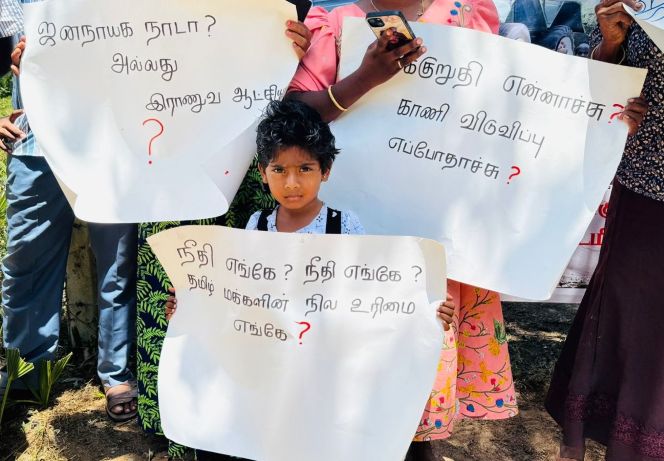
In response, the people of Keppapulavu have launched relentless, peaceful demonstrations right outside the military headquarters. Slogans like “Our Land is Our Right” and “Return Our Soil to Us” echo continuously across the region.
Holding up fading placards, protestors—ranging from frail elders to young children—sit on the dusty roadsides, braving the blistering sun. With tears in their eyes, they emphasize that reclaiming their seized fields is the only way they can ever rebuild a life of dignity. This land grab remains an open wound in Sri Lanka’s north, demanding the urgent attention of the international community.
Life in the Shadow of Barbed Wire
Sixteen years after the war’s conclusion, the tragedy of Keppapulavu is mirrored in hundreds of villages across the northern region. Shuffled from post-war displacement camps into “temporary” relocation settlements, the lives of these citizens represent an ongoing, unresolved humanitarian crisis.
True resettlement is not merely about handing over a concrete shelter. It is about restoring a community’s livelihood, preserving their distinct culture, and returning their self-respect. Unfortunately, the ground reality tells a starkly different story.
Denied access to their ancestral soil, traditional farmers and generational fishermen have been reduced to daily-wage laborers, struggling to find menial work. The temporary settlements lack basic infrastructure, offering severely limited access to clean drinking water, proper sanitation, and quality education.
For these people, land is not just a financial asset or real estate. It is their identity, their history, and the foundational heritage they owe to future generations. Stripping them of their land is synonymous with stripping them of their right to exist.
The Double Agony: Disappearances and Broken Families
As devastating as the land crisis is, it coexists with another deeply painful scar cutting through the heart of almost every Tamil family in the North: the issue of enforced disappearances.
If you look closely into the eyes of a mother sitting under the makeshift protest tents in Keppapulavu, you will see a grief far heavier than the loss of land. It is the agonizing pain of a lost child.
“Where is my son, who was handed over to the military in the final days of the war?” This haunting cry from mothers echoes ceaselessly across Mullaitivu, Kilinochchi, and Jaffna.
Despite repeated interventions by international human rights organizations and the establishment of various domestic mechanisms, these mothers have received no concrete answers.
Many have passed away on these very roadsides, their hearts breaking after years of waiting in vain for their children to walk through the door. This is not merely a political talking point; it is a profound humanitarian catastrophe and a grueling, generational battle for justice.
Broken Promises and Political Expediency
Every election season, southern political leaders travel north, handing out lofty promises of land releases and swift resolutions for the families of the disappeared. Whenever a regime change occurs in Colombo, new seeds of hope are planted.
However, history offers a bitter lesson: once these leaders ascend to power, their promises are promptly thrown to the wind.
The political aspirations of the Tamil people cannot be oversimplified into mere debates over devolution or provincial power-sharing. It is fundamentally about safeguarding their daily civil rights and achieving accountability for wartime atrocities.
Retaining ancestral lands under the guise of “national security” will never pave the way for true ethnic reconciliation. If sustainable peace is to dawn on the island, the fundamental political rights and humanitarian needs of these citizens must be met immediately.
A Struggle for Human Dignity
A genuine political solution cannot be found solely within the legal drafts debated inside the air-conditioned chambers of Parliament in Colombo. It hinges entirely on wiping away the tears of villagers in places like Keppapulavu and ensuring their constitutional rights.
It is high time for Tamil political representatives and the international community to exert coordinated, meaningful pressure on this front.
Despite decades of betrayal, the struggle of the Keppapulavu people continues. The placards held high in the scorching heat and torrential rains are symbols of the broader Tamil struggle for justice in Sri Lanka.
Their voices, reaching out toward the forbidden mango trees and barricaded fields behind the barbed wire, are calling for much more than acreage. They are fighting a holistic humanitarian battle to reclaim a stolen life, an erased history, and a severed family tree.
The ultimate question remains: When will the Sri Lankan government and the global community truly listen? Driven by the unwavering hope that their voices will one day shake the conscience of Sri Lanka’s ruling elite, the people of Keppapulavu refuse to back down. Only the unconditional return of their ancestral lands and real justice for their disappeared loved ones can bring true, lasting peace to the North.