Pakistan: The Crisis of Delayed Justice, How Pendency is Eroding the Legal System
As of 2025, there were nearly 1.86 million pending cases at the lower court level alone


By Nasir Aijaz
The AsiaN Representative
ISLAMABAD: The harrowing text of a social media post, which translates from Urdu as: “Kasur: Outraged by receiving date after date (adjournments) for five years, a petitioner opened fire and killed the Sessions Judge”—presents a tragic and extreme manifestation of a deep-rooted institutional disease.
While violence inside a courtroom is entirely inexcusable and represents a breakdown of law and order, this horrific incident, reportedly having taken place in Punjab province’s Kasur city, highlights the profound public desperation and psychological toll caused by an adversarial system that stretches legal grievances across generations.
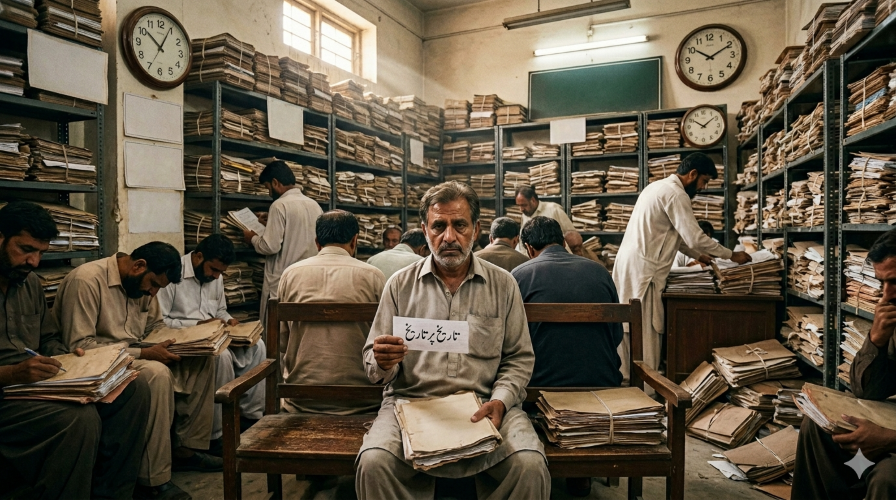
The phrase “Tarikh par Tarikh” (date after date) has evolved from a satirical dramatic trope into a daily, agonizing reality for millions of Pakistanis. When an ordinary citizen enters the judicial pipeline, they enter a labyrinth of endless postponements, complex procedures, and institutional inertia.
The sheer volume of unresolved litigation in Pakistan paints a stark picture of a collapsing infrastructure. According to tracking data compiled by the Law and Justice Commission of Pakistan and independent research institutes, the aggregate backlog across all tiers of the judiciary has reached staggering proportions.
The District Judiciary: The frontline of Pakistan’s legal system, comprising District and Sessions Courts, bears the absolute brunt of this crisis. As of 2025, there were nearly 1.86 million pending cases at the lower court level alone. Civil litigation constitutes the vast majority of this backlog, making up roughly 64% of the district-level strain.
The Higher Judiciary: Beyond the lower courts, the higher echelons, including the Supreme Court, the Provincial High Courts, and specialized tribunals, are managing an additional 0.39 million pending matters. Specialized constitutional review backlogs also continue to edge higher, with specific federal constitutional registries tracking tens of thousands of delayed petitions.
Cumulatively, well over 2.2 million cases remain frozen in various stages of the judicial machine, a figure that grows exponentially each year as new filings outpace systemic capacities.
The structural causes behind this perpetual gridlock are multi-faceted, ranging from procedural vulnerabilities to human resource deficiencies.
Judicial Vacancies and High Turnover: The ratio of judges to the general population in Pakistan remains dismally low. Compounding this scarcity is the practice of frequent administrative transfers.
When a presiding judge who has spent months reviewing evidence and listening to arguments is suddenly reshuffled, the incoming judge is often forced to restart the proceedings from scratch, wiping away months of progress.

Exploitation of Procedural Loopholes: The legal framework frequently permits routine, non-essential adjournments. Stratagems such as lawyer strikes, missing witnesses, and frivolous intermediate petitions are commonly deployed to deliberately prolong trials, exhausting the financial and emotional reserves of the opposing party.
The maxim “Justice delayed is justice denied” is not merely an academic concept; it has severe real-world ramifications. When the state fails to resolve disputes within a reasonable timeframe, the societal fabric begins to fray.
Property disputes alienate families, criminal suspects languish in overcrowded prisons for years without a conviction, and commercial growth is throttled because contractual breaches cannot be swiftly rectified.
More dangerously, an inaccessible or sluggish judicial system forces citizens to resort to alternative, unregulated means of conflict resolution. Whether through illegal parallel courts, tribal councils, or vigilante violence—as shockingly displayed in social media posts, the public’s faith in the state’s monopoly on justice evaporates when the formal courts cease to offer a functional remedy.
To prevent the total collapse of public trust, radical structural reforms are urgently required. This includes imposing strict statutory limits on the number of allowed adjournments, institutionalizing mandatory alternative dispute resolution (ADR) mechanisms to divert minor civil cases out of the main docket, expanding the use of electronic court filings, and significantly increasing the number of judges in the district courts.
Until the structural incentives of the legal process shift away from delay and toward resolution, the millions of petitioners waiting for their day in court will remain trapped in an endless cycle of Tarikh par Tarikh—a cycle that occasionally, and tragically, erupts into catastrophic violence.