
Supreme Eurasian Economic Council Meets in Kazakhstan
Summit calls to strengthen external partnerships, enahnce global economic role

By Kuban Abdymen
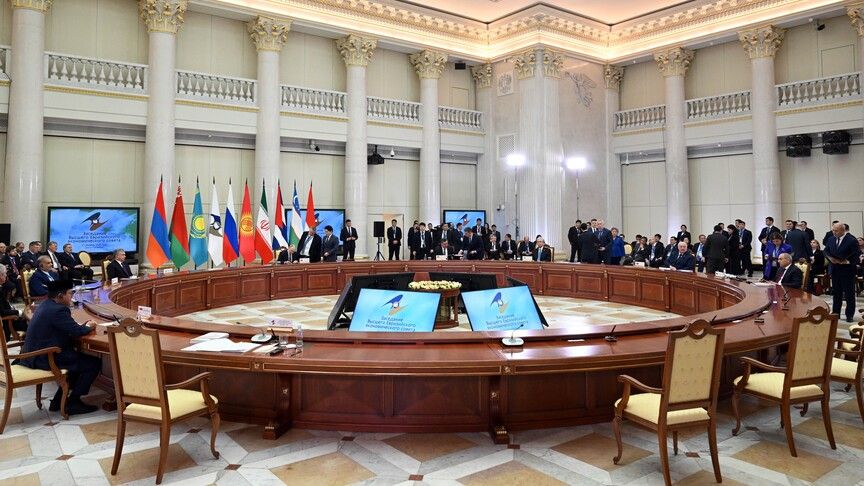
ASTANA: A meeting of the Supreme Eurasian Economic Council was held at the Palace of Independence in the center of Kazakhstan’s capital, Astana as part of the Eurasian Economic Union summit, focusing on the next stage of Eurasian integration amid global economic uncertainty.
The Supreme Eurasian Economic Council is the highest body of the Eurasian Economic Union, which came into force on January 1, 2015. Today, 11 years later, the bloc is facing deepening internal contradictions.
The Union formally provides for the free movement of goods, services, capital, and labor. In practice, its members increasingly face different sanctions risks, foreign-policy pressures, and trade priorities.
Russia remains the bloc’s central economy, but it is also the main source of external pressure on the Union.
Leaders of the participating countries at the Astana meeting reaffirmed their commitment to deeper economic integration, stressing the removal of internal trade barriers, harmonization of regulations, and expansion of the free movement of goods, services, capital, and labor.
Strengthening the resilience of member economies to external shocks was identified as a shared priority.
A major part of the discussions centered on transport and logistics development. Participants highlighted the strategic importance of the East–West and North–South corridors, modernization of border infrastructure, and digitalization of customs procedures. Kazakhstan reiterated its ambition to consolidate its role as a key transit hub in Eurasia.
Economic cooperation was also in focus, particularly joint projects in manufacturing, energy, agriculture, and the digital economy, alongside efforts to build integrated production chains and reduce import dependence.
Financial integration measures included broader use of national currencies in mutual trade and improved payment systems. Digital transformation initiatives and the expansion of electronic trade platforms were also discussed.
The summit concluded with calls to strengthen external partnerships, including cooperation with observer states such as Uzbekistan, and to enhance the EAEU’s global economic role.


