Asean, EU Leaders Step Up Call for Peaceful Resolution of Middle East Conflict
The rising international political pitch jives with Pope Leo’s religious message of world peace and security

By Ivan Lim
SINGAPORE: Pope Leo XIV, the first American head of the Vatican City in Rome, has led in condemning the US war on Iran on moral grounds, eliciting a stern rebuff from President Donald Trump. But the pontiff, who speaks for 1.4 billion Catholics, is standing pat on his views on peace and humanity.
On a four-nation tour of Africa, he warned on April 21 in Equatorial Guinea that “humanity is at risks being tragically compromised without a change of direction in the assumption of political responsibility and without respect for institutions and international agreements.” – hallmarks of Mr Trump’s “America first” policy.
Meanwhile, anti-war sentiments are coalescing around some Asian and Western nations concerned with the zero-some way the United States is prosecuting the war against Iran.
Its latest blockage of the Strait of Hormuz and seizure of Iranian cargo vessel, calculated to exact concessions from Tehran has renewed tensions and complicated peace negotiations mediated by Pakistan following the extension of a two-week cease-fire.
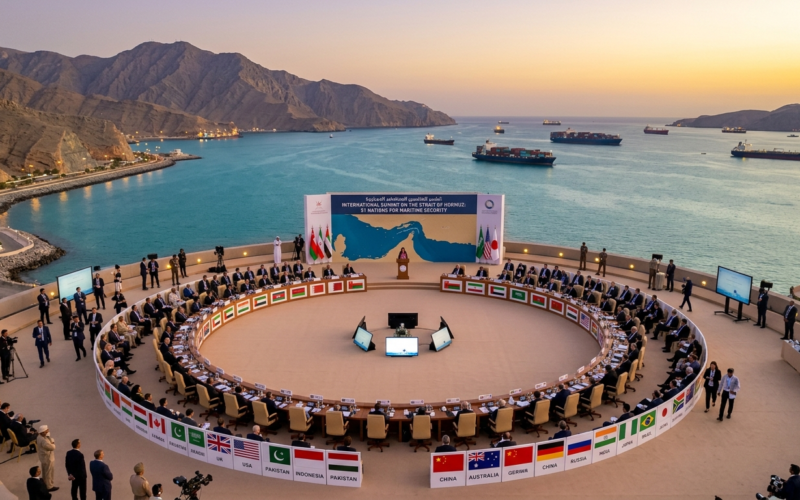
In response to the unpredictable outcome for a diplomatic settlement to the conflict, Britain and France, have taken the initiative to rally a coalition of nations, minus the United States, to launch a diplomatic mission to secure the re-opening of the vital Hormuz waterway through which 20 per cent of the global energy and gas supplies flow.
Earlier, the United Kingdom, France, Germany and Spain had rejected President Trump’s call to join his war against Iran on grounds that they were not consulted before he started bombing Iran on Feb 28.
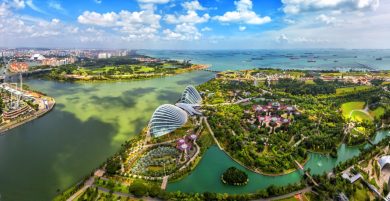
Singapore joined Britain and France in a virtual meeting on April 17 attended by 51 nations in establishing an alternative defensive way to re-open the Strait of Hormuz with its Prime Minister, Lawrence Wong, warning against that “weaponization” of the water-way by US and Iran would set up a bad precedent.
He has in mind the Strait of Singapore and the adjacent Straits of Malacca which, under the United Nations Convention on Law of the Sea, allows for free passage of international ships.
Despite the hostile rhetoric between Trump and his Iranian protagonists, European Union and Asean leaders have stepped up the call for the warring parties to hammer out a compromised deal to end the war, now in its eighth week.
In a joint statement on April 13, the foreign ministers of the 11-member South-east Asia grouping urged the warring parties to work towards a “comprehensive and enduring resolution in accordance with UN charter and UN security council resolutions”.
Standing up for their belief in a rules-based order, the Asean states are shaken by combined effect of President Donald Trump’s sweeping Liberation Day tariffs, unlawful abduction of President Nicolas Maduro of Venezuela in January, and the current war on Iran, resulting in a growing popular disenchantment with Mr Donald’s leadership.
The latest survey on The State of South-east Asia by ISEAS-Yusof Ishak Institute in Singapore showed public opinion has shifted against the US. A majority (51.9 per cent) of respondents viewed the US unfavourably.
And if asked to take sides between the two superpowers, they would choose China as a more steadfast partner, citing Mr Trump’s foreign policies as a negative factor.
In contrast, the 2025 survey had put the US ahead of China as the preferred partner. Beijing’s hardline approach in pressing its claims in the South China Sea was a sore point.
Recent events have seen China gaining new recognition as a stable force in the international arena.
A tilt towards Beijing is underscored by the visit on April 14 to China by Spanish Prime Minister Pedro Sánchez to forge closer ties. EU’s most vocal critic of Trump, Mr Sanchez, on his fourth visit to Beijing, and President Xi Jinping, called for closer Europe-China relations to counter erosion of multi-lateral norms.
The same day visiting Crown Prince of Abu Dhabi,Sheikh Khaled bin Mohamed bin Zayed Al Nahyan, and Mr XI discussed a four-point proposal for the Middle East based on principles of peaceful co-existence, sovereignty, and international rule of law as well as co-ordinated development and security.
United Arab Emirates had come under Iranian attacks on its energy infrastructure as Tehran retaliated against US-Israeli bombing.
In sync with EU and Asean countries, China, has begun to speak openly on the Middle East conflict, pressing the warring parties to settle their hostilities through negotiations brokered by Islamabad, Pakistan.
The rising international political pitch jives with Pope Leo’s religious message of world peace and security.