The View from Manama: Bahrain Did Not Choose This War – So, Why Is It Paying the Price?

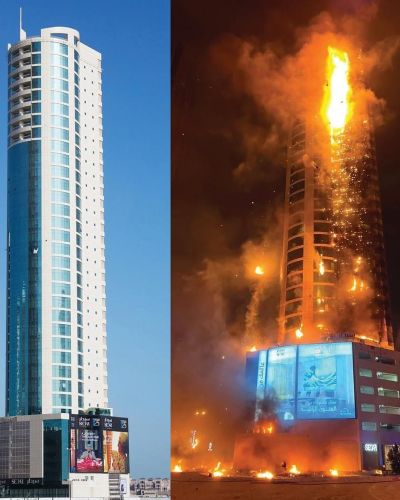
MANAMA: Four days into the war launched on Saturday by the United States and Israel against Iran, Bahrainis are asking a simple, personal question: Why has their country been pulled into a lethal confrontation in which civilians and residential buildings have been struck and normal life abruptly upended and drmatically affected?
For many, the explanations circulating in political and media circles ring hollow. “It is assumed that Iran attacked Bahrain and the Gulf states to pressure them into urging the U.S. to end the war,” columnist Jaafar Salman observed.
“It is also said that the Gulf was targeted because the Iranian regime sought to project strength and demonstrate fidelity to the threats it made before the war, particularly to a domestic audience, a significant portion of which has grown disenchanted.”
Yet, regardless of the theories, the conclusion in Bahrain remains firm: No rationale can justify the targeting of a neighboring state that neither declared war nor participated in hostilities.

“We are not concerned with pretexts,” Jaafar added. “Nothing justifies attacking our country and our brothers in the Gulf. For years, Bahrain and the Gulf states worked to prevent war from reaching Iran. We opened doors to negotiations. We publicly committed that our territories would not be used to launch attacks against Iran. We explicitly and unequivocally rejected war. Therefore, no argument can legitimize what was launched against us by our neighbor.”
Jaafar’s point reflects a broader sentiment. In times of war, he argues, nations cannot afford internal equivocation. “Some alarmists continue to justify the Iranian bombardment of Bahrain under the pretext of the American bases,” he said, suggesting that because Iran is under U.S. attack, it has the right to strike any American presence. “They conveniently forget that the American military footprint is not confined to Bahrain or the Gulf. Iran is encircled by American bases, yet it chose to strike here.”
He further stressed that no attacks on Iran were launched from Gulf soil, and that Gulf governments did not authorize the use of their territories for offensive operations.
“Even if one were to dispute this, nothing can justify targeting civilian sites — hotels, homes, residential buildings — under the claim that Americans reside there. By that logic, any civilian space becomes a battlefield. It is the same reasoning Israel once invoked to rationalize strikes in Gaza.”
Columnist Tamam Abu Safi framed the issue even more starkly. When air raid sirens echoed across Bahrain, she wrote, the immediate question was not who initiated the broader regional war.
“The question was simpler, clearer, more urgent: Who targeted our homes? Who terrified our children? Who decided that Bahrain’s skies would become an arena for settling scores?”

Bahrain, she emphasized, declared no war. It did not serve as a platform for aggression, nor did it join any military decision-making against Iran. Its position — like that of its Gulf neighbors — was articulated from the outset: no to using our land in war, no to entanglement in a conflict we did not choose, yes to de-escalation, yes to dialogue. These were not rhetorical flourishes but consistent diplomatic positions expressed in official statements and policy commitments.
And yet, missiles and drones entered Bahraini airspace.“What happened was not a ‘political message’ nor a ‘legitimate response,’” Abu Safi argued. “It was not the targeting of an American facility, as Iranian media suggests with chilling detachment. When a residential building is struck, it is not a military installation. When civilians are injured in their homes, they are not enemy combatants. Our homes are not foreign bases. Our buildings are not warships. Our children are not collateral damage in someone else’s war.”
From Bahrainis’ perspective, this is not a dispute about alignments or alliances. It is a question of sovereignty and civilian protection. The Bahraini view, articulated across columns and conversations alike, insists on a basic principle: that neutrality declared in good faith should not be punished, and that the burden of geopolitical rivalry must not be borne by ordinary families seeking only to live in peace.