
Journalism Must Be a Bridge of Solidarity, Not a Megaphone for Division
There is a clear difference between criticism grounded in facts and rhetoric designed to provoke hostility

By Lee Sang-ki
Publisher of The AsiaN
SEOUL: An important article recently arrived from Bahrain. Habib Toumi, editor of The AsiaN’s English edition, reported on remarks by Isa Al Shaiji, President of the Bahrain Journalists Association (BJA).
“Journalists, writers, and intellectuals should refrain from engaging in unnecessary disputes that could undermine the unity and solidarity of the Gulf community,” he said.
His warning comes at a time when misinformation, hostility, and attempts to sow division are threatening trust among the six member states of the Gulf Cooperation Council (GCC).
His message deserves attention far beyond the Gulf.
Across Asia, political polarization, religious tensions, and ethnic conflicts continue to challenge our societies. Unverified information crosses borders within seconds, while a few inflammatory words can destroy trust built over generations.
This does not mean journalists should avoid reporting on conflicts or criticizing those in power. Holding power accountable and exposing wrongdoing remain fundamental responsibilities of journalism. But there is a clear difference between criticism grounded in facts and rhetoric designed to provoke hostility.
Since founding the Asia Journalists Association (AJA) and launching The AsiaN, I have worked with journalists from many countries with different histories, cultures, and political systems.
Through these experiences, I have come to believe that we share essential values: respect for facts, human dignity, and a commitment to dialogue across differences.
I sincerely applaud President Al Shaiji for his courage and insight, and thank Habib Toumi for bringing his important message to our readers.
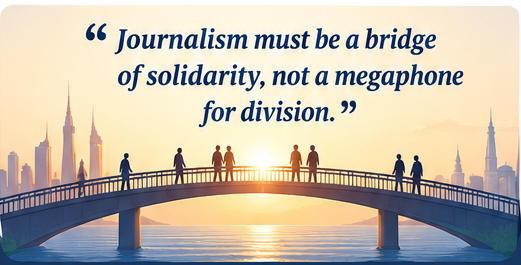
Journalism must be a bridge of solidarity, not a megaphone for division.
That is also the path The AsiaN must continue to follow.


