By Dr. Hassan Humeida
KIEL, GERMANY: Why do volcanoes Remain a Global Threat: Understanding Eruptions and Hazards? Volcanoes can create islands, build mountains, and enrich soils—yet they can also destroy entire communities within hours.
As some of the most powerful forces on Earth, volcanoes are monitored closely by modern science, but eruptions cannot be prevented or predicted with absolute certainty. With hundreds of millions of people living near active zones, understanding volcanic behavior remains a critical global necessity.
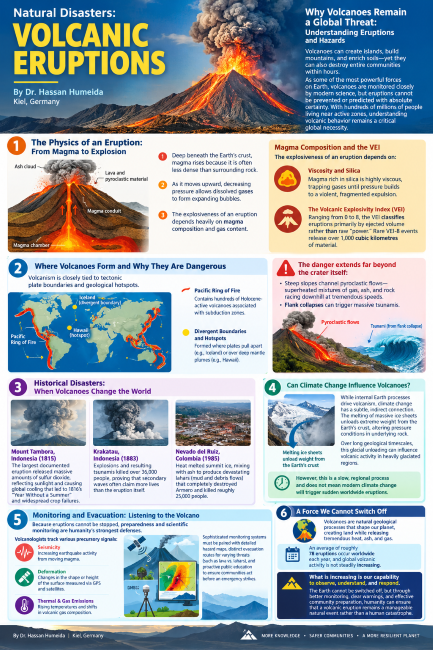
The Physics of an Eruption: From Magma to Explosion: Deep beneath the Earth’s crust, magma rises because it is often less dense than surrounding rock. As it moves upward, decreasing pressure allows dissolved gases to form expanding bubbles.
The explosiveness of an eruption depends heavily on magma composition and gas content:
- Viscosity and Silica: Magma rich in silica is highly viscous, trapping gases until pressure builds to a violent, fragmented expulsion.
- The Volcanic Explosivity Index (VEI): Ranging from 0 to 8, the VEI classifies eruptions primarily by ejected volume rather than raw “power,” with rare VEI-8 events releasing over 1,000 cubic kilometres of material.
Where Volcanoes Form and Why They Are Dangerous – Volcanism is closely tied to tectonic plate boundaries and geological hotspots:
- The Pacific Ring of Fire: Contains hundreds of Holocene-active volcanoes associated with subduction zones.
- Divergent Boundaries and Hotspots: Formed where plates pull apart (e.g., Iceland) or over deep mantle plumes (e.g., Hawaii).
The danger extends far beyond the crater itself. Steep slopes channel pyroclastic flows—superheated mixtures of gas, ash, and rock racing downhill at tremendous speeds—while flank collapses can trigger massive tsunamis.
Historical Disasters: When Volcanoes Change the World – History demonstrates the far-reaching impact of volcanic catastrophes:
- Mount Tambora, Indonesia (1815): The largest documented eruption released massive amounts of sulfur dioxide, reflecting sunlight and causing global cooling that led to 1816’s “Year Without a Summer” and widespread crop failures.
- Krakatau, Indonesia (1883): Explosions and resulting tsunamis killed over 36,000 people, proving that secondary waves often claim more lives than the eruption itself.
- Nevado del Ruiz, Colombia (1985): Heat melted summit ice, mixing with ash to produce devastating lahars (mud and debris flows) that completely destroyed Armero and killed roughly 25,000 people.
Can Climate Change Influence Volcanoes? While internal Earth processes drive volcanism, climate change has a subtle, indirect connection. The melting of massive ice sheets unloads extreme weight from the Earth’s crust, altering pressure conditions in underlying rock. Over long geological timescales, this glacial unloading can influence volcanic activity in heavily glaciated regions.
However, this is a slow, regional process and does not mean modern climate change will trigger sudden worldwide eruptions.
Monitoring and Evacuation: Listening to the Volcano – Because eruptions cannot be stopped, preparedness and scientific monitoring are humanity’s strongest defenses. Volcanologists track various precursory signals:
- Seismicity: Increasing earthquake activity from moving magma.
- Deformation: Changes in the shape or height of the surface measured via GPS and satellites.
- Thermal & Gas Emissions: Rising temperatures and shifts in volcanic gas composition.
Sophisticated monitoring systems must be paired with detailed hazard maps, distinct evacuation routes for varying threats (such as lava vs. lahars), and proactive public education to ensure communities act before an emergency strikes.
A Force We Cannot Switch Off: Volcanoes are natural geological processes that shape our planet, creating land while releasing tremendous heat, ash, and gas. While an average of roughly 78 eruptions occur worldwide each year, global volcanic activity is not steadily increasing.
What is increasing is our capability to observe, understand, and respond. The Earth cannot be switched off, but through better monitoring, clear warnings, and effective community preparation, humanity can ensure that a volcanic eruption remains a manageable natural event rather than a human catastrophe.