Natural Disasters: Earthquakes
A realistic goal: not to calm the Earth, but to prepare people for its movements

By Dr. Hassan Humeida
KIEL, GERMANY
Why Earthquakes Occur, Where the Greatest Dangers Lie, and How Modern Technology Can Save Lives: Earthquakes are among the most powerful natural forces on Earth. Within seconds, enormous stresses that have built up in rocks over decades or even centuries can be released.
Yet the magnitude of an earthquake alone does not determine whether it becomes a disaster. Building standards, ground conditions, population density, infrastructure, and a society’s level of preparedness are equally important.
A low rumble begins, and then the ground starts to shake. Buildings tremble, roads crack, and furniture topples. Within seconds, what seemed solid and secure can become unpredictable.
Most earthquakes do not appear out of nowhere; deep beneath our feet, tectonic plates are constantly moving—slowly, but with enormous force.
At their boundaries, stresses accumulate until they are suddenly released. The crucial question is therefore not simply how powerful an earthquake can be, but how well prepared we are.
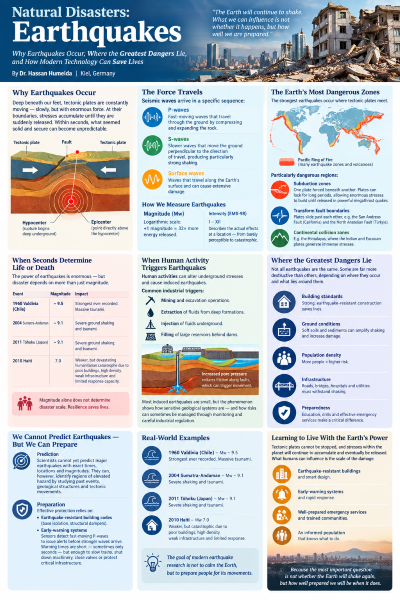
The Force Begins Deep Beneath the Surface: Most earthquakes occur along faults, which are fractures in the Earth’s crust where blocks of rock move relative to one another. Sometimes this movement is blocked for a long period while stress continues to build within the surrounding rock. Eventually, the stress becomes greater than the friction holding the rocks together, and the fault suddenly slips, releasing stored energy in the form of seismic waves.
The point where the rupture begins deep underground is called the hypocenter, while the point directly above it on the Earth’s surface is known as the epicenter.
Seismic waves arrive in a specific sequence:
- P-waves: Fast-moving waves that travel through the ground by compressing and expanding the rock.
- S-waves: Slower waves that move the ground perpendicular to the direction of travel, producing particularly strong shaking.
- Surface waves: Waves that travel along the Earth’s surface and can cause extensive damage.
Today, the moment magnitude scale ($Mw$) is primarily used to measure the size of an earthquake. The scale is logarithmic: an increase of one magnitude corresponds to roughly 32 times more energy being released. However, magnitude does not tell us exactly how strongly an earthquake is experienced at a particular location. For this, the European Macroseismic Scale (EMS-98) is used, ranging from I to XII to describe actual effects—from barely perceptible shaking to catastrophic destruction.
Where the Earth Is Most Dangerous: The strongest earthquakes usually occur where tectonic plates meet. One of the world’s most active regions is the Pacific Ring of Fire, which surrounds the Pacific Ocean and contains numerous earthquake zones and volcanoes.
Particularly dangerous regions include:
- Subduction zones: Areas where one tectonic plate is forced beneath another. Plates can become locked together for long periods, allowing enormous stresses to accumulate until they are released in extremely powerful megathrust earthquakes.
- Transform fault boundaries: Zones where tectonic plates slide horizontally past one another, such as the San Andreas Fault in California and the North Anatolian Fault in Türkiye.
- Continental collision zones: Regions like the Himalayas, where the colliding Indian and Eurasian plates generate immense stresses within the Earth’s crust.
When Seconds Determine Life or Death: The immense power of earthquakes is illustrated by some of the strongest events in modern history. The 1960 Valdivia earthquake in Chile reached a magnitude of approximately 9.5 and remains the strongest earthquake ever instrumentally recorded, generating a massive tsunami. The 2004 Sumatra-Andaman earthquake (magnitude ~9.1) and the 2011 Tōhoku earthquake in Japan (magnitude ~9.1) similarly demonstrated the catastrophic dual threat of severe ground shaking and subsequent tsunamis.
Conversely, the 2010 Haiti earthquake (magnitude 7.0) proved that magnitude alone does not dictate disaster scale. Despite being weaker than megathrust events, it resulted in a devastating humanitarian catastrophe due to inadequate, poorly resistant buildings, high population density, weak infrastructure, and limited emergency response capacity. Resilience is just as important as raw power.
When Human Activity Triggers Earthquakes: Earthquakes are not always exclusively natural phenomena. Human activities can alter underground stresses and cause induced earthquakes.
Common industrial triggers include:
- Mining and excavation operations.
- The extraction of fluids from deep geological formations.
- The injection of fluids underground.
- The filling of large reservoirs behind dams.
When fluids are injected into deep rock formations, pore pressure increases and reduces friction along existing faults. Under certain conditions, faults can become unstable and trigger movement.
While most induced earthquakes are small, this phenomenon demonstrates the sensitivity of geological systems, meaning risks can sometimes be managed through continuous monitoring and careful industrial regulation.
We Cannot Predict Earthquakes—But We Can Prepare: One of the greatest challenges in earth science remains prediction. Scientists cannot currently predict major earthquakes reliably with exact times, locations, and magnitudes.
They can, however, identify regions of elevated hazard by studying past events, geological structures, and tectonic movements.
Because exact prediction remains out of reach, effective protection relies on preparedness:
- Earthquake-resistant building codes: Designing structures to withstand ground movement using technologies like base isolation and structural dampers.
- Early-warning systems: Sensors that detect fast-moving P-waves to issue alerts before stronger waves arrive. Though warning times are short—sometimes only seconds—they are enough to slow trains, shut down industrial machinery, close valves, or protect critical infrastructure.
Learning to Live With the Earth’s Power: The Earth will continue to shake. Tectonic plates cannot be stopped, and stresses deep within the planet will continue to accumulate and eventually be released. What humans can influence, however, is the scale of the damage.
Earthquake-resistant buildings, effective early-warning systems, well-prepared emergency services, and an informed population can turn a natural event into a manageable crisis rather than a catastrophe.
Modern earthquake research has a realistic goal: not to calm the Earth, but to prepare people for its movements. Because the most important question is not whether the Earth will shake again, but how well prepared we will be when it does.