The Divided Atmosphere: Climate Guilt, Consumption, and Global Responsibility
The global climate crisis can be solved only if the polluter-pays principle is respected

By Dr. Hassan Humeida
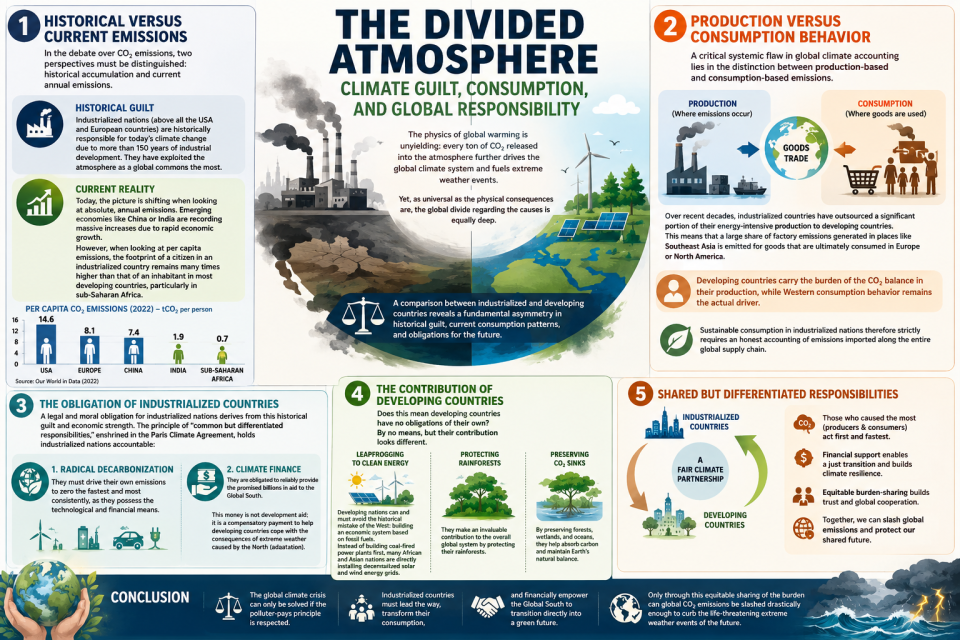
KIEL, GERMANY: The physics of global warming is unyielding: every ton of carbon dioxide (CO2) released into the atmosphere further drives the global climate system and fuels extreme weather events. Yet, as universal as the physical consequences are, the global divide regarding the causes is equally deep.
A comparison between industrialized and developing countries reveals a fundamental asymmetry in historical guilt, current consumption patterns, and obligations for the future.
Historical versus Current Emissions: In the debate over CO2 emissions, two perspectives must be distinguished: historical accumulation and current annual emissions.
- Historical Guilt: Industrialized nations (above all the USA and European countries) are historically responsible for today’s climate change due to more than 150 years of industrial development. They have exploited the atmosphere as a global commons the most.
- Current Reality: Today, the picture is shifting when looking at absolute, annual emissions. Emerging economies like China or India are recording massive increases due to rapid economic growth. However, when looking at per capita emissions, the footprint of a citizen in an industrialized country remains many times higher than that of an inhabitant in most developing countries, particularly in sub-Saharan Africa.
Production versus Consumption Behavior: A critical systemic flaw in global climate accounting lies in the distinction between production-based and consumption-based emissions.
Over recent decades, industrialized countries have outsourced a significant portion of their energy-intensive production to developing countries. This means that a large share of factory emissions generated in places like Southeast Asia is emitted for goods that are ultimately consumed in Europe or North America.
Developing countries carry the burden of the CO2 balance in their production, while Western consumption behavior remains the actual driver.
Sustainable consumption in industrialized nations therefore strictly requires an honest accounting of emissions imported along the entire global supply chain.
The Obligation of Industrialized Countries: A legal and moral obligation for industrialized nations derives from this historical guilt and economic strength. The principle of “common but differentiated responsibilities,” enshrined in the Paris Climate Agreement, holds industrialized nations accountable:
- Radical Decarbonization: They must drive their own emissions to zero the fastest and most consistently, as they possess the technological and financial means.
- Climate Finance: They are obligated to reliably provide the promised billions in aid to the Global South. This money is not development aid; it is a compensatory payment to help developing countries cope with the consequences of extreme weather caused by the North (adaptation).
The Contribution of Developing Countries: Does this mean developing countries have no obligations of their own? By no means, but their contribution looks different.
Developing nations can and must avoid the historical mistake of the West: building an economic system based on fossil fuels. Their central contribution lies in leapfrogging (skipping stages of development).
Instead of building coal-fired power plants first, many African and Asian nations are directly installing decentralized solar and wind energy grids. Furthermore, they make an invaluable contribution to the overall global system by protecting their rainforests and preserving CO2sinks.
Conclusion: The global climate crisis can be solved only if the polluter-pays principle is respected. Industrialized countries must lead the way, transform their consumption, and financially empower the Global South to transition directly into a green future. Only through this equitable sharing of the burden can global CO2emissions be slashed drastically enough to curb the life-threatening extreme weather events of the future.