A Satirical Look at Pakistan’s Daily Petrol Price Adjustments


By Nasir Aijaz
The AsiaN Representative
ISLAMABAD: The current economic and geopolitical landscape is placing significant strain on nations globally, and Pakistan is no exception. In a climate where international tensions, particularly regarding key oil transit points like thec, send shockwaves through the energy market, the Pakistani government recently pivoted its policy on setting domestic petroleum prices. Previously, these were adjusted on a fortnightly basis; now, in an attempt to respond instantly to global fluctuations, the government reviews and resets prices daily.
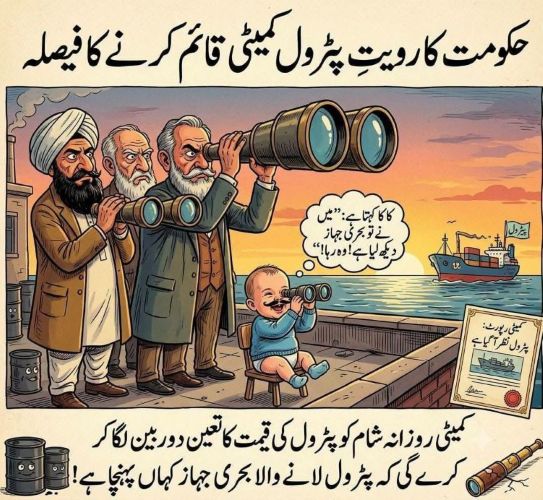
This shift, however, has not been met with widespread public approval. Frequent and substantial price hikes have followed this decision, fueling public frustration and, as is often the case in Pakistan, inspiring a potent form of digital dissent: satire. A caricature has gone viral on social media, brilliantly weaving current economic realities with a deeply embedded cultural reference, effectively summarizing public sentiment.
The viral image, in its clever depiction of a fictional ‘Petrol Sighting Committee,’ is more than just a passing laugh; it’s a biting commentary on governance, institutional inefficiency, and the daily struggles of ordinary citizens.
The central irony of the viral image lies in the direct parallel it draws between the critical task of managing national fuel prices and the culturally significant, yet often bureaucratic, practice of sighting the new moon (Ruet-e-Hilal, an Arabic word used in Urdu language in Pakistan).
In Pakistan, the Ruet-e-Hilal Committee, composed primarily of prominent religious scholars, holds the high-stakes responsibility of determining the start of Islamic months, most notably Ramadan and the festival of Eid-ul-Fitr. Their gathering to ‘sight the moon’ with telescopes and binoculars is a televised event, often associated in the public eye with anticipation, deliberation, and occasionally, contentious announcements.
The image satirically replaces this context. It is inscribed with a bold heading in Urdu language, which says: The Government decides to establish a ‘Petrol Sighting’ Committee.
The header text itself sets the tone, using the precise language of official proclamations and explicitly combining “Ruet” (sighting) with “Petrol,” instantly creating the humorous premise.
The image shows a group of distinguished men (matching the typical profile of committee members) peering not through celestial telescopes, but terrestrial binoculars, scanning the horizon.
The ‘Moon’ is an Oil Tanker. The object of their scrutiny, as confirmed by the helpful caption tagged to a baby sitting on a chair – “Uncle says, ‘I have seen the sea vessel! There it is!’,”. And the ship explicitly labeled ‘Petrol’ is a single oil tanker sailing in the distance.
The baby’s comment, “Uncle says, ‘I have seen the sea vessel! There it is!’,” highlights the apparent naivety or oversimplification that some perceive in the process.
The final touch of institutional parody is the official “Report”, stamped and sealed, confirming in bureaucratic language that “Petrol has been sighted.”
This caricature mockingly links the high-level economic policy of daily price adjustments to a ritualistic sighting process, suggesting that the government’s approach might be lacking in sound, predictable economic planning and is instead overly reliant on reaction and, perhaps, symbolic ‘sightings’ of shipments.
The humor, though witty, springs from genuine pain and anxiety. The decision to implement daily reviews on petrol prices, in a nation where fuel costs are a primary inflation driver, has direct consequences.
A change every 15 days provided a small window of predictability for businesses, transporters, and individual consumers, however, daily adjustments introduce constant uncertainty. Businesses cannot plan fuel costs, leading to price volatility across all sectors.
For the average citizen, every trip to the pump becomes a gamble, and the cascading effect means essential goods also face fluctuating costs, putting immense pressure on household budgets.
The caricature also leverages existing public criticism regarding the Moon Sighting Committee itself. This body receives significant state funding, and its proceedings are sometimes criticized as antiquated in an era of astronomical calculations.
By conflating fuel pricing with this committee, the satirist is asking: If we have established sophisticated mechanisms (though costly) for sighting the moon, why does our economic management seem so reactive and lacking in strategic foresight? The parallel subtly critiques the alleged disparity between resource allocation (for a ceremonial committee) and efficient results (for the actual economy).
The ‘Petrol Sighting Committee’ image is a classic example of political satire serving as a powerful tool in public discourse. In environments where direct dissent might be restricted or where technical economic arguments fail to resonate broadly, cultural satire provides a universally understood visual language.
It takes a complex policy shift and a widely felt grievance and distills them into a single, memorable, and humorous scenario that millions can immediately identify with.
This viral image is a signal. It indicates that the public perceives the daily fuel price adjustments as arbitrary and lacks confidence in the government’s economic strategy. While humor can offer temporary relief, the issues it spotlights, unpredictability, inflation, and perceived institutional priorities, are serious matters that demand addressing.
In a time of increasing economic strain, the government would do well to consider the public sentiment reflected in such satire, recognizing that while the ‘moon sighting’ is for faith, the ‘oil sighting’ needs more than just binoculars to provide relief to the nation.
Ends