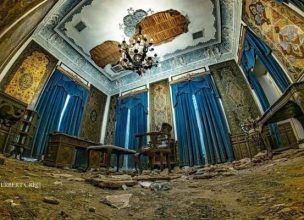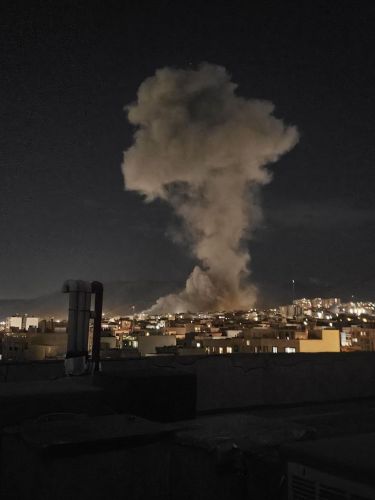
(Photo: Vahid)
By Alireza Bahrami
TEHRAN: President Donald Trump, by attacking Iran, made a decision that five presidents before him had not made. The decision, he said, was made to prevent Iran from acquiring nuclear weapons.
Now that the security of a vast region and the order of the global economy have been disrupted, he is accused of not having the necessary plan and calculations before making the decision.
“Venezuela and Iran have 31% of the world’s oil reserves,” US Senator Lindsey Graham has said in a television interview. “We are going to share 31% of the known reserves, and this is a nightmare for China.”
These words caused Iranian officials to say, “So, the problem was not nuclear weapons from the beginning!”
Also, an old argument of Iranian officials has been that the Israeli regime, with its large number of nuclear warheads and a history of wars and numerous attacks, is going to disarm Iran from a nuclear point of view; and this is a contradiction.
Iran has always been a challenge for the West, especially the United States, since the 1979 revolution. Fundamentalist behavior in Iran has always been a source of conflict. Even after the Khatami presidency, which introduced the idea of a “dialogue of civilizations” and was welcomed around the world, the Ahmadinejad presidency, which questioned the Holocaust, again destroyed all interactions.
However, it allowed countries such as the United States and Britain to sell a huge number of weapons to Arab countries in the region.
The domestic hatred of Ahmadinejad – who was apparently undesirable for the West and in practice, was very beneficial to them – led Rouhani to become president in Iran.
During his first term, the JCPOA agreement was concluded between Iran and six Western countries. Iran’s uranium enrichment was limited and in return, Iran received financial resources from oil sales.
However, with the end of the Obama administration and the inauguration of Trump (first term), the new president canceled this agreement, saying that it did not provide good financial benefits for the United States.
President Biden, however, considered a war with Iran to be harmful to his country’s economy and the world. Until Trump became president of the United States again. Since then, Iran has been attacked twice.
Hundreds of people died, many homes were destroyed, and the war spread to several countries in the region, as Trump claimed to have destroyed Iran’s nuclear capability. Now, the “safe” option for countries such as the United Arab Emirates and Qatar for investment has been called into question.
After the war began, oil prices fluctuated greatly, stock markets experienced intense tension, and lines of cars formed in front of gas stations in various countries, worried about the future, because a third of the world’s oil passes through the Strait of Hormuz, which the war caused to close.
As oil prices rose, pressure on Trump increased; until he said on Monday, “I think the war is coming to an end.”
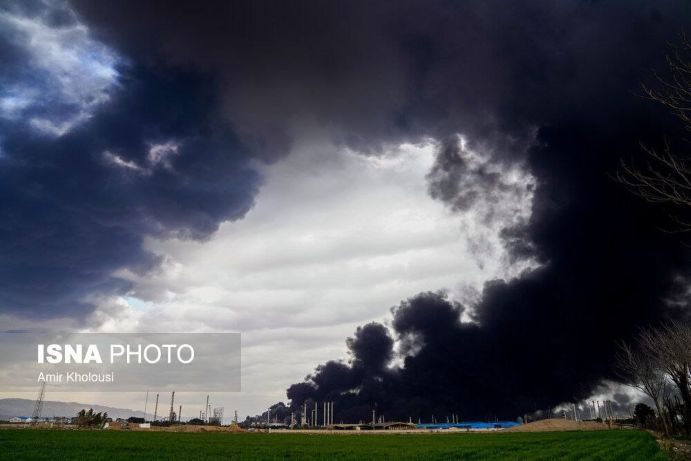
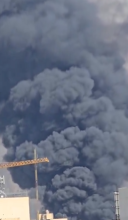
The Rey petrol depot in southeast Tehran and the Fardis petrol depot 60 km from Tehran were simultaneously targeted by missiles (Photo: Amir Kholousi)
After this statement, oil prices fell on world markets, but the people and soldiers who were killed did not survive. A few hours later, the price of oil rose above $100 again following the reactions of Iranian officials; a price that has been unprecedented since Russia invaded Ukraine.
Iran’s diplomatic team in the nuclear negotiations has repeatedly criticized Trump and his special envoy, mocking them for treating a diplomatic issue like a real estate transaction.
Iranian officials responded to Trump’s words by saying that they would only agree to a ceasefire if they received a guarantee that Iran would not be attacked again in a few months.
But whether it is Trump or someone else, the Middle East oil is a major target. And for this purpose, a war can be launched. During Bush’s invasion of Iraq, the claim of building nuclear weapons was also made; a claim that was later proven to be untrue, but the United States controlled the exploitation of Iraq’s oil wells for years.
Likewise, for years, it controlled the mines of Afghanistan; and the scenario that was also carried out, with pride, regarding Venezuela. Senator Lindsey Graham says, “It’s a good investment.”
But the head of Iran’s emergency organization says that of the more than 1,250 people killed in the war, 190 are under the age of 18.
Of the wounded, 1,400 are women. 700 of the wounded are under 18 and 60 are under five, while 200 of the dead are women, the youngest being 8 months old and the oldest 88 years old.
This is the true face of war; in countries of color! In the third world!