Natural Disasters: Landslides and Mudflows
Scientific monitoring, sound engineering, and responsible planning can turn a sudden natural hazard into a manageable event

By Dr. Hassan Humeida
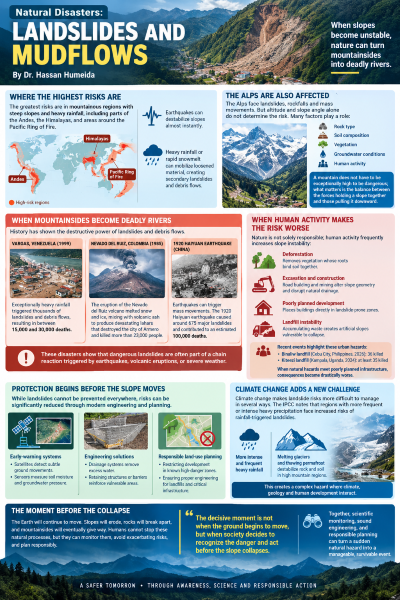
Kiel, Germany: Where Slopes Become Unstable: The Growing Threat of Landslides and Debris Flows: The highest risks are generally found in mountainous regions with steep slopes and heavy rainfall, including parts of the Andes, the Himalayas, and areas surrounding the Pacific Ring of Fire. Earthquakes can destabilize slopes almost instantaneously, while heavy rainfall or rapid snowmelt can mobilize loosened material to create secondary landslides and debris flows.
The Alps are also affected by landslides, rockfalls, and mass movements. However, altitude and slope angle alone do not determine the risk. Rock type, soil composition, vegetation, groundwater conditions, and human activity all influence slope stability. A mountain does not have to be exceptionally high to be dangerous; what matters is the delicate balance between the forces holding a slope together and those pulling it downward.
When Mountainsides Become Deadly Rivers: History has repeatedly demonstrated the destructive power of landslides and debris flows. In Vargas, Venezuela (1999), exceptionally heavy rainfall triggered thousands of landslides and debris flows, resulting in between 15,000 and 30,000 deaths.
In Colombia (1985), the eruption of the Nevado del Ruiz volcano melted snow and ice, mixing with volcanic ash to produce devastating lahars that destroyed the city of Armero and killed more than 23,000 people.
Earthquakes also trigger massive mass movements, such as the 1920 Haiyuan earthquake in China, which caused around 675 major landslides and contributed to an estimated 100,000 deaths. These disasters show that dangerous landslides are often part of a chain reaction triggered by earthquakes, volcanic eruptions, or severe weather.
When Human Activity Makes the Risk Worse – Nature is not solely responsible; human activity frequently increases slope instability:
Deforestation: Removes vegetation whose roots bind soil together.
Excavation and construction: Road building and mining alter slope geometry and disrupt natural drainage.
Poorly planned development: Places buildings directly in landslide-prone zones.
Landfill instability: Accumulating waste creates artificial slopes vulnerable to collapse.
Recent events highlight these urban hazards. In January 2026, a major collapse at the Binaliw landfill in Cebu City, Philippines, killed 36 people, while the 2024 collapse of the Kiteezi landfill in Kampala, Uganda, killed at least 35 people following heavy rainfall. When natural hazards meet poorly planned infrastructure, consequences become drastically worse.
Protection Begins Before the Slope Moves: While landslides cannot be prevented everywhere, risks can be significantly reduced through modern engineering and planning:
Early-warning systems: Satellites detect subtle ground movements, while sensors measure soil moisture and groundwater pressure.
Engineering solutions: Drainage systems remove excess water, and retaining structures or barriers reinforce vulnerable areas.
Responsible land-use planning: Restricting development in known high-danger zones and ensuring proper engineering for landfills and critical infrastructure.
Climate Change Adds a New Challenge: Climate change makes landslide risks more difficult to manage in several ways. The Intergovernmental Panel on Climate Change (IPCC) notes that regions experiencing more frequent or intense heavy precipitation face increased risks of rainfall-triggered landslides.
Furthermore, in high mountain regions, melting glaciers and thawing permafrost destabilize rock and soil, creating a complex hazard where climate, geology, and human development interact.
The Moment Before the Collapse: The Earth will continue to move. Slopes will erode, rocks will break apart, and mountainsides will eventually give way. Humans cannot stop these natural processes, but they can monitor them, avoid exacerbating risks, and plan responsibly.
The decisive moment is not when the ground begins to move, but when society decides to recognize the danger and act before the slope collapses. Together, scientific monitoring, sound engineering, and responsible planning can turn a sudden natural hazard into a manageable, survivable event.
Scientific monitoring, sound engineering, and responsible planning can turn a sudden natural hazard into a manageable event