Indonesia Bids for UN Security Council Seat, Pledges Dialogue-first Diplomacy
“1,000 friends are too few and one enemy is too many”


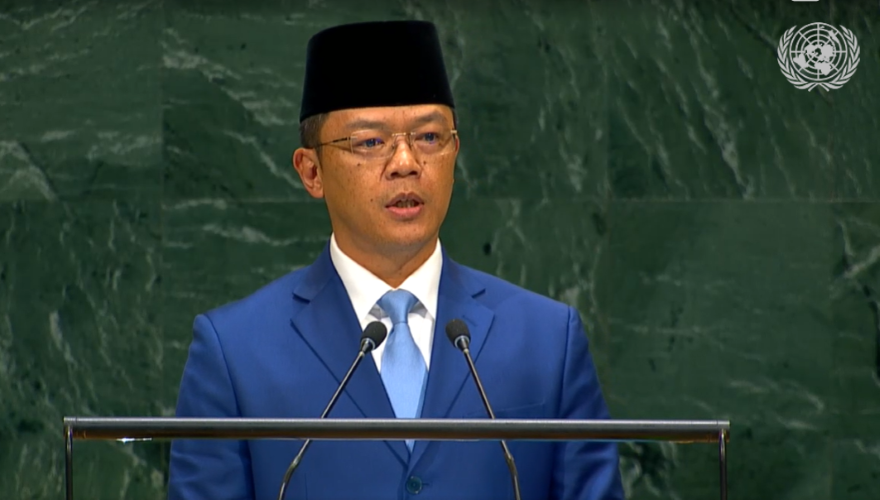
By Habib Toumi
New York: Indonesia will seek a non-permanent seat on the United Nations Security Council for 2029–2030, Foreign Minister Sugiono said, pledging to promote dialogue, respect for international law and practical cooperation amid growing geopolitical tensions.
Sugiono told the UN General Assembly that Indonesia’s foreign policy would be guided by a principle voiced by President Prabowo Subianto at the UN last year: “1,000 friends are too few and one enemy is too many.”
The phrase, repeated by Sugiono in his address on Sunday, reflects Indonesia’s stated policy of engaging with all partners and keeping channels of cooperation open.
“It is in this spirit that Indonesia presents its candidature for a non-permanent seat on the UN Security Council for the 2029–2030 term,” Sugiono said.
He said Indonesia would pursue its diplomacy through humanitarian assistance, peacebuilding and engagement across regions and international institutions.
“Indonesia will work to keep dialogue open, build common ground and turn shared responsibility into practical cooperation,” he said.
Sugiono also called for stronger multilateral institutions, arguing that the answer to shortcomings in the international system was not less multilateralism but “a stronger and better multilateralism.”
He said the United Nations must become more representative, agile and capable of delivering results as countries confront wars, humanitarian crises, economic shocks, climate disasters and rapid technological change.
“Multilateralism that cannot deliver will lose people’s trust,” he said.
Focus on national and regional resilience
Sugiono linked Indonesia’s international diplomacy to what he described as national resilience, including food and energy security, education, healthcare, employment and an economy capable of withstanding external shocks.
He also pointed to Indonesia’s ethnic and cultural diversity as a source of strength, saying democratic participation, dialogue and respect for differences were essential to maintaining national unity in a country of more than 280 million people.
A resilient Indonesia, he said, would be better positioned to contribute to regional and global stability.
Sugiono highlighted the role of the Association of Southeast Asian Nations (ASEAN), saying the grouping had demonstrated for almost six decades that countries with different political systems, development levels and national interests could maintain dialogue and seek common ground.
“We do not always agree, but we have made a conscious choice to stay together,” he said.
He called for ASEAN to continue adapting so that it remains relevant to its members and the wider region.
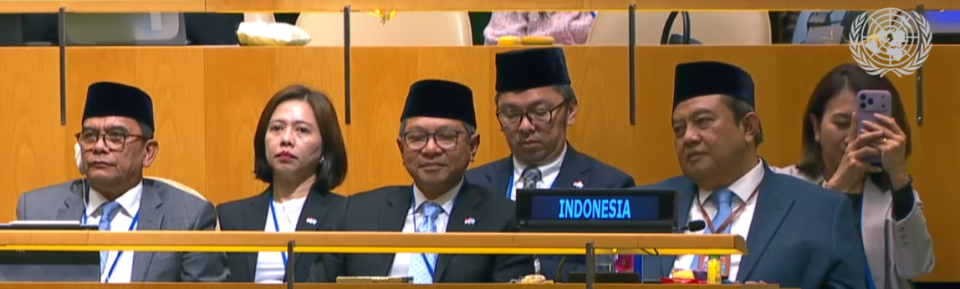
Palestine cited as test of multilateralism
Sugiono devoted part of his address to the Palestinian issue, describing it as a major test of whether the international system can uphold the principles on which it was founded.
Indonesia, he said, would continue supporting the Palestinian people’s right to self-determination and an independent and sovereign Palestinian state based on a two-state solution and international law.
“Palestine is not only a question for one region,” Sugiono said. “It is a test of whether the multilateral system can uphold the very principles it was created to defend.”
Indonesia’s position, he said, was shaped in part by its own history of struggle against colonialism.
Indonesia highlights peacekeeping record
Sugiono also emphasized Indonesia’s contribution to UN peacekeeping, saying the country has deployed personnel to UN missions since 1957.
He highlighted Indonesian participation in the UN Interim Force in Lebanon (UNIFIL), where Indonesian peacekeepers have served for nearly two decades.
Although UNIFIL may be entering its final chapter, Indonesia’s commitment to international peace and security would continue, he said.
Indonesia would carry its diplomacy forward through humanitarian assistance, peacebuilding and engagement with countries and international institutions, Sugiono said.
He also expressed appreciation for UN Secretary-General António Guterres, who has led the organization through wars, geopolitical tensions, the COVID-19 pandemic and humanitarian crises.
The next secretary-general, Sugiono said, would face the responsibility of strengthening the organization and translating multilateralism into concrete results.
“Draw closer, not drift apart”
Indonesia’s Security Council campaign comes as Jakarta seeks to deepen its engagement through ASEAN and wider multilateral groupings, including the G20, D-8, BRICS and MIKTA.
Sugiono said Indonesia would seek to engage all partners while preserving space for cooperation.
“Indonesia will extend the friendship to deliver practical cooperation,” he said.
Closing his address, Sugiono echoed a call made by Prabowo at the UN a year earlier to “draw closer, not drift apart.”
He said greater collective resilience was needed so that nations could withstand crises, regions could preserve cooperation and international institutions could continue delivering for their people.
“Only through our collective resilience can the United Nations be strong enough to fulfill the promise we made 81 years ago — a future of peace for generations to come,” Sugiono said.
“1,000 friends are too few and one enemy is too many.”