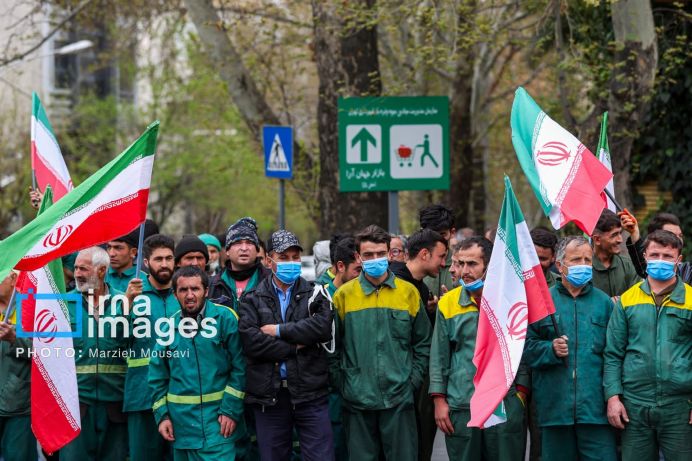
(Photo: Marzieh Mousavi)
By Alireza Bahrami
TEHRAN: People must have been saturated with news about Trump and Netanyahu’s attack on Iran by now.
In the dense volume of news about any war, the dead gradually become a number. So far, about 2,000 Iranians, many of whom were civilians, have been killed in hundreds of airstrikes. However, some killings are so significant that they are widely reported. For example, the killing of 170 people in an elementary school in southern Iran!
But the war also has victims that no one talks about. Of course, some of these silent victims do not live in Iran at all and are scattered all over the world; but since I am in Tehran, I am talking about the Iranian part of it.
Naturally, the war affected many jobs and reduced many incomes. But less than 3 weeks after the war began, the Persian New Year holidays began in Iran. Many companies and sellers earn significant income in the month before the New Year holidays begin; To make up for the deficit of previous months and not go bankrupt.
Many companies lost this income completely this year. For example, travel agencies and cleaning service companies. Many vendors also lost 80 percent of their income; for example, pastry shops or nut shops.
Although when companies encounter financial problems, the first defensive move of dignity is to reduce and downsize personnel; and this means unemployment of people who had jobs before the war, what I saw in Tehran is indicative of the negative impact of the war on a vulnerable segment of society: street vendors.
Street vendors who sell goods on the side of the street in busy intersections have a significant increase in income in the weeks leading up to the New Year. They lost this opportunity for this year.
On the evening of the last day of the year, I drove to several busy squares and intersections in Tehran where street vendors gather. Since I was a child, I have never seen these places so deserted at this time of year. In previous years, there were crowds of people and, of course, crowds of buyers.
Although the number of street vendors had also decreased, at times their number exceeded the number of passers-by.
When I asked one of them why he didn’t leave the city like some other people, to protect his life? He said: “I send money to my family in western Iran every week. If I don’t earn for a week, my mother and sisters will face problems.”
* When the war starts, many people go to villages and cities far from the center of the attacks. A group of people also have to stay and work because of their jobs. They are not only nurses, emergency workers and firefighters. A few days ago, the funeral of a Tehran municipality sweeper was held. He was a 55-year-old man, born in a port city in northwestern Iran.
He had no wife or children, and his parents had died many years ago. This municipal worker was killed in an attack on a neighborhood near our house in the northern half of Tehran. His colleagues, dressed in street sweeper uniforms, held his funeral.
In every war, a number of people and soldiers are killed. They have families. Wives, children, parents.
Today I saw a video in which foreign journalists were very moved and crying in a hospital after seeing a 2-year-old child who had lost 5 members of his family in the missile barrage.
A group of the dead have children who will live with the problems of losing their parents for years.
The problems of this group of society and their damage will never be measured, because it is not possible with any system.
All of these are silent victims of war.
War is the enemy of life.