From Pakistan’s Skies to China’s Heavenly Palace
For decades, Pakistan's space program has concentrated primarily on satellite technology


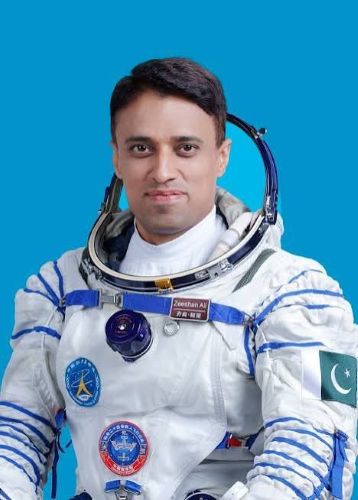
By Nasir Aijaz
The AsiaN Representative
ISLAMABAD: Pakistan has entered a new chapter in its scientific and technological history, as on November 25, 2026, a Pakistani national Muhammad Zeeshan Ali travelled into space aboard China’s Shenzhou-24 spacecraft, becoming country’s first to enter Earth’s orbit and the first foreign astronaut to visit China’s Tiangong space station.
His journey is more than an individual professional achievement. It represents an important milestone in Pakistan-China relations, the internationalization of China’s human spaceflight program and Pakistan’s aspirations to develop its scientific and technological capabilities.
At the age of 40, Zeeshan has become a symbol of a new generation of Pakistani professionals entering fields that were once dominated by a small number of technologically advanced countries.
Zeeshan is a former Pakistan Air Force pilot who was selected to represent Pakistan in China’s human spaceflight program. Although detailed information about his early life, family, educational background and personal career history has not yet been widely published, the media says his professional aviation experience provided an important foundation for his transition into astronaut training.
Military pilots are accustomed to demanding technical environments, complex operational procedures, teamwork and decision-making under pressure.
Zeeshan was not the only Pakistani selected for the program. Khurram Daud, another Pakistan Air Force pilot, was selected alongside him for astronaut training. Both candidates underwent an intensive selection and preparation process in China.
The selection was conducted through medical, psychological, physiological and aptitude assessments. Their subsequent training included spacecraft operations, flight simulations, emergency procedures, survival exercises and Chinese-language instruction. Zeeshan was ultimately selected as the payload specialist for the Shenzhou-24 mission, while Khurram Daud served as the reserve astronaut.
An interesting aspect of Zeeshan’s preparation was learning technical Chinese. Since the spacecraft and space station use Chinese-language operating systems, commands and technical terminology, communication skills were essential for working safely and efficiently with his Chinese colleagues.
According to reports, the Pakistani astronaut spent approximately seven months training in Beijing before his historic flight.
The Shenzhou-24 mission was launched on November 25, 2026, from the Jiuquan Satellite Launch Centre in northwestern China.
The spacecraft was carried into orbit by China’s Long March-2F rocket. It transported three astronauts: Tang Hongbo (China): Mission commander and experienced astronaut; Wu Yi (China): Flight engineer, and Muhammad Zeeshan Ali (Pakistan): Payload specialist and the first foreign astronaut to participate in a Chinese crewed spaceflight.
After launch, the spacecraft successfully entered its planned orbit and travelled to China’s Tiangong space station. The crew entered the station at approximately 2:35 p.m. Beijing time. They joined the three astronauts already aboard the station as part of the Shenzhou-23 mission.
This was a historic development for China’s space program because, until this mission, its crewed spaceflights had exclusively carried Chinese astronauts.
Zeeshan’s participation therefore opened the door to a new phase of international cooperation in China’s human spaceflight activities. He is expected to spend approximately five to ten days in orbit before returning to Earth aboard the Shenzhou-23 spacecraft with two members of the previous crew.
The Tiangong space station, whose name means Heavenly Palace or Celestial Palace, is China’s independently developed orbital research laboratory. It represents one of the most significant achievements of China’s modern space program. The station became fully operational in late 2022.
One of the most important aspects of Zeeshan’s mission is its scientific component. His participation is not simply symbolic or diplomatic. He has been assigned responsibilities connected with scientific experiments jointly developed by Pakistani and Chinese researchers.
According to Pakistan’s Space and Upper Atmosphere Research Commission (SUPARCO), the mission includes four collaborative research projects covering biotechnology and materials science.
The experiments include research into advanced composite materials that could have applications in spacecraft protection and future space technologies; an investigation into self-healing materials, particularly carbon-fiber composites that may automatically repair small cracks or damage.
Such materials could potentially improve the durability and reliability of spacecraft structures; research into quinoa seeds and their potential behavior under space conditions. This could contribute to future investigations into growing food during extended space missions; research involving photosynthetic microorganisms, including cyanobacteria, which may have potential applications in producing oxygen and supporting biological life-support systems.
The cyanobacteria experiment is particularly interesting because these microorganisms can use sunlight to produce energy through photosynthesis. Such research could eventually contribute to the development of sustainable life-support systems for astronauts undertaking longer missions.
SUPARCO invited Pakistani scientists, researchers and students to submit experimental proposals for the mission. More than 300 proposals were received, and the selected projects underwent a multi-stage scientific evaluation.
Zeeshan’s role includes installing experimental equipment and samples, carrying out scheduled activities and helping researchers obtain information about how the experiments perform in the space environment.
The foundation of this historic flight was laid in February 2025, when Pakistan’s SUPARCO and China’s China Manned Space Agency (CMSA) signed an agreement on astronaut selection, training and participation in a crewed mission to the Chinese space station.
Under this agreement, China committed to selecting and training Pakistani astronaut candidates and providing an opportunity for one of them to participate in a spaceflight. The program was significant because Pakistan became the first country to participate in China’s crewed spaceflight program through this arrangement.
The partnership also builds upon decades of cooperation between the two countries in satellite development, space technology and scientific research.
China has previously helped launch Pakistani satellites, while Pakistan has continued developing its own space research capabilities through SUPARCO. The two countries are also exploring further cooperation in lunar exploration. A Pakistani-built rover is expected to participate in a future Chinese lunar mission around 2028.
Pakistan’s connection with human spaceflight did not begin with Zeeshan Ali.
In October 2023, Pakistani adventurer Namira Salim travelled aboard Virgin Galactic’s commercial suborbital spaceflight, becoming the first Pakistani woman to travel to space.
However, her flight was a suborbital journey, whereas Zeeshan’s mission has taken him into Earth’s orbit and to an operational space station. Consequently, Ali holds the distinction of being the first Pakistani to travel into orbit and the first Pakistani astronaut to participate in a crewed orbital space-station mission.
For decades, Pakistan’s space program has concentrated primarily on satellite technology, communications, remote sensing and related research. The participation of a Pakistani astronaut in a Chinese orbital mission introduces a new dimension to that program.
However, a single astronaut’s participation cannot automatically transform Pakistan into a major space power. Sustained investment, quality education, scientific institutions, technological infrastructure and long-term research policies will be essential.
The real test, however, will be what Pakistan does after this historic flight.
According to latest reports, Prime Minister Shehbaz Sharif and Field Marshal Asim talked to Zeeshan from the SUPARCO headquarters.