Natural Disasters: Extreme Weather
The crucial choice facing humanity is either preparing for a changing climate or allowing risks to outpace human adaptation


By Dr. Hassan Humeida
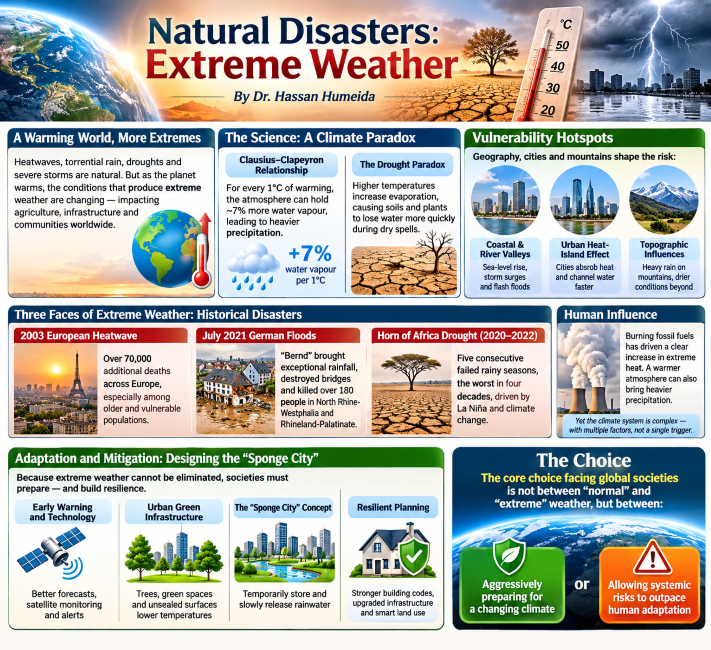
Kiel, Germany: Extreme Weather in a Warming World: Understanding the Shifts: Heatwaves, torrential rain, droughts, and severe storms are natural parts of the climate system. Yet as the planet warms, the conditions that produce extreme weather are changing, impacting agriculture, infrastructure, and communities worldwide.
While not every individual storm or heatwave is directly “caused” by climate change, human-induced warming shifts the global climate baseline—thereby altering the probability and potential intensity of many extreme events.
Physical Principles and the Climate Paradox: Extreme weather definitions depend on location, as conditions that are rare in one region may be normal in another. Scientists evaluate these events by comparing them against long-term regional averages:
- The Clausius–Clapeyron Relationship: For every degree Celsius of warming, the atmosphere can hold roughly 7 percent more water vapour. When sufficient moisture and favorable atmospheric conditions align, this allows for significantly heavier precipitation.
- The Drought Paradox: Higher temperatures simultaneously increase evaporation demand, causing soils and plants to lose water more rapidly during dry spells. Consequently, the same warming that intensifies extreme rainfall also increases the risk of severe drought.
Vulnerability Hotspots: Geography, Cities, and Mountains – Geographic features and human development dictate how severely extreme weather strikes:
- Coastal and River Valleys: Coastal areas face combined sea-level rise, storm surges, and heavy rain, while river valleys remain highly vulnerable to flash floods.
- The Urban Heat-Island Effect: Cities built with asphalt and concrete absorb and store heat. At the same time, sealed surfaces prevent infiltration, channeling water into drainage systems faster and escalating flood risks.
- Topographic Influences: Mountain ranges force moist air upward to release heavy precipitation, while creating dry, sheltered conditions on their leeward sides.
Three Faces of Extreme Weather: Historical Disasters – Recent decades highlight the diverse and devastating nature of climate extremes:
- The 2003 European Heatwave: One of the deadliest weather-related disasters in modern European history, causing over 70,000 additional deaths, particularly among older and vulnerable populations.
- The July 2021 German Floods: Low-pressure system “Bernd” dropped exceptional rainfall in North Rhine-Westphalia and Rhineland-Palatinate, destroying bridges and killing over 180 people in densely settled valleys.
- The Horn of Africa Drought (2020–2022): Five consecutive failed rainy seasons marked the most severe drought in four decades, fueled by a prolonged La Niña phase and intensified by human-induced climate change.
Human Influence and the Complex Climate System: While extreme weather existed long before modern industry, the burning of fossil fuels has driven unequivocal increases in extreme heat worldwide.
A warmer atmosphere similarly creates the potential for heavier precipitation. However, other dynamics remain complex—for instance, while large-scale atmospheric circulation shifts, hypotheses that climate change simply slows down the jet stream to drive extremes lack sufficient universal support. The system relies on intricate multi-factor mechanisms rather than a single trigger.
Adaptation and Mitigation: Designing the “Sponge City” – Because extreme weather cannot be eliminated, societies must focus on mitigation and robust adaptation:
- Early Warning and Technology: Enhanced weather forecasts, satellite monitoring, and automated alerts give authorities time to prepare.
- Urban Green Infrastructure: Trees, green spaces, and unsealed surfaces lower local temperatures and allow rain infiltration. “Sponge cities” go further by designing urban areas to temporarily store and slowly release rainwater.
- Resilient Planning: Building codes, critical infrastructure upgrades, and strategic land-use planning must account for higher temperatures and flood hazards before construction begins.
The core choice facing global societies is not between “normal” and “extreme” weather, but between aggressively preparing for a changing climate and allowing systemic risks to outpace human adaptation.