The Future of the Ganges Water-Sharing Treaty Renewal
When the current agreement is renewed, it should be transformed into a "river basin management agreement"


By Bhanu Ranjan Chakraborty
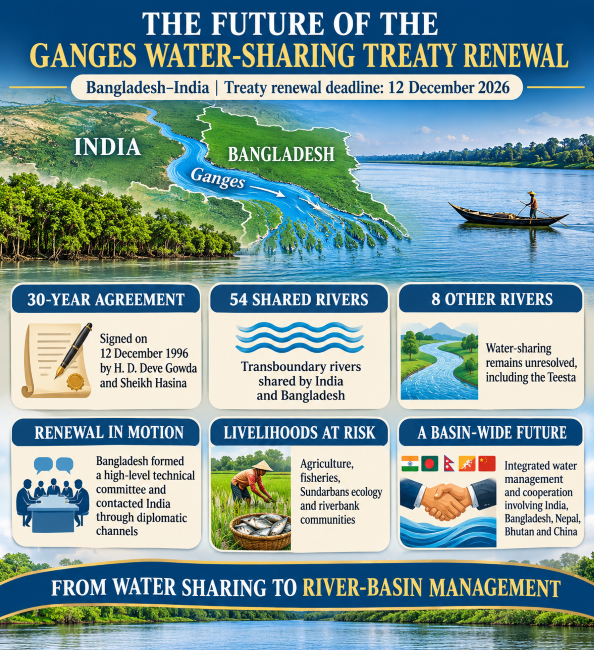
DHAKA: The sharing of water from common rivers between Bangladesh and India has long been an unresolved issue. In 1996, a 30-year Ganges Water-Sharing Treaty was signed between the two nations; this agreement is set to expire on December 12, 2026.
There are 54 transboundary—or common—rivers that flow through both Bangladesh and India. The technical committee of the Indo-Bangladesh Joint Rivers Commission (JRC) held a meeting earlier this year.
Furthermore, the JRC continues to facilitate discussions regarding water scarcity and the management of these 54 shared rivers.
However, while the 1996 treaty specifically addresses the sharing of the Ganges waters, no resolution has yet been reached regarding the distribution of water from eight other rivers currently under discussion, including the Teesta.
Current Status of the 1996 Ganges Water-Sharing Treaty:
The Ganges Water-Sharing Treaty is the most discussed agreement between India and Bangladesh. On December 12, 1996, the then-Prime Minister of India, H. D. Deve Gowda, and the Prime Minister of Bangladesh, Sheikh Hasina, signed this 30-year agreement in New Delhi.
The treaty is set to expire on December 12, 2026. Regarding the renewal or amendment of this agreement, Bangladesh has indicated its intention to continue discussions, placing the highest priority on securing a fair share of water and addressing future water requirements.
Bangladesh’s position on renewing the treaty:
Bangladesh’s Minister of Water Resources, Shahiduddin Chowdhury Anee, has stated that the Bangladesh government is playing an active role—both bilaterally and internationally—to secure a fair share of the Ganges River waters through the signing of a new agreement.
During a session of the National Parliament on November 10, he mentioned that the government has already formed a high-level technical committee and has reached out to India through diplomatic channels to initiate discussions. He further added that the government is also working toward the adoption of an integrated water resources management approach involving the basin countries: India, Nepal, Bhutan, and China.
Meanwhile, while speaking to journalists at the Ministry of Foreign Affairs on November 2, State Minister for Foreign Affairs Shama Obaid Islam expressed optimism that the Ganges water-sharing agreement with India would be renewed before its current term expires in December of this year. She also expressed confidence that India would take an appropriate decision in this regard.
Concerns of local residents and experts:
Environmentalists warn that a failure to renew the agreement could lead to a situation even worse than in the past. With the demand for freshwater having risen significantly in both India and Bangladesh, the latter is urging India to engage in discussions to reach a new understanding.
Mahbub Siddiqui, an environmentalist and researcher specializing in water issues in the Barind region, suggests that Bangladesh should sign the 1997 United Nations (UN) Watercourses Convention to secure its fair share of upstream water.
He further argues that a multilateral dialogue and agreement—involving neighboring India, Nepal, Bhutan, and China—are necessary to ensure an equitable distribution of the Ganges’ waters.
Gautam Lahiri, an international analyst based in New Delhi, notes that if the Ganges Water Sharing Treaty is not renewed, it will cease to be in effect, leaving India with no further obligation to provide water.
He points out that although Bangladesh has expressed support for renewing the treaty, the necessary preparatory steps were not taken in a timely manner; even the interim government failed to initiate any discussions over the past two years. Nevertheless, Lahiri advocates for the prompt resolution—through dialogue—of various bilateral issues, including connectivity, trade, railway operations, and the distribution of the Ganges’ waters.
Growing Risks to Agriculture and Livelihoods:
The decline in water flow in the Ganges has already impacted agriculture and fisheries in northern Bangladesh. Farmers in the Barind region report that falling water levels are damaging rice and wheat crops. Reduced river flow has also led to a decline in the availability of fish.
Furthermore, the Ganges-Kopotaksha Irrigation Project—the largest of its kind in Bangladesh—was originally designed to irrigate 955 square kilometers of farmland; however, due to a lack of water, the project has become virtually non-functional.
According to experts, failure to reach a new agreement could severely harm agriculture, fisheries, the ecological balance of the Sundarbans, and the livelihoods of millions of people living along the riverbanks in Bangladesh.
Environmentalists suggest that when the current agreement is renewed, it should be transformed into a “river basin management agreement,” which would foster well-being for both present and future generations.