By Dr. Hassan Humeida
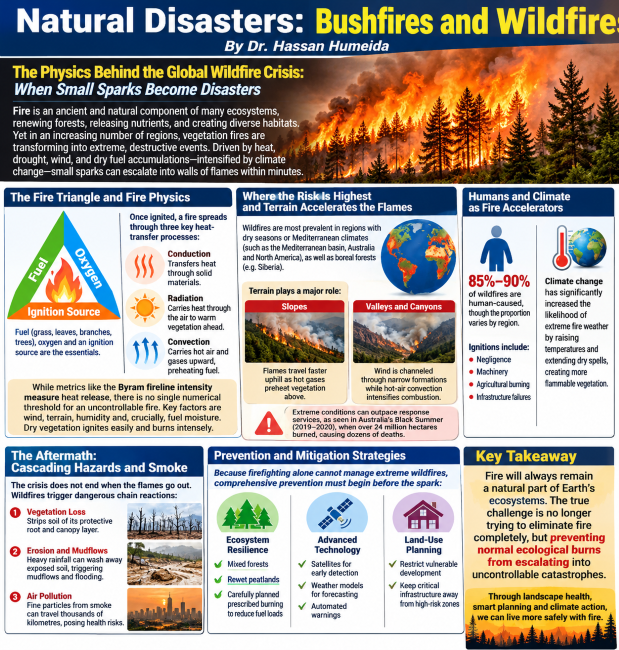
KIEL, GERMANY: The Physics Behind the Global Wildfire Crisis: When Small Sparks Become Disasters: Fire is an ancient and natural component of many ecosystems, renewing forests, releasing nutrients, and creating diverse habitats. Yet in an increasing number of regions, vegetation fires are transforming into extreme, destructive events. Driven by heat, drought, wind, and dry fuel accumulations—intensified by global climate change—small sparks can escalate into walls of flames within minutes.
The Fire Triangle and Fire Physics: Every fire relies on the basic fire triangle: fuel (grass, leaves, branches, trees), oxygen, and an ignition source. Once ignited, a fire spreads through physical heat-transfer processes:
- Conduction: Transfers heat through solid materials.
- Radiation: Carries heat through the air to warm vegetation ahead of the active front.
- Convection: Carries hot air and gases upward, preheating surrounding fuel.
While metrics like the Byram fireline intensity measure heat release along a fire front, there is no single numerical threshold that dictates when a fire becomes uncontrollable. Behavior is complexly dictated by wind, terrain, humidity, suppression capability, and crucially, the moisture content of the fuel. Dry vegetation ignites far more easily and burns intensely.
Where the Risk Is Highest and Terrain Accelerates the Flames: Wildfires are most prevalent in regions with pronounced dry seasons or Mediterranean climates (such as the Mediterranean basin, Australia, and North America), as well as boreal forests in places like Siberia.
Terrain heavily influences fire dynamics:
- Slopes: Flames travel faster uphill because rising hot gases preheat vegetation directly above.
- Valleys and Canyons: Wind can be channeled through narrow formations while rapid hot-air convection intensifies combustion.
Extreme conditions can easily outpace emergency response services, as tragically demonstrated during Australia’s Black Summer of 2019–2020, where over 24 million hectares burned, causing dozens of direct deaths and hundreds of smoke-related fatalities.
Humans and Climate as Fire Accelerators: While popular claims state that 85% to 90% of all wildfires are human-caused, the true proportion varies widely by region. In densely populated areas, negligence, machinery, agricultural burning, and infrastructure failures account for many ignitions.
However, ignition is only the start; landscape condition dictates severity. Human-induced climate change has significantly increased the likelihood of extreme fire weather by raising temperatures and extending dry spells, creating large quantities of highly flammable vegetation.
The Aftermath: Cascading Hazards and Smoke – The crisis does not end when the flames go out. Wildfires trigger dangerous environmental chain reactions:
- Vegetation Loss: Strips soil of its protective root and canopy layer.
- Erosion and Mudflows: Heavy rainfall easily washes away exposed soil, triggering severe mudflows and flooding, particularly on steep terrain.
- Air Pollution: Fine particles from smoke can travel thousands of kilometres, creating wide-scale public health crises.
Prevention and Mitigation Strategies – Because firefighting alone cannot manage extreme modern wildfires, comprehensive prevention must begin before the spark:
- Ecosystem Resilience: Creating mixed forests, rewetting peatlands, and practicing carefully planned prescribed burning to reduce dangerous fuel loads.
- Advanced Technology: Using satellites for early fire detection, weather models for danger forecasting, and automated warning systems.
- Land-Use Planning: Restricting vulnerable residential and critical infrastructure placement directly adjacent to highly flammable vegetation zones.
Fire will always remain a natural part of Earth’s ecosystems. The true challenge is no longer trying to eliminate fire completely, but preventing normal ecological burns from escalating into uncontrollable catastrophes through landscape health, smart planning, and climate action.