Natural Disasters: Tropical Cyclones
The ocean is the engine that powers tropical cyclones

By Dr. Hassan Humeida
Kiel, Germany: The Growing Threat of Tropical Cyclones: Heat Engines of the Ocean: They begin over warm tropical seas, often far from land, but within days, tropical cyclones can develop into enormous storm systems capable of devastating entire coastlines.
Known as hurricanes in the Atlantic and eastern Pacific, typhoons in the northwestern Pacific, and cyclones in other regions, these storms bring multiple hazards simultaneously: destructive winds, torrential rainfall, storm surges, and severe flooding. As the climate warms, the physical conditions governing these storms are changing, presenting coastal communities worldwide with a growing challenge.
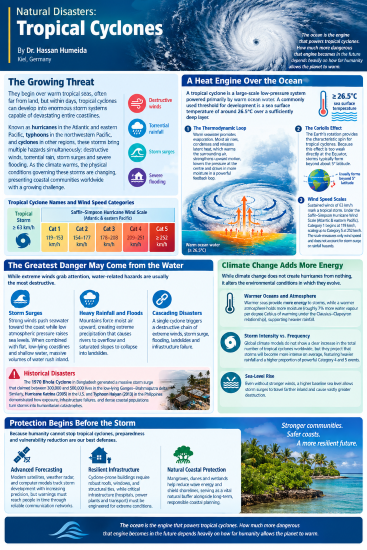
A Heat Engine Over the Ocean: A tropical cyclone is a large-scale low-pressure system powered primarily by warm ocean water. A commonly used threshold for development is a sea surface temperature of around 26.5°C over a sufficiently deep layer.
- The Thermodynamic Loop: Warm seawater promotes evaporation, filling the atmosphere with moisture. As warm, humid air rises in thunderstorms, water vapour condenses and releases latent heat. This warms the surrounding air, strengthens upward motion, and lowers the pressure at the storm’s centre, drawing in more moisture in a powerful feedback loop.
- The Coriolis Effect: The Earth’s rotation provides the characteristic spin for tropical cyclones. Because this effect is too weak directly at the Equator, storms typically form beyond about 5 degrees latitude.
- Wind Speed Scales: Sustained winds of 63 km/h mark a tropical storm. Under the Saffir–Simpson Hurricane Wind Scale (used in the Atlantic and eastern Pacific), Category 1 begins at 119 km/h, scaling up to Category 5 at 252 km/h. However, the scale measures only wind speed and does not account for storm surge or rainfall hazards.
The Greatest Danger May Come from the Water – While extreme winds grab attention, water-related hazards are usually the most destructive:
- Storm Surges: Strong winds push seawater toward the coast while low atmospheric pressure raises sea levels. When combined with flat, low-lying coastlines and shallow water, massive volumes of water rush inland.
- Heavy Rainfall and Floods: Mountains force moist air upward, creating extreme precipitation that causes rivers to overflow and saturated slopes to collapse into landslides.
- Cascading Disasters: A single cyclone triggers a destructive chain of extreme winds, storm surge, flooding, landslides and infrastructure failure.
Historical disasters underscore these terrifying risks. The 1970 Bhola Cyclone in Bangladesh generated a massive storm surge that claimed between 300,000 and 500,000 lives in the low-lying Ganges–Brahmaputra delta. Similarly, Hurricane Katrina (2005) in the U.S. and Typhoon Haiyan (2013) in the Philippines demonstrated how exposure, infrastructure failures, and dense coastal populations turn storms into humanitarian catastrophes.
Climate Change Adds More Energy – While climate change does not create hurricanes from nothing, it alters the environmental conditions in which they evolve:
- Warmer Oceans and Atmosphere: Warmer seas provide more energy to storms, while a warmer atmosphere holds more moisture (roughly 7 percent more water vapour per degree Celsius of warming under the Clausius–Clapeyron relationship), supporting heavier rainfall.
- Storm Intensity vs. Frequency: Global climate models do not show a clear increase in the total number of tropical cyclones worldwide, but they project that storms will become more intense on average, featuring heavier rainfall and a higher proportion of powerful Category 4 and 5 events.
- Sea-Level Rise: Even without stronger winds, a higher baseline sea level allows storm surges to travel farther inland and cause vastly greater destruction.
Protection Begins Before the Storm – Because humanity cannot stop tropical cyclones, preparedness and vulnerability reduction are our best defenses:
- Advanced Forecasting: Modern satellites, weather radar, and computer models track storm development with increasing precision, but warnings must reach people in time through reliable communication networks.
- Resilient Infrastructure: Cyclone-prone buildings require robust roofs, windows, and structural ties, while critical infrastructure (hospitals, power plants, and transport) must be engineered for extreme conditions.
- Natural Coastal Protection: Mangroves, dunes, and wetlands help reduce wave energy and shield shorelines, serving as a vital natural buffer alongside long-term, responsible coastal planning.
The ocean is the engine that powers tropical cyclones. How much more dangerous that engine becomes in the future depends heavily on how far humanity allows the planet to warm.