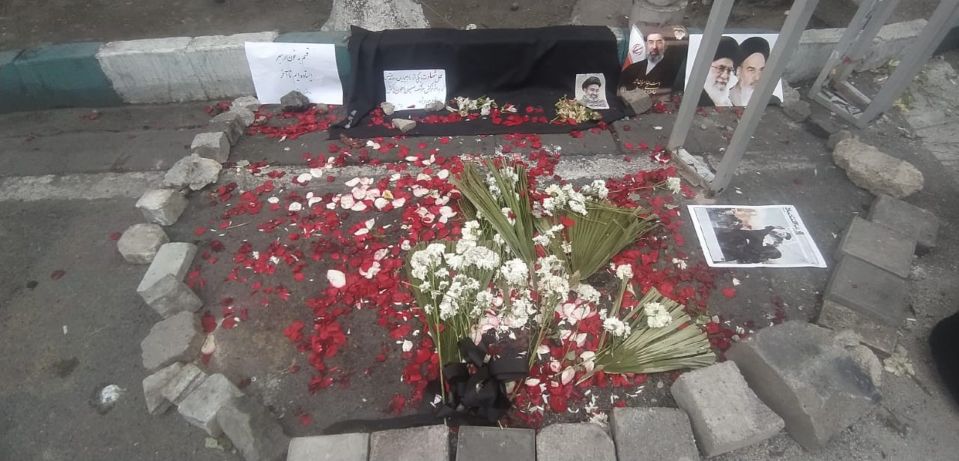
People laid flowers at the scene of his death and a memorial was erected.
(Photo: Alireza Bahrami)
By Alireza Bahrami
TEHRAN: A group of Iranian journalists experienced being in a war zone on the country’s western border (the border with Iraq) in 1981-89. At that time, the number of media outlets and technological communication facilities was small, so the number of war journalists in Iran was small.
After that, a few Iranian photographers and journalists worked in wars in Afghanistan, Lebanon, etc., mainly for international agencies. But in the past 9 months, a large number of Iranian journalists have experienced war journalism; in their own city; at home!
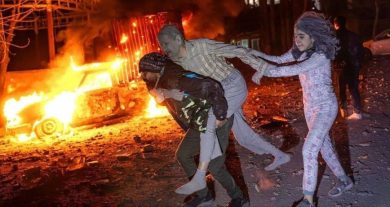
Journalists in Tehran patrol the city so that they can quickly reach the location when an attack occurs; and perhaps be allowed to take photos or videos. Or narrate the scene in text form.
The emergency services have always warned not to be present at the scene when a missile, bomb, or drone hits; because the explosion may be repeated.
In the tragic story of the elementary school in southern Iran, a second missile attack occurred a few minutes later, and most of the students and teachers (168 people) were killed in the second attack while fleeing to shelters.
But the reporter, in a war situation, cannot heed the emergency advice.
First Narrative:
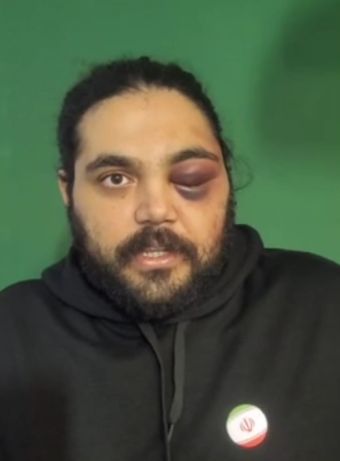
Mostafa Eslamifar is now a war correspondent in Tehran. He works for the news website Ensaf News. You saw the image of the broken windows of the website’s office in one of my reports on the 12-day war (8 months ago).
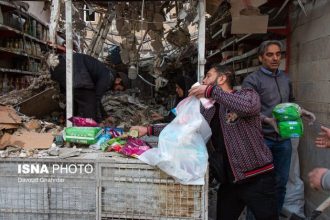
Mostafa quickly reached the site of a missile attack on a neighborhood in Tehran. When he arrived, he saw that a number of wounded people needed help. He abandoned his work as a reporter and, as a paramedic, helped the wounded.
After a few minutes, the second attack occurred, and a shrapnel hit Mostafa in the face and eye.
He had gone to the attack site in a taxi, and the taxi driver, who was still at the location, came to Mustafa’s aid and took him to the hospital.
Mustafa says that treatment began immediately at the hospital, but I feel that when they realized that I was a journalist, they showed more attention and kindness.
The journalist said: Of course, it was not a serious incident, and my injury is not important in front of my fellow citizens who were killed in a heartbreaking way; but I was not spared the damage of the war either!
Second Narrative:
I have been working at ISNA news agency since 2000, before the attack on the Twin Towers in New York. We have had diverse experiences together. On the first day of the war, when the site of the first attack was 700 meters from the ISNA building, we were not in shock, but we did not feel well. Our house had been attacked.
And after the Iran Television building was bombed, access to the Iranian media building was restricted, at the discretion of the managers of these media outlets. Iranian media became a potential target.
A few days ago, when the Israeli army announced an attack on an area in central Tehran and released a map of the area minutes before the attack, the ISNA building was located in the area. Even the guards temporarily left the building. Was ISNA a possible target?
A few minutes later, it became clear that a police building had been targeted. This building is located two streets up the ISNA building, less than 200 meters away. Shrapnel from the attack hit the roof of a medical clinic building, on the same street as ISNA, five buildings to the east.
When I went to the ISNA building a few hours later, on the main street, the blood of a passerby was spread on the ground. He was killed by a bomb shrapnel hit in the head. The neighbors said that the woman was in the street with her husband. And when the woman was killed, her husband lay on the ground and hugged her and cried!…
The next day, flowers were poured at the site and a monument was erected.
War has come to our homes and has permeated our lives; at home, at work, on the streets, for people of all professions; but journalists, along with firefighters and paramedics, are civilians who go into the middle of the battlefield. They do not run away!