
By Ivan Lim
Former AJA President, Contributor to AsiaN
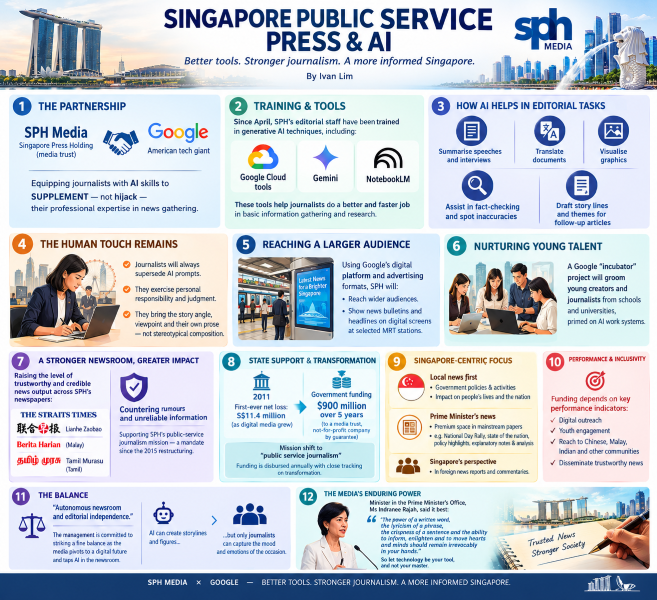
SINGAPORE: In a tie-up with American tech giant, the Singapore Press Holding (SPH)Media is equipping its journalists with the requisite AI skills to supplement but not hijack their professional expertise in news gathering.
Since April, the editorial staff has been trained in the use of generative AI techniques, including Google Cloud tools, Gemini and NoteboolLM. These tools will help journalists do a better and faster job in basic information gathering and research.
AI can play its role in various aspects of editorial tasks, such as summarising speeches and interviews; in translating documents, visualizing graphics. Acting as an extra pair of eyes, AI can assist in fact-checking and identify point out inaccuracies. Or even draft story lines, and themes for follow-up articles.
However, these remain as guidelines. Journalists will still supersede AI prompters and exercise personal responsibility and judgment – putting their imprint on the news stories in terms of story angle, and viewpoint. And instead of stereotypical composition, the news reports reflect the writer’s prose.
AI upgrade of news flows aside, the SPH management is harnessing Google digital platform and advertising formats to reach a larger audience.
Thus, commuters on selected Singapore Mass Rapid Trains stations would soon be able to keep up with the latest news bulletins and headlines on digital screens.
With an eye on future, SPH is also working with Google on a “incubator” project for grooming young creators and journalists from schools and universities primed on AI work systems.
Overall, the SPH-Google collaboration aims to raise the level of trustworthy and credible news output by its stable of newspapers: the English-language. The Straits Times, and its sister papers, Lianhe Zaobao (Chinese), Berita Harian (Malay) and Tamil Murasu.
In doing so, the newspapers will also help counter the spread and influence of rumours and unreliable information that surface on online platforms. This is seen as critical for the press championing public-service journalism, a mandated role since coming under the ambit of a trust in a major restructuring of the business model five years ago.
In 2011, the SPH conglomerate of shareholder interests suffered its first-ever net loss of S$11.4 million as digital media ate into its revenue pie. This put the viability of the news business in doubt
Entered a white knight. SPH having been revamped into a media trust — a not-for-profit limited company by guarantee — the government stepped in with a substantive $900 million funding support over five years, declaring it wants to see newspapers thrive as a print-cum-digital media outfit. The money will be disbursed annually with close tracking on its transformation.
Attached to this state funding is a mission shift to “public service journalism”.
11.One of its key features: Singapore-centric news. Local development news that impact on people’s life and the nation will take centre stage. Accordingly, the order of priority in news coverage will be current affairs with special reference on government policies and activities.
Thus, news of the Prime Minister will receive premium space in the mainstream newspapers. For instance, the annual National Day Rally at which Prime Minister Lawrnce Wong delivered key policies were highlighted as headline news and displayed in front page of The Straits Times, the premier national news organ..
Mr Wong’s “state of the nation” address on Aug 16 outlined state support for family and parenthood, harnessing AI for economic growth and plans on adjacent islands for the republic’s long-term growth.
The comprehensive coverage, including explanatory notes and analysis, underscored the Press larger responsibilities. Hence reports of transport fare hikes carried graphic snapshots of the new fare structure and how they apply to students and adults. In addition, a special column titled Ask ST (Straits Times) with a Q & A on how the hikes are determined by the Transport Advisory Council. (English is the administrative language in the cosmopolitan city-state and the ST of the government’s media of choice for pitching out to the public on policy announcements. The other is the government-owned MediaCorp TV Channel News Asia).
A secondary feature of Singapore-orientation is the injection of the national perspective in foreign news reports. Singapore’s standpoint will be spotlighted in the new paper’s news coverage and commentaries.
The public mission role of the media service is crucial to People’s Action Party government in its contest with opposition parties to win hearts and minds of the electorate and secure the mandate to rule under Singapore’s Westminster parliamentary democracy system.
In this regard, its funding for the SPH media trust is contingent on the Press scoring on the key performance index that include outreach on the digital front, and to youths and to the Chines, Malay, Indian and other racial groups that made up Singapore electorate. A new metric is for the Press to disseminate trustworthy news.
The SPH media trust is still a work in progress. As it pivots towards a digital future and taps the use of AI in the newsroom, the management.is committed to striking a fine balance between “autonomous newsroom and editorial independence”.
While AI algorithms can create storylines and figures, the journalists alone could capture the mood and emotions of the occasion.
Minister in the Prime Minister’s Office, Ms Indranee Rajah, summed it up best in a speech at the Singapore Press Club Awards Night recently: “The power of a written word, the lyricism of a phrase, the crispness of a sentence and the ability to inform, enlighten and to move hearts and minds should remain irrevocably in your hands.”
“So let technology be your tool, and not your master.”


