By Ivan Lim,
Former AJA President, Contributor to AsiaN
SINGAPORE: The prolonged Middle-East conflict that began with US-Israeli attack on Iran on Feb 28 has been most unsettling for Singapore, from disruption of energy supplies to severing of food supply chains via blockage of the Strait of Hormuz, and now tolls imposed by Tehran on cargo vessels transiting the key water-way.
On July 24, the Trump administration has slapped fresh new tariffs of 12.5 per cent on Singapore, dealing a new blow to the city-state’s economic prospects.
Around a third of Singapore’s domestic exports to US are liable to be taxed under the new Section 103 rate – higher than the 10 per cent global levy that expired last week. The city-state has rejected the “forced labour” allegations cited by the US Trade Representative and is seeking to negotiate a new deal.
Seen as protectionist measure, the levy also hit the European Union, China and other Asian nations as well as Asean members — Malaysia, Cambodia, Vietnam and Thailand while Indonesia faces a 10 per cent levy under its bilateral trade deal with the US.
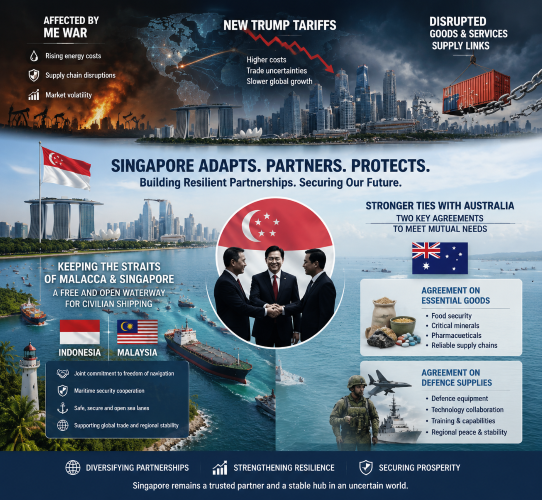
Facing these daunting challenges to its future growth, Singapore has been both speaking boldly out on the threats to cargo vessels in the Straits of Hormuz, including condemning new Houthi attacks on Saudi Arabia oil facilities in the Red Sea, and going all-out in sewing up new trade and security deals with like-minded nations via a fast-track “omni-dimensional diplomacy”.
To start with, the island-nation, characterized as “punching above its weight”, has rallied Asean and other like-minded nations to take a vigorous common stand on international navigation “as a right” under the 1962 UN Convention on Law of the Sea and “not a privilege that can be paid for or negotiated”.
It has also struck a deal with Indonesia and Malaysia to keep the Straits of Malacca and Singapore a free and open waterway for civilian shipping. This, atter an Indonesian official was inspired by Iran’s example in April to propose toll charges.
Beyond the fact that littoral states, Singapore, Malaysia, and Indonesia have a cooperative mechanism that manages the open waterway, Asean states are also mindful of the wider repercussions that any disputes over the passage through the Straits would draw in US and China and stir up regional tensions.
Since independence in 1965, Singapore has not only survived but also thrived on the back of a strategy of making the world as its hinterland.
In recent days, the port city has chalked up new partnerships to circumvent the disruptions in the goods and service supply links.
On July 27, Singapore and Australia signed two agreements to ensure both sides meet mutual needs in essential goods and defence supplies. The legally binding pacts boost existing free-trade agreements tying both parties down to refrain from restricting the export of diesel and liquified natural gases.
Alluding to the Middle-East conflict at the joint Australian-Singapore ministerial committee meeting, Trade and Industry Minister Tan See Leng, said “it has actually triggered an urgent momentum into making sure that both our countries continue to be able function as near normal as possible.”
At the Adelaide meeting, Foreign Minister Dr Vivian Balakrishan lauded the historic pact for economic and supply chain resilience amid a “fractured, fractious and uncertain” world while Defence Minister Chan Chun Sing highlighted the deep reservoir of trust that paves the way for military engagement and co-operation between the two nations.
In a win-win deal, Australia supplies liquified petroleum gas to Singapore while the republic refines petroleum ore for Australia.
Marking Singapore’s ground-breaking trade foray into Africa, President Tharman Shangmugaratnam’s visit to Tanzania has opened doors for business deals with a proposed free trade agreement with East Africa Community, a regional bloc of eight East African countries.
He noted that Tanzania and Zanzibar are expanding their port and tourist facilities that the republic could tap with its experience and expertise in sectors ranging from transport, logistics to hospitality and energy.
Even as Singapore, the Asean chair in 2027, looks further afield, its leaders have taken steps to strengthen ties with new Asean member, Timor Leste. Prime Minister Lawrence Wong’s first visit to Dili on July 2-3 was highlighted by signing of an agreement to promote and strengthen bilateral cooperation.
For a start, Singapore will provide job openings for Timorese workers in construction and marine shipyards.
Currently, the republic has vast investments in Asean’s 11th member and looking for projects in wholesale trade, renewable energy, healthcare and training.
PM Wong noted that since 2022, the republic has helped train Timorese officials to take part in ASEAN meetings.
“Now that Timor-Leste has joined ASEAN, the next priority is for it to contribute fully to the organisation and prepare for its chairmanship of ASEAN in 2029,” he said.
On how Iran’s “weaponization” of the Strait of Hormuz is hurting the republic’s economy, the Monetary Authority of Singapore (MAS) noted that ‘Fuel reserves have been drawn down significantly and renewed supply disruptions in the Middle East could cause sharp surges in oil prices thereby raising costs to businesses and consumers’
On the impact of Trump’s new tariffs, MAS commented that their “adverse impact would be cushioned by export diversification and the boom in tariff-exempt electronics exports”
Overall, it sees Singapore’s economic outlook as cloudy while the US conflict with Iran drags on with no clear end in sight.