By Leo Nirosha Darshan
COLOMBO: Despite temporarily banning foreign research vessels and ships due to intense international pressure, the Sri Lankan government was ultimately forced to reopen its ports by formulating standardized operating procedures applicable to all nations.
This delicate pivot clearly illustrates the immense diplomatic pressure Colombo faces as it attempts to maintain strict neutrality amid a intensifying geopolitical chess match between global superpowers.
To counter China’s expanding maritime influence in the region, India and the United States—key pillars of the Quad alliance—have drastically intensified their security and economic engagements with Sri Lanka.
As the island nation walks this diplomatic tightrope, understanding the intricate dynamics of its relationships with Beijing, New Delhi, and Washington reveals the high-stakes balancing act defining contemporary South Asian geopolitics.
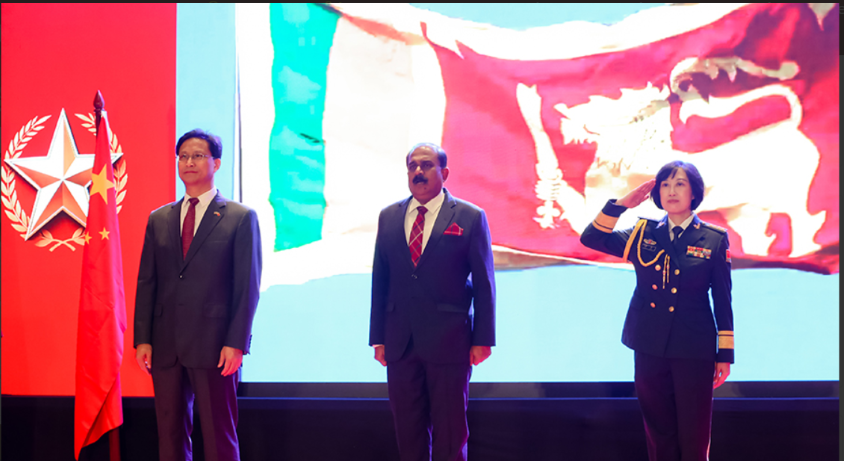
Marking the 99th founding anniversary of the People’s Liberation Army (PLA) of China, the Chinese Ambassador to Sri Lanka, Qi Zhenhong, delivered a keynote address at a grand reception in Colombo. During the event, Ambassador Qi publicly announced that China would further strengthen its defense and military cooperation with Sri Lanka.
Highlighting historical ties, the ambassador pointed to a wide array of ongoing and future initiatives, including advanced military training for Sri Lankan armed forces, military equipment transfers, technical assistance, and 10 million yuan in emergency defense aid following the destruction caused by Cyclone Ditwa.
While this may appear at first glance to be a routine bilateral military engagement, regional analysts view it as a critical geopolitical maneuver within the broader framework of competing imperial ambitions across South Asia and the Indian Ocean.
The Hambantota Port Conundrum and Dual-Use Fears
At the heart of China-Sri Lanka relations lies the Hambantota International Port, a project that remains a primary source of deep strategic anxiety for both India and the United States. Operating under a 99-year lease controlled largely by Chinese state-owned enterprises, the port has frequently been cited by Western critics as a prime example of debt-trap diplomacy.
Although the port has rapidly evolved into a bustling commercial hub, defense establishments in Washington and the Indian Indo-Pacific command continuously warn that it could serve as a dual-use naval facility. In times of peace, it functions commercially, but during a military crisis, it could be leveraged by Beijing.
Situated merely 10 nautical miles away from primary international shipping lanes, a permanent Chinese military footprint in Hambantota would fundamentally alter the security architecture and balance of power in the Indian Ocean—a prospect Washington and New Delhi find entirely unacceptable.
The Research Ship Controversies and Maritime Research
Over the past few years, the arrival of high-tech Chinese marine scientific research and intelligence-gathering vessels—such as the Yuan Wang 5 and Shi Yan 6—at Sri Lankan ports triggered major international storms.
India and the United States fiercely opposed these visits, arguing that under the guise of marine research, these vessels were actually conducting sophisticated electronic surveillance. Their objective: mapping underwater topographical data of the Indian Ocean and intercepting communication frequencies originating from sensitive military installations in India and the critical US base on Diego Garcia.
Caught in the crosshairs of superpower espionage, the Sri Lankan government initially imposed temporary restrictions on foreign research projects and vessels. However, facing overlapping geopolitical demands, Colombo transitioned to a regulated framework, opening its maritime borders under uniform guidelines. This policy shift underscores the severe diplomatic strain inherent in Sri Lanka’s quest for strategic autonomy.
India and the US Counter-Strategy: Economic and Security Integration
To neutralize Beijing’s expanding maritime foothold, India and the United States have aggressively bolstered their defense and economic integration with Sri Lanka.
India has actively strengthened the Colombo Security Conclave, established a Maritime Rescue Coordination Center at the Sri Lankan Navy Headquarters, and integrated regional surveillance networks. Furthermore, through critical debt restructuring support and continuous economic lifelines, New Delhi aims to preserve its traditional sphere of influence in its immediate southern maritime neighbor.
Simultaneously, the United States has solidified its presence. Through the U.S. International Development Finance Corporation (DFC), Washington has channeled over $553 million into the Colombo Port’s West Container Terminal project.
By marrying economic investment with broader Indo-Pacific security architectures, the US ensures its strategic posture remains robust in the region.
Navigating a Geopolitical Knife-Edge
Ambassador Qi Zhenhong’s recent announcement serves as a stark reminder to the international community that Beijing maintains a long-term strategic stake in Sri Lanka. Yet, for an island nation heavily reliant on Indian economic assistance for recovery and Western-backed financial institutions like the IMF for economic survival, this triangular geopolitics is akin to walking on a knife-edge.
For the administration in Colombo, the ultimate diplomatic test lies in safeguarding national sovereignty: avoiding actions that severely compromise India’s core security sensitivities, while simultaneously retaining vital Chinese developmental and financial backing to ensure domestic economic stability.