
Pakistan’s War Austerity Plan: Educational Institutions Closed, 4-Day Work Week Introduced

By Nasir Aijaz,
The AsiaN Representative
ISLAMABAD: In March 2026, Pakistan found itself at the center of a self-imposed “energy emergency” as the spillover from the conflict in West Asia (Middle East) threatens to derail its fragile economic recovery. While the government maintains that the current fuel reserves are sufficient for nearly a month, it has moved with startling speed to implement a so-called “War Austerity Plan.”
Here is a detailed look at the current situation, the unprecedented measures, and the underlying reasons for the government’s controversial decisions.
First, the rulers announced record hikes in fuel prices amid claims of ‘Sufficient’ stock. It was largest single hike in Pakistan’s history. Petroleum Minister Ali Pervaiz Malik had confirmed that the country holds 28 days of oil stocks. However, the government justified the hike by citing the closure of the Strait of Hormuz, a vital chokepoint through which 20% of global oil flows.
However, the analysts suggest the hike was also a move to satisfy International Monetary Fund (IMF) conditions, as the rising cost of imports threatened to balloon the circular debt.
The next move caught many by surprise, as the federal and provincial governments ordered the immediate closure of educational institutions. All public and private schools are closed from March 16 to March 31, while universities have been ordered to transition entirely to online classes.
By keeping millions of students and teachers off the roads, the state hopes to significantly reduce the daily domestic consumption of fuel, preserving the 28-day reserve for essential services and industry.
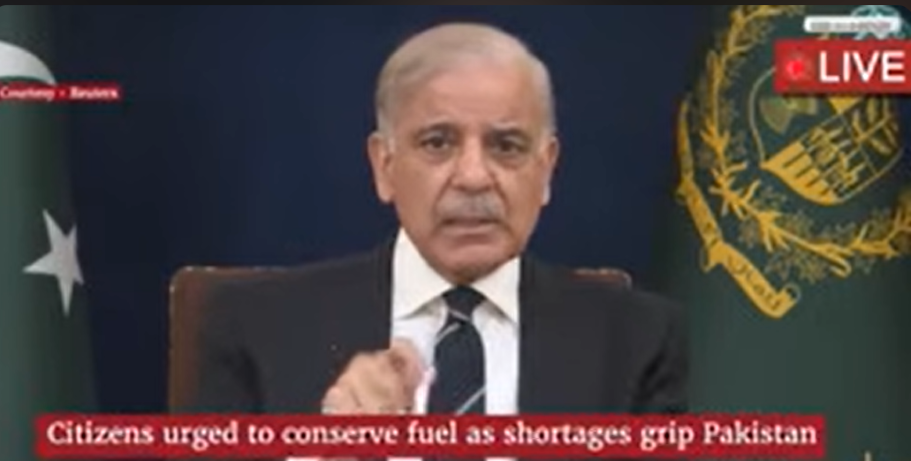
Prime Minister Shehbaz Sharif also introduced ‘New Work Week’ of four days and remote work. Under this move, most government offices (excluding essential services like banks and healthcare) now operate only four days a week. The offices will now remain closed on Friday, Saturday and Sunday.
A mandatory 50% work-from-home policy has also been implemented for both public and private sectors to minimize commuting.
Moreover, 60% of the government’s non-essential vehicle fleet has been grounded, and fuel allowances for officials have been slashed by 50%. The Prime Minister announced that Cabinet members will not draw salaries for two months, and parliament members will see a 25% deduction in their pay.
The public, social media users and the critics however severely ridiculed the government decisions, as the lavish lifestyle of the rulers contrasted with the so-called austerity plan. They cited the example of buying a new most modern aircraft, worth 10 to 11 billion rupees for Ms. Maryam Nawaz, the niece of the Prime Minister, who is the Chief Minister of Punjab province.
While the public is reeling from the ‘petrol shock’, and skyrocketing inflation, the political landscape remains uncharacteristically quiet. The “silence” of the political parties can be attributed to several factors including ‘National Security Narrative. The government has framed these measures as a War-Time Necessity, and in Pakistan, questioning austerity during a perceived regional security threat often carries a high political cost.
The impact of these measures is expected to be a double-edged sword. While they may save foreign exchange reserves in the short term, economists warn that the 17-20% jump in fuel costs will lead to cascading inflation in food and essential goods.


