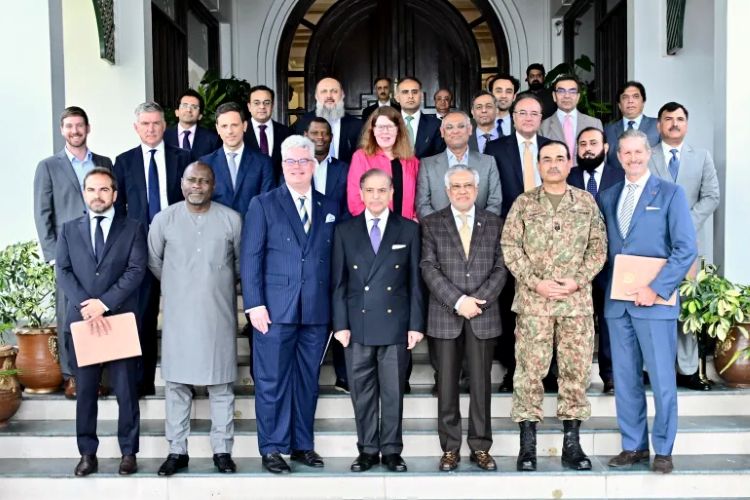
attended by Pakistani Prime Minister Shehbaz Sharif as well as Asim Munir, the army chief
(Official photo released from Prime Minister’s House)
By Nasir Aijaz
The AsiaN Representative
ISLAMABAD: Pakistan’s geostrategic relevance has rarely waned since its inception, but at moments of regional upheaval it acquires an almost disproportionate significance.
Located at the crossroads of South Asia, Central Asia, the Middle East, and China’s western flank, Pakistan becomes especially critical whenever the United States and its allies recalibrate their military or strategic posture in the broader region.
History suggests that during such moments, Pakistan’s internal political balance tilts decisively in favor of its military establishment. At the heart of Pakistan’s enduring importance lies geography. It borders Iran and Afghanistan to the west, India to the east, China to the north, and commands access to the Arabian Sea through the strategic coastline of Balochistan and Sindh.
This positioning makes Pakistan a natural logistical hub for military operations, intelligence gathering, and regional power projection. As tensions involving Iran intensify—whether through sanctions, covert operations, proxy conflicts, or the looming specter of direct confrontation, Pakistan inevitably returns to the strategic calculus of Washington and its partners.
History offers a revealing pattern. Whenever a US-led intervention or major geopolitical contest emerges in Pakistan’s neighborhood, the country’s civilian political order weakens, while the military steps forward as the preferred interlocutor of external powers.
The first major example occurred in the late 1970s. Following the Soviet Union’s intervention in Afghanistan in 1979, Pakistan became the frontline state for the US-led effort to counter Soviet influence.
Yet even before the Afghan jihad formally began, Prime Minister Zulfikar Ali Bhutto had been removed from power in a military coup led by Army Chief General Zia-ul-Haq in 1977. It soon became clear that Zia’s regime was far better aligned with American strategic needs.
Under military rule, Pakistan became the staging ground for the “Mujahideen” project, channeling US and Saudi resources into Afghanistan. The militarization of Pakistan’s state and society during this period had long-lasting consequences, including the empowerment of the intelligence apparatus and the normalization of military dominance in governance.
The pattern repeated itself two decades later. In 1999, Army Chief General Pervez Musharraf overthrew Prime Minister Nawaz Sharif’s government. Once again, the timing proved consequential. Within two years, the United States would launch its “War on Terror” following the attacks of September 11, 2001, and Pakistan, under military rule, became a central ally.
Musharraf’s government provided airspace, logistical corridors, intelligence cooperation, and bases, decisions that profoundly reshaped Pakistan’s security environment. Civilian oversight was once again sidelined in favor of centralized, military-led decision-making, justified by the imperatives of national security and external alignment.
These historical precedents are instructive when examining current developments. The evolving situation around Iran, marked by heightened US-Iran tensions, regional proxy conflicts, and persistent speculation about future military escalation, has once again elevated Pakistan’s strategic relevance.
Pakistan shares a long and sensitive border with Iran, maintains complex relations with Gulf States, and hosts critical infrastructure projects such as the China–Pakistan Economic Corridor (CPEC). Any instability in Iran reverberates across Pakistan’s western provinces, particularly Balochistan, already grappling with insurgency, underdevelopment, and cross-border militancy.
Against this backdrop, the consolidation of power by Pakistan’s military leadership appears less coincidental and more structural.
Well before any open escalation involving Iran, the Army Chief, Field Marshal General Asim Munir, who had visited the USA and held a meeting with President Trump, moved to strengthen the institutional position of the military.
Through constitutional and legal changes, the military’s influence over key aspects of governance, national security, and economic decision-making has been reinforced. Supporters argue that this consolidation is necessary to ensure stability amid economic crisis and regional volatility.
Critics, however, see it as a continuation of Pakistan’s cyclical drift away from democratic norms whenever external pressures intensify.
Military involvement in economic decision-making is evident from certain agreements signed between US companies and Pakistan’s Frontier Works Organization, in September last year for mining of ‘critical mineral resources.’
These agreements were signed after the Field Marshal’s US visit. The agreements have opened the gates for increasing US presence in Pakistan.
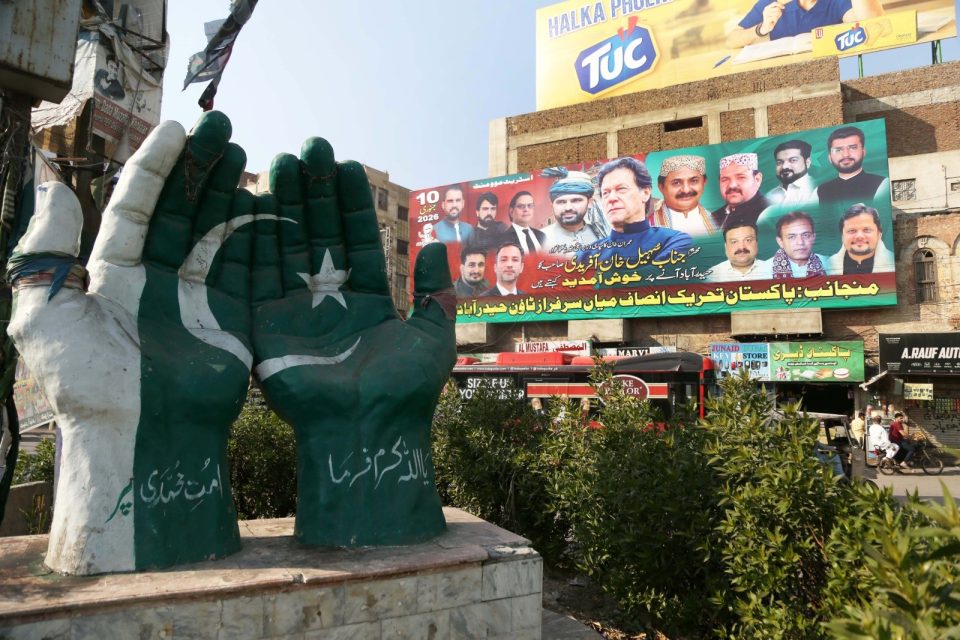
What distinguishes the current moment from earlier episodes is not merely the possibility of another regional conflict, but the broader transformation of global power politics. Unlike the Cold War or the immediate post-9/11 era, the United States today operates in a more contested international system.
China’s deepening partnership with Pakistan, Russia’s renewed interest in South Asia, and Iran’s own regional networks complicate the strategic environment. Pakistan is no longer a singular client state, but a balancing actor, albeit one whose military remains the most coherent and decisive institution.
Yet the implications for Pakistan’s internal political arena are sobering. Civilian governments, already weakened by economic mismanagement, political polarization, and institutional fragility, find themselves further marginalized.
The expansion of military influence, even if justified in the language of stability and security, risks perpetuating a cycle where democratic development is repeatedly deferred in the name of external exigencies. Each such episode leaves behind deeper institutional imbalances and a polity accustomed to governance by decree rather than consensus.
Moreover, regional instability does not necessarily translate into national security. Past experience shows that Pakistan’s involvement in externally driven conflicts has often produced blowback—radicalization, terrorism, economic distortion, and diplomatic isolation. The militarization of policy-making may deliver short-term coherence, but it also narrows the space for debate, accountability, and long-term strategic planning.
As tensions around Iran simmer and great power rivalries intensify, Pakistan once again stands at a familiar crossroads. The military’s ascendancy appears, for now, firmly entrenched.
Whether this consolidation will help Pakistan navigate the coming storm, or merely postpone another reckoning between civilian aspirations and security-driven governance—remains an open question.
One thing, however, is clear: in Pakistan’s turbulent political landscape, the dust has not yet settled. In my opinion, the dust, once again, is far from settling.