From Political Changes to Economic Growth, from Wars to Disasters: Asia’s Defining Year 2025 (III)

The year 2025 in Asia was shaped by impressive economic performances, historic turning points, lingering tensions between neighbors, high-stakes elections, waves of protest, the change of governments, cautious diplomatic breakthroughs among certain states, and relentless natural disasters with deep scars for peoples and countries.
THE AsiaN, founded on Asia Journalist Association’s network of journalists, is highlighting through articles written by its members the major issues that defined 2025 across Asia’s regions and countries. – Editor’s note”.
Thai Military Invasion of Cambodia Changes Cambodian Youth’s Mindsets for the Nation
By Sophal Chhay,
Advisor of Cambodia News, Cambodia
PHNOM PENH: During more than three decades of civil war since 1970, Cambodians -especially the young -had little or no opportunity to develop skills, knowledge, or awareness of national issues.
The war tore the country apart under competing foreign interventions and political ideologies, forcing most young people to spend their formative years not in classrooms but on battlefields.
Throughout this 30-year nightmare, more than three million people died from murder, forced labor, disease, and starvation, while tens of thousands were left disabled, widowed, or orphaned.
What many young people learned during this time was limited to fighting skills to repel what they believed were invading enemies. However, those “enemies”, in reality, were often their own fellow citizens, armed and financed by foreign powers following World War II.
On December 29, 1998, Cambodia -under the leadership of Prime Minister Samdech Techo Hun Sen- declared national reconciliation and complete peace across the Kingdom.
From that moment, young people in particular gained opportunities to develop themselves through education and skills training both inside and outside formal institutions, and most no longer considered military service as part of their future.
In his message for the 36th World Population Day on July 11, 2025, Prime Minister Samdech Thipadei Hun Manet stated that Cambodia’s population stood at approximately 17.2 million in 2024 and is projected to reach 22 million by 2050.
He noted that people aged 15–59 accounted for 63.1% of the population in 2024 and would decline only slightly to 61.7% by 2050. These figures, he emphasized, demonstrate that Cambodia will continue to benefit from a substantial working-age population, providing a strong foundation for long-term socio-economic development.
Building on the sacrifices of previous generations who fought to secure peace and sovereignty, today’s youth now have a rare opportunity to develop their country under conditions of stability. These values and experiences are priceless.
As the core force of the nation -possessing energy, potential, and confidence -young people must contribute actively to political and social life to protect and advance themselves, their families, and their communities.
Although Cambodia has had a military service law in place since 2006, the government has not enforced compulsory enlistment, instead relying on voluntary recruitment. Consequently, during peacetime, most young Cambodians gave little thought to joining the armed forces.
This situation changed dramatically after the Thai military repeatedly violated Cambodia’s territorial integrity, particularly from July 2025 onward.
Prime Minister Hun Manet announced amendments to the conscription law, with a revised system to be implemented from 2026. Under the new law, the service period will be extended from 18 to 24 months.
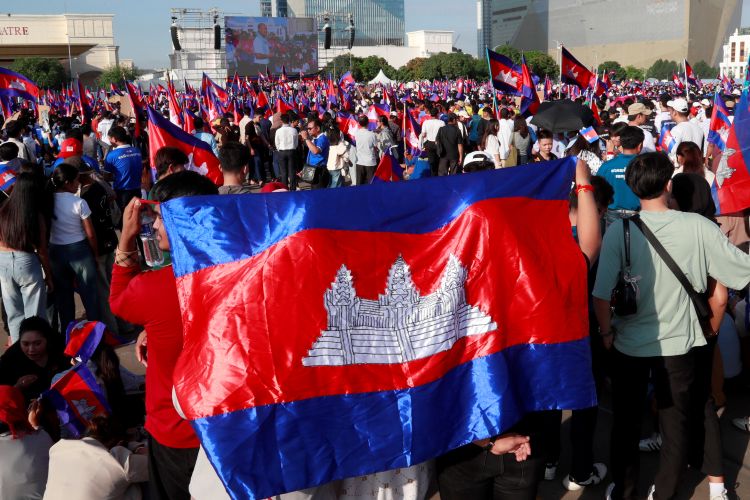
Motivated by a deep sense of duty to defend their homeland, tens of thousands of Cambodian young people volunteered for military service following the Thai military’s incursion. In parallel, responding to a call by Senate President and former Prime Minister Samdech Techo Hun Sen to support domestic industries, nearly all Cambodians at home and abroad -especially young people- began boycotting Thai products. In border areas, some businesses even stopped accepting Thai baht.
Both voluntary enlistment and the boycott of Thai goods reflect a national spirit fundamentally different from that of past internal conflicts, when Cambodians fought against one another. This time, the struggle is against foreign aggression.
Cambodian youth are now channeling their patriotism into strengthening the national economy, promoting local products, and working alongside the government to reinforce moral values, dignity, and national identity.
At the same time, like young people everywhere, Cambodian youth do not seek war but peace. Through the Union of Youth Federations of Cambodia (UYFC), they support the government’s commitment to preserving sovereignty, territorial integrity, peace, and stability, while accelerating development across all sectors for the benefit of the nation.
UYFC focuses on vocational training and education, healthcare promotion, security, justice, freedom, and expanded youth participation in national development. Through these efforts, Cambodian youth have come to better understand their role in society and are reshaping their mindset—to love, build, and protect their nation within Southeast Asia.