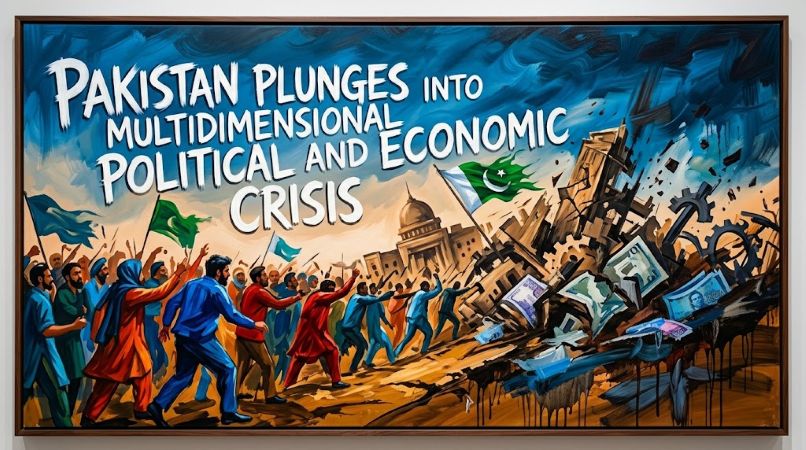
Pakistan Plunges into Multidimensional Political and Economic Crisis
In Sindh, provincial identity and administrative autonomy are deeply intertwined with historical and cultural heritage


By Nasir Aijaz
The AsiaN Representative
ISLAMABAD: Pakistan is currently navigating one of the most volatile and precarious phases in its modern history. Plagued by escalating geopolitical tensions with neighboring nations, a crippling economic downturn, and self-inflicted political instability, the country finds itself on a dangerous precipice.
At the heart of this multifaceted crisis lies a deep friction between governance policies, federal overreach, and the aspirations of the country’s diverse provinces.
As friction mounts across multiple fronts, from administrative restructuring debates in Sindh to the dismantling of a provincial government in Khyber Pakhtunkhwa, the nation stands at a critical juncture requiring urgent, democratic statesmanship.
The foundational layer of Pakistan’s current predicament is economic. Burdened by staggering inflation, heavy external debt servicing, and narrow fiscal spaces, the general populace continues to bear the brunt of harsh stabilization measures.
Economic recovery remains elusive in an environment where capital flight, dwindling foreign reserves, and high energy costs paralyze domestic industries.
Compounding these economic woes is a deteriorated foreign policy landscape. Relations with key neighboring countries have experienced severe friction, straining regional trade and security cooperation. Rather than fostering a unified national front to address these external vulnerabilities, the political leadership has frequently exacerbated domestic polarization, turning structural economic challenges into a broader crisis of governance.
Domestically, national cohesion has faced additional strain due to recurring debates over administrative restructuring. Proposals to carve out new provinces from existing ones, most notably campaigns targeting the geographic and political integrity of Sindh, have unleashed waves of intense anxiety and public backlash.
For the people of Sindh, provincial identity and administrative autonomy are deeply intertwined with historical and cultural heritage. Calls to divide the province have been widely interpreted by local political factions and civil society as an encroachment on provincial rights and an attempt to dilute regional representation.
These fears were further amplified by signals pointing toward federal intentions regarding the control and utilization of vital coastal resources. The resulting protests in Sindh highlight a growing trust deficit between the federation and regional entities, underscoring that any major structural reform must emerge from broad-based consensus rather than top-down decrees.
If tensions in the south exposed fractures over provincial autonomy, developments in the northwest pushed the constitutional framework to its breaking point. For a prolonged period, Khyber Pakhtunkhwa (KP)—governed by the party of incarcerated former Prime Minister Imran Khan, has been locked in a fierce political standoff with the federal government.
The crisis escalated dramatically when the KP government initiated a long march toward Islamabad. In response, federal authorities implemented a draconian lockdown of the capital. Major entry points, including the historic Attock Bridge, were barricaded with shipping containers and barbed wire, effectively cutting off provincial mobility and paralyzing normal civic life.
Amid this high-stakes standoff, the elected government in Khyber Pakhtunkhwa was dissolved, governor rule and a state of emergency was imposed.
Critics and constitutional experts have decried this move as a severe blow to parliamentary democracy and federalism, arguing that bypassing an elected mandate deepens public alienation and sets a perilous precedent for inter-provincial harmony.
Underpinning these political tremors is the perennial debate surrounding the role of Pakistan’s military establishment. As the country navigates these overlapping crises, public discourse frequently points to behind-the-scenes institutional maneuvering, with analysts and opposition figures suggesting powerful military orchestration behind political realignments and administrative crackdowns.
Conversely, the military’s public affairs wing, the Inter-Services Public Relations (ISPR), has consistently maintained that the armed forces have no role in politics and operate strictly within the constitutional domain. However, the visible gap between official denials and the ground realities of political engineering leaves a profound credibility gap.
When executive actions, judicial outcomes, and administrative interventions appear synchronized to suppress mainstream political opposition, institutional neutrality becomes a subject of intense public skepticism.
Pakistan’s current crisis is not merely a transient political dispute; it is a structural test of the country’s federal parliamentary democracy. The path of confrontation, marked by the stifling of political opposition, administrative restructuring without consensus, and the sidelining of elected provincial setups, threatens to push the federation toward deeper instability.