
By Habib Toumi
ABU DHABI: Falconry, one of the world’s oldest hunting traditions, is entering a new era in which centuries-old knowledge is increasingly intersecting with scientific research, environmental conservation and artificial intelligence.
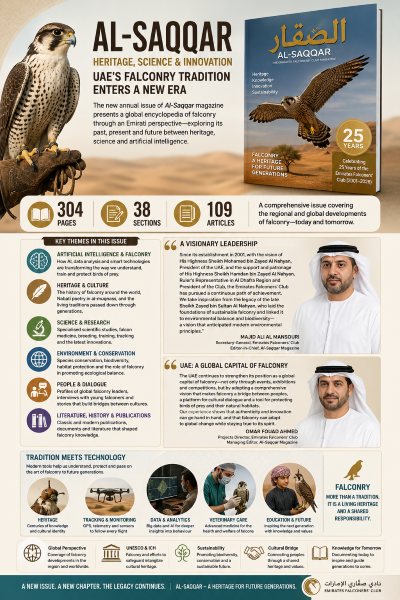
That is the central theme of the latest annual issue of Al-Saqqar, the magazine published by the Emirates Falconers’ Club, which offers a sweeping examination of the past, present and future of falconry in the UAE, the region and around the world.
With 304 pages, 38 sections and 109 articles, the new edition goes well beyond traditional accounts of falconry. It examines the practice through cultural, scientific, environmental and technological perspectives, presenting an Emirati vision that seeks to preserve its heritage while embracing the tools of the future.
The publication coincides with the 25th anniversary of the Emirates Falconers’ Club, marking a quarter-century of efforts to safeguard falconry and reinforce its cultural and human significance.
But the anniversary is also an opportunity to look forward.
The magazine explores how falconry is adapting to rapid scientific and digital transformation, including the growing use of technologies for tracking, monitoring, imaging, recording and analyzing data.
Artificial intelligence is emerging as a particularly important new frontier.
Such technologies can help researchers and conservationists better understand the behavior and movements of birds of prey and their quarry, while supporting efforts to protect species and their natural habitats.
In his editorial, Majid Ali Al Mansouri, Secretary-General of the Emirates Falconers’ Club and Editor-in-Chief of Al-Saqqar, recalls the Club’s journey since its establishment in 2001.
He attributes its vision to its founder, Sheikh Mohamed bin Zayed Al Nahyan, President of the UAE, and highlights the support and patronage of Sheikh Hamdan bin Zayed Al Nahyan, Ruler’s Representative in the Al Dhafra Region and President of the Club.
Al Mansouri also points to the legacy of the late Sheikh Zayed bin Sultan Al Nahyan, whose approach to falconry linked the practice with environmental balance and biodiversity conservation.
That philosophy, he says, anticipated many of the principles that underpin contemporary environmental thinking.
Over the past 25 years, the Emirates Falconers’ Club has sought to place falconry within a modern institutional framework, bringing together inherited knowledge and scientific innovation.
The result is a changing understanding of falconry, not merely as a traditional hunting practice, but also as a multidisciplinary field connecting culture, ecology, veterinary science, education and technology.
The magazine argues that modernization does not necessarily mean abandoning tradition. Instead, new tools can help preserve and deepen knowledge accumulated over centuries.
In the section “A Look at Falconry,” Omar Fouad Ahmed, Projects Director at the Emirates Falconers’ Club and Managing Editor of Al-Saqqar, says the UAE is continuing to strengthen its role as a global center for falconry.
The country’s contribution extends beyond hosting competitions, exhibitions and festivals, he says. Falconry is also being used as a means of cultural exchange, bringing communities together and creating dialogue around shared heritage and environmental responsibility.
The UAE experience, Ahmed argues, demonstrates that authenticity and innovation can coexist and that preserving cultural heritage can go hand in hand with investment in research and education.
The new issue reflects that philosophy in its wide-ranging content.
Alongside its main focus on artificial intelligence and falconry, the magazine features specialized scientific studies and examines the relationship between falconry and UNESCO’s efforts to safeguard intangible cultural heritage.
It also profiles internationally recognized figures in falconry and gives young falconers a voice through interviews exploring how a new generation is engaging with an ancient tradition.
Culture occupies an important place as well. The issue features Nabati poetry associated with Al-Muqnass, the traditional practice of falconry hunting, alongside articles on falcon medicine and international educational experiences.
Other contributions examine the latest scientific research and technological innovations involving birds of prey, while historical features trace the development of falconry across different cultures and regions.
The magazine also highlights important historical and contemporary publications that have documented falconry and helped preserve its intellectual and cultural legacy.
Taken together, the issue presents a powerful message: falconry is not simply a tradition looking back at its past. It is a living heritage capable of adapting to the future.
From the knowledge passed down by generations of falconers to the possibilities offered by artificial intelligence, Al-Saqqar portrays falconry as a field where heritage and innovation can meet and where preserving the past may depend, in part, on embracing the future.


