U.S. Looks Askance at an Asia-Pacific Where China Looms as Rival Hegemon

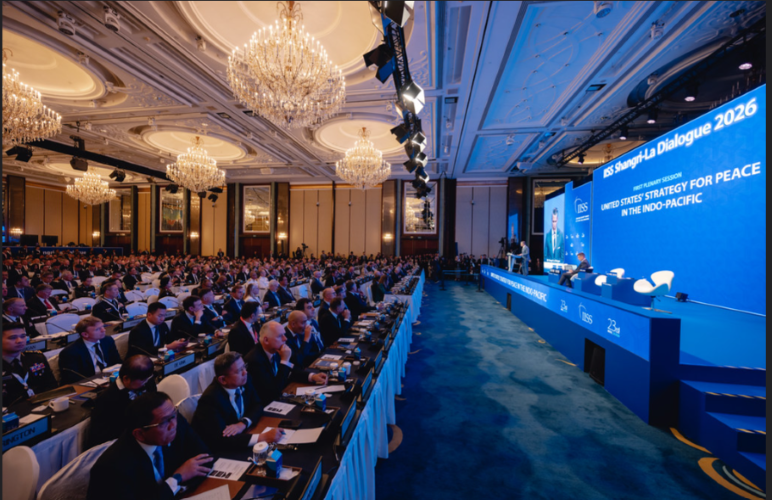
for a ‘new era of pragmatic idealism’ (Photo: IISS)
By Ivan Lim
Former AJA President, Contributor to AsiaN
SINGAPORE: At the Shangri-La Dialogue in Singapore in May, his Secretary of War Peter Hegseth sketched out the scenario of a rival seeking to upset the regional balance of power underpinned by US.
Expressing “rightful alarm” that an assertive China is flexing its muscles in the South China Sea and beyond, he declared that his Department of War aimed to thwart any such unraveling.
However, he said the US would not act as a Lone Ranger.
Instead, it would count on allies and partners to join an Asian model of collective military force to do so. In keeping with Asian states’ non-confrontational approach, the US would lead with strength and confident posture “to speak and walk softly while carrying a big stick”.
That there is still room for dialogue after Trump and Xi Jinping agreed during their Beijing summit in mid-May on a “constructive strategic stability” framework. Even so, the War Secretary still touted America’s fire-power.
“Going forward, we will be intentional about how and when we communicate, and we will lead first and foremost with actions,” he said.
“We will prioritize lethal capabilities, strategic discipline, and businesslike cooperation over empty rhetoric and peacocking.”
His speech was peppered with power rhetoric. If only to establish his credentials, he reminded his audience that “when I was in the United States Army as a young lieutenant, the motto of my first rifle platoon was those who long for peace must prepare for war.”
Then circling back to the China threat explicitly, he emphasised that “It bears repeating again and again, those who long for peace must prepare for war. From my first platoon to the First Island Chain.” This refers to islands stretching from Japan to South-east Asia facing China’s eastern provinces. It is where the United States forward defence line for monitoring and counter any potential military activities in the Western Pacific.
Hegseth also delivered a blunt message: “Make no mistake America is a Pacific nation and we inset China respect our longstanding presence in the region and not just insist but maintain the manifest military strength to underwrite it.”
To be sure, the US defence chief has in mind the supporting roles played by Australia, Japan, South Korea and the Philippines as well as India – allies and partners that set out to meet Trump’s ‘gold standard” on spending to beef up their military capabilities.
For good measure, he lauded Indonesia, Malaysia, Vietnam and Thailand for “bringing skin to the game”. Singapore, the host of the Shangi-la Dialogue, for its part, has” consistently punch above its weight by investing heavily in its military and serving as a vital hub for US logistics activities and rotational deployments, strengthening our shared regional posture.”
To justify his hawkish stance, Hegseth pointed to post-war lesson, saying “History is not over. alliances are not judged by the number of flags, but by the number of formations. We don’t need more conferences. We need more combat power. I’m sorry to say this here: less Shangri-La, more ships, more subs.”
America’s talk of raw hard power undercuts stood out in sharp contrast to the concept of conflict resolution through diplomacy. Some 54 ministerial-level delegates and their defence chiefs and officials from 44 nations were at the three-day pow-wow from May 29 to 31 where they had face-to-face talks, seeking to better understand rivals’ positions and clarify their differences and avoid misunderstandings. Dialogue is seen as key to managing crises before they slipped into conflict.
Not unexpectedly it devolves upon the host of the Shangri-la Dialogue to offer a different and well-balanced perspective to the US warrior in chief.
Ina commentary on the outcome of the Shangri-la Dialogue, Singapore defence minister Chan Chun Sing spoke of three false dichotomies that emerged from his conversations with fellow defence ministers.
First, choosing between talking and arming.
“Some people think you are either a peacemaker who loves dialogue or a hawk who loves big guns. This is a false choice. Dialogue without a real military behind it has zero credibility. But building up a massive military without talking to your neighbours is just begging for an accidental war. We need both.”
Secondly, Chan alluded to the US penchant for ignoring international rules of conduct and acting in ‘’transactional terms” .
“It is tempting for countries to only follow the rules when they favour them.…If we throw out the rulebook completely, we lose all predictability.
“Without shared rules, nations resort to cut-throat “beggar-thy neighbour” policies where everyone ultimately loses.”
Thirdly, only focusing on today’s fires and forgetting tomorrow’s challenges.
“If we look only at the short-term, we will constantly be overwhelmed by the next disaster. Never let the urgent completely crowd out the important.”
New issues cropping up for international attention include cyber warfare and critical infrastructure. For a start, 17 nations witnessed the launch during the Shangri-la Dialogue of a framework for protecting the undersea cable networks dubbed Guide or Guiding Principles for Underwater Infrastructure Defence Exchanges.
The 23rd edition of the Shangri-la Dialogue under auspicious of the London-based Internation Institute for Strategic Studies might be viewed by sceptical Washington politicians as one too many as platforms for public military posturing. Yet its “real magic” takes place during closed-door luncheons and private meetings away from the limelight.
“Leaders packed into the SLD for solidarity. They come to build strategic trust develop partnerships and do the heavy lifting required to keep the peace,” added Chan. In defence diplomacy, “success means quietly stopping a crisis before it even starts.”
Paradise indeed, even as the annual Singapore high-powered dialogue look to alerting the world on potential new flashpoints.