
Pakistan: The Myth of the Passive Youth
State Crackdowns, Digital Dissidence, and Pakistan’s Gen-Z Exodus

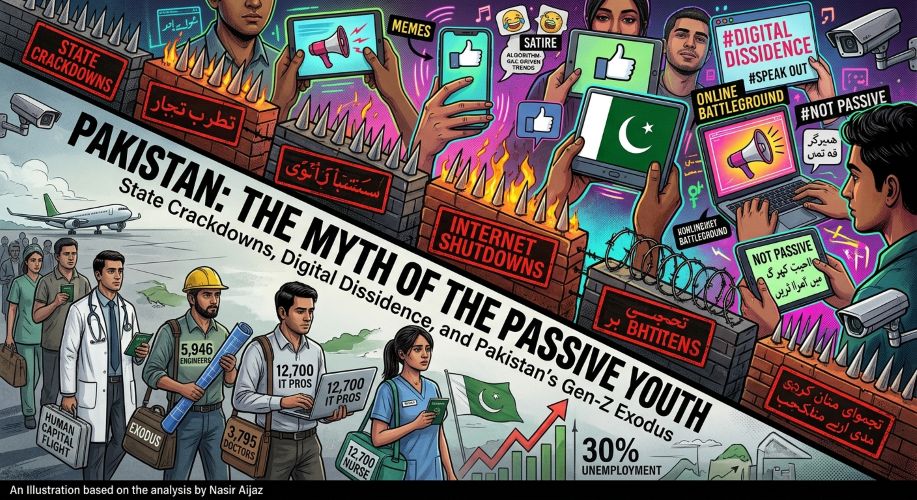
By Nasir Aijaz
The AsiaN Representative
ISLAMABAD: During the last couple of years, while observing the Gen-Z movements taking place in Nepal, Bangladesh, and Sri Lanka, I expected a similar uprising in Pakistan given the grave situation prevailing in the country.
However, surprisingly, nothing happened here. This sparked a question in my mind: Does Generation Z even exist in Pakistan? The answer was yes, absolutely it does. Why then does it remain inactive or passive, and what are the factors behind this?
I tried to explore the reasons. Pakistan has an overwhelming youth bulge, with over 60% of the country’s population under the age of 30. However, looking at the street level, it is easy to perceive them as “inactive” compared to the historic, student-led movements of the 1960s or the massive Gen-Z uprisings seen globally.
The reality is that Pakistan’s Gen Z is not passive; rather, their energy has been redirected, systematically suppressed, and fragmented by unique structural realities.
Unlike previous generations who took to the streets, Pakistan’s Gen Z is a digital subculture. They are highly active, but their battleground is online. They have redefined political communication through memes, satire, and algorithmically driven trends to bypass traditional media censorship.
When this digital energy did spill onto the streets—most notably around the political shifts after 2022 and the February 2024 elections—the state responded with an unprecedented, high-tech crackdown. The state’s counter-strategy effectively dismantled the traditional avenues of physical protest.
By resorting to frequent internet shutdowns, the throttling of social media platforms, and the implementation of advanced firewalls, the state directly targeted Gen Z’s organizational infrastructure.
Strict anti-protest measures, mass arrests, and pervasive surveillance mean that standing on a street corner carries a much higher risk of ruining one’s future than it did decades ago. For a generation already facing immense pressure, silence has become a conscious strategy for self-preservation.
When a youth population faces skyrocketing inflation, a commercialized education system that no longer guarantees employment, and a massive gap between effort and reward, they generally have two choices: Voice (protest) or Exit (emigration).
Recent surveys show that an astonishing 67% of Pakistani youth want to leave the country. Consequently, Pakistan is currently experiencing one of the most severe waves of human capital flight in its history.
According to recent data from the Bureau of Emigration and Overseas Employment, more than 2.9 million Pakistanis left the country between 2022 and late 2025.
The scale of this exodus is reflected in recent statistics. In 2024, a total of 727,381 individuals secured employment abroad—a trend that escalated to 763,526 departures in 2025.
In 2025 alone, the country lost 5,946 engineers; 5,659 accountants; 3,795 doctors; 1,725 teachers; 1,640 nurses; and over 12,700 IT professionals. Furthermore, data shows that during the first four months of the current year, 250,000 Pakistanis legally left the country.
Roughly 6% of Pakistan’s annual university graduates are registering to leave immediately upon finishing their degrees, with thousands more exiting through private channels, student visas, or direct international recruitment.
The primary cause behind this human capital flight is prolonged domestic instability. With inflation clipping the wings of the middle class, real wages have stagnated while the cost of living has skyrocketed.
Unemployment among the general youth population hovers near 30%. For a qualified doctor or IT specialist, the domestic salary structure offers virtually no parity with international markets, rendering local employment economically unviable.
Independent surveys, including data from the International Organization for Migration (IOM), indicate that nearly four in ten Pakistanis would leave the country if given the chance.
Young professionals cite their primary driver as not just immediate financial gain, but a pervasive sense of disillusionment with the state apparatus, inconsistent public policies, and an absence of meritocracy and social justice.
Concurrently, aging populations and rapid digitization in the West and the Gulf have created a massive demand for qualified doctors, nurses, and tech professionals. Western nations offering streamlined paths to permanent residency present an alternative that promises security, healthcare, and a predictable future—things the domestic environment currently struggles to guarantee.
While low-skilled laborers typically migrate alone and send a high percentage of their earnings home, highly skilled professionals tend to migrate permanently with their immediate families.
Ultimately, I found the answers to my queries regarding why Gen Z appears inactive and passive. They are a vibrant force on social media but lack the institutional safety or appetite for risk to take to the streets; meanwhile, the rest of their energy is being consumed by a historic mass exodus.


