Kyrgyzstan Seeks UN Security Council Seat with Call for Balanced Global Diplomacy
Bishkek will make worthy contributions to international community efforts in addressing global challenges, threats


By Habib Toumi
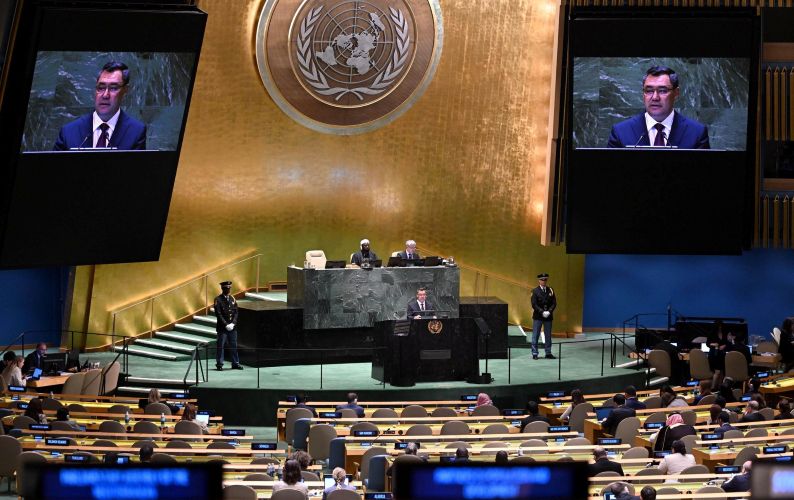
BISHKEK: President Sadyr Zhaparov has appealed to world leaders to support Kyrgyzstan’s bid for a non-permanent seat on the United Nations Security Council, warning that rising geopolitical tensions and unequal representation are weakening the international system.
In a formal address issued ahead of the June 3, 2026 UN vote in New York, Zhaparov said the world was facing a dangerous period marked by intensifying rivalry between states, growing armed conflicts, and declining respect for international law.
“Today, geopolitical rivalry is intensifying across the world,” the Kyrgyz president declared, adding that the “universality of international law is being weakened and the risk of conflicts is growing day by day.”
Zhaparov pointed to ongoing wars and instability in Europe, the Middle East, and Africa as evidence that the current global order was under severe strain. He also criticized the vast sums being spent on warfare, saying more than three trillion dollars was being consumed by military conflicts worldwide.
“This number of resources could provide a decent life for all humanity,” he said, arguing that such funds should instead be directed toward environmental protection and eliminating hunger.
The speech formed part of Kyrgyzstan’s campaign to secure its first-ever seat on the Security Council, the UN body responsible for maintaining international peace and security. Zhaparov argued that smaller and developing countries remain underrepresented within the Council, undermining its legitimacy.
“The continued imbalance in the composition of the Council,” he said, particularly the limited participation of “small, developing and landlocked countries,” weakens the global system of collective security.
The Kyrgyz leader presented his country as a neutral and independent actor capable of helping reduce polarization among major powers. He stressed that Kyrgyzstan was “not bound by any system of bloc commitments” and was not involved in confrontational geopolitical alliances.
According to Zhaparov, this position allows the country to maintain “a balanced, independent and pragmatic position aimed at reducing polarization and restoring functional dialogue.”
He also criticized what he described as double standards in international politics, saying Kyrgyzstan opposed “the selective application” of the UN Charter and rejected the use of humanitarian issues for political purposes.
During the address, Zhaparov highlighted Kyrgyzstan’s experience in peacefully resolving border disputes in Central Asia. He said all border delimitation issues with neighboring countries had been completed “exclusively by peaceful means.”
“This is not merely a declarative position,” he stated. “It is an implemented model showing that even the most sensitive security issues can be resolved on the basis of negotiations.”
The president also sought to portray Kyrgyzstan as a democratic and reform-oriented state. He referred to the country’s previous service on the United Nations Human Rights Council and noted recent legal reforms introducing quotas for women, youth, ethnic minorities, and persons with disabilities.
Zhaparov claimed that Kyrgyzstan currently provides women with the highest level of parliamentary representation in the world and said new laws had introduced gender quotas across the executive and judicial branches of government.
If elected to the Security Council, he pledged that Kyrgyzstan would focus on preventive diplomacy, mediation, nuclear disarmament, and the relationship between climate change and security.
“Kyrgyzstan has consistently pursued its foreign policy on the basis of the principles of complete renunciation of weapons of mass destruction,” he said.
The president also emphasized the country’s environmental commitments, pointing to Kyrgyzstan’s accession to the BBNJ Agreement in 2025 despite being a landlocked nation.
“As a mountainous country, we are promoting the concept ‘from mountains to the ocean,’” Zhaparov explained, arguing that ecological systems across the world are deeply interconnected.
A significant portion of the speech focused on Afghanistan, which Zhaparov described as crucial to the stability of Central Asia. He said Kyrgyzstan had been providing humanitarian assistance to Afghan civilians and supported the country’s gradual integration into the international community.
The Kyrgyz president added that his country’s candidacy enjoyed unanimous support from other Central Asian nations, describing this as evidence of growing regional unity.
In a direct appeal to UN member states, Zhaparov argued that Kyrgyzstan’s election would represent “historical justice,” noting that more than sixty countries, including Kyrgyzstan, had never served on the Security Council.
He contrasted this with rival candidate Philippines, which he said had already been elected to the Council four times.
“The election of Kyrgyzstan would be evidence of the international community’s political will to restore historical justice and to ensure equal rights for all countries to be elected to the leading organ of the United Nations,” he said.
Concluding the speech, Zhaparov promised that Kyrgyzstan would work to improve the effectiveness and transparency of the Security Council and to make a worthy contribution to the collective efforts of the international community in addressing global challenges and threats, if elected.
“I deeply trust, Your Excellencies, that you will support the Kyrgyz Republic during the vote in June 2026,” he told the heads of state.