Sindh and Korea: Tales of Bonfire Gatherings and Cultural Heritage


By Nasir Aijaz
The AsiaN Representative
ISLAMABAD: While traveling through South Korea, a country that has made massive strides in modern technology, I was often amazed to witness people performing certain rituals to fulfill their hopes and dreams that were remarkably similar to those we see in South Asian countries and our own Sindh.
I will share one example. In an ancient village, which has been designated a UNESCO World Heritage site and preserved by the Korean government as a tourism hub, there stood an ancient tree within an enclosure. Hundreds of slips of paper were tied to its branches; every visitor writes their wish on a piece of paper and ties it there. Small slips of paper were specifically kept there for visitors so that everyone could write down a wish.
However, I recently discovered another interesting similarity between Sindhi and Korean customs. On the morning of March 3rd, around 5:00 AM our time, I read a message my Korean friend, Lee Sang-ki, posted on AJA WhatsApp. He had just returned from the bonfire ritual celebrated on the Korean Lunar New Year. His message touched upon the fires of war raging in the Middle East in contrast to the traditional bonfires of Korea.
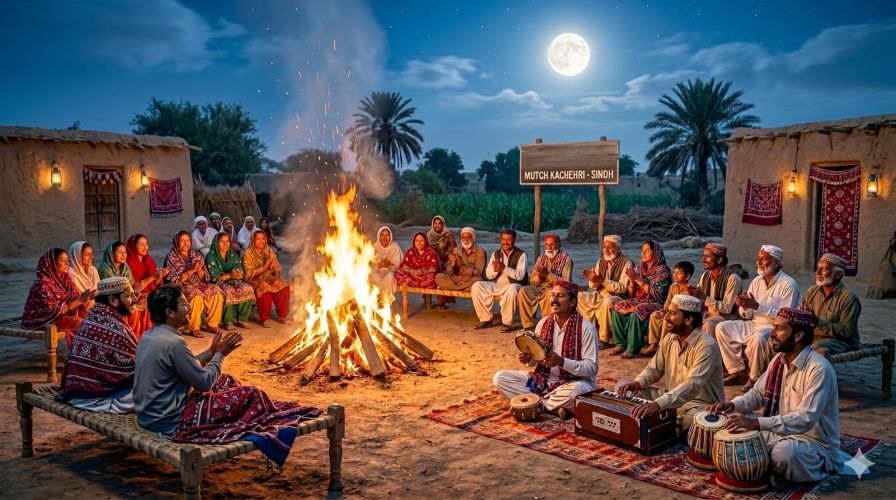
The Korean New Year follows the lunar calendar, and they observe a three-day public holiday. On one specific night (which was the night of March 3rd), during the full moon, the Korean people light massive bonfires to celebrate. This tradition is called Jeongwol Daeboreum. In Sindh, we have “Mach Kachahri” (bonfire gatherings) during the winter, which have become a part of our cultural identity; in Korea, these bonfires are lit once a year on this specific night.
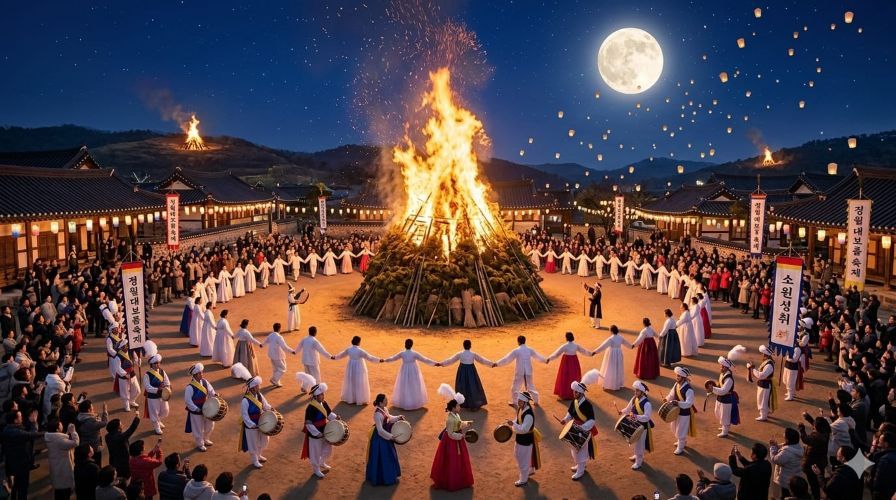
Jeongwol Daeboreum is one of Korea’s most ancient and significant festivals, celebrated on the 15th day of the first month of the lunar year when the moon is at its peak. On March 3, 2026, this day was celebrated with great fervor across Korea. In Korean culture, it is known as the “Full Moon Festival.” It is the night when the first full moon of the New Year shines in the sky, symbolizing prosperity, light, and blessings.
The roots of this ritual date back to ancient Korean eras, with traces found in the Period of the Three Kingdoms. Historical records mention its celebration during the reign of King Soji of the Silla Kingdom (479–500 AD). In ancient times, when Korea was an agrarian society, the full moon was considered a symbol of fertility and growth. Farmers believed that prayers offered on this day would protect the year’s harvest and prevent famine.
Historically, several fascinating customs are linked to this day.
Daljip Taeugi (Burning the Moon House): People build large stacks of wood and straw (called the “Moon House”) and set them on fire. It is believed that this fire burns away the misfortunes of the previous year.
Jwibulnori: Farmers used to set fire to the dry grass on the edges of their fields to kill insects and pests and to make the soil fertile. Today, this has evolved into a game where cans filled with charcoal fire are whirled around in the air.
Gwi-balgi-sul (Ear-sharpening Wine): There is a tradition of drinking cold rice wine on the morning of this day so that one’s ears may hear only good news throughout the year.
Special Foods: People prepare Ogokbap (five-grain rice) and eat dried vegetables to gain strength for the coming summer heat. Additionally, adults and children crack hard-shelled nuts with their teeth to ensure strong teeth and healthy skin.
There is an intriguing legend behind the Korean bonfire tradition. It is said that in the year 488 AD, on the first full moon of the New Year, a crow brought a letter to the King. The letter stated: “If this letter is opened, two people will die; if it is not opened, one person will die.” Confused, the King followed a wise man’s advice and opened it. Inside, it said: “Immediately shoot arrows into the palace.”
When the King did so, he discovered that the Queen and a monk were conspiring against him. Out of gratitude to the crow, the King declared the day sacred and started the tradition of preparing Yakshik (sweet rice with nuts and berries) to feed the birds.
A humorous custom called Deowi Palgi (Selling the Heat) also takes place. Early in the morning, if you meet a friend or family member, you call out their name. If they answer, you quickly say: “Buy my heat!” (Nae deowi sagara!). It is believed that if you successfully “sell” your heat to someone else, you won’t suffer from the scorching summer heat and will stay cool all year. Nowadays, Koreans even play this prank over the phone.
In ancient times, the color and position of the moon on this night were used to predict the year ahead. A bright white moon signaled heavy rains (good for crops), while a reddish moon was a sign of drought. If the moon tilted toward the north, it meant a good harvest for the mountainous regions; if toward the south, it meant prosperity for coastal areas.
In major cities like Seoul and Busan, massive bonfire events are held. In Busan, the festival is most famous on the beaches of Haeundae and Gwangalli. A giant cone-shaped “Moon House” (Daljip) made of bamboo and pine branches is constructed. Thousands of people tie slips of paper with their prayers and wishes to the structure.
As the full moon rises over the ocean horizon, the stack is set ablaze. The belief is that as the flames leap toward the sky, they carry the people’s prayers to the moon. In Seoul, the night is celebrated in the Hanok Village with traditional drums, flutes, and dancing to ward off evil spirits.
While the Korean customs of whirling fireballs or burning the “Moon House” differ from Sindhi traditions, there is a shared human essence. Korea’s society, shaped by harsh winters and snow, celebrates the coming of spring with fire as a symbol of warmth and life. In contrast, prosperity in Sindh’s geography has historically depended on water (the Indus River). Thus, we have rituals like the worship of Darya Shah (The River Deity).
While Korea’s rituals are rooted in Shamanism and ancient folk beliefs where fire wards off evil, Sindh’s traditions are more influenced by Sufism and folk wisdom, emphasizing the protection of trees or feeding birds. Although the subcontinent has festivals like Holi or Lohri where fires are lit, the Korean Jeongwol Daeboreum is unique for its agricultural purpose (killing pests) and the specific ritual of the “Moon House.”
Ultimately, every civilization creates its own colors based on its environment and history. Korea’s full moon night is as unique as Sindh’s Cheti Chand or other seasonal festivals. Jeongwol Daeboreum is not just a holiday; it is a historical expression of the Korean people’s love for their land, their crops, and their families.
While they are separated by thousands of miles, Sindh and Korea share a glowing commonality: the belief that a communal fire can burn away the misfortunes of the past and light the way for a prosperous future.
Despite the geographical distance, these two traditions mirror each other in profound ways: Both festivals serve as a bridge between seasons. In Korea, it signals the start of the farming cycle. In Sindh, the Match is a celebration of survival through the winter and a preparation for the spring harvest.
Both traditions prioritize the “Kachehri” (gathering) and the “Community.”
In Korea, the Ganggangsullae (circle dance) performed around the fire symbolizes unity.
In Sindh, the fire is a democratic space where every person, regardless of status, sits at the same level to share stories.
There is a shared belief in the cleansing power of fire. Koreans use the fire to drive away Gwishin (ghosts or bad luck). In Sindhi folklore, the warmth of the fire is often associated with “Barkat” (blessings), and the gathering itself is seen as a way to preserve the social fabric and moral health of the village.