China-Pakistan: A New Era of Industrial, Technological, and Agricultural Cooperation
The signing of these 34 agreements is the beginning of the work, not the end

By Nasir Aijaz
The AsiaN Representative
ISLAMABAD: In a comprehensive and forward-looking diplomatic mission that underscores the enduring all-weather strategic partnership between Pakistan and China, Chief Minister of Sindh Province, Syed Murad Ali Shah conducted a high-level, week-long official tour of China’s Hubei Province and the global financial hub of Shanghai.
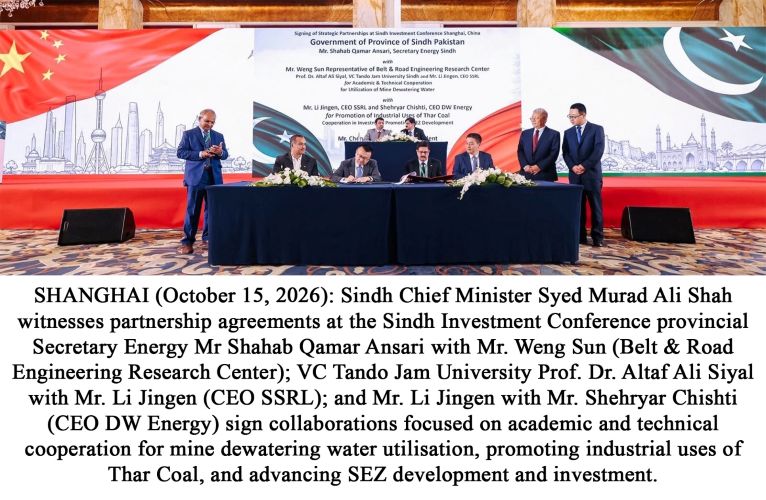
Spanning from October 11 to October 15, 2026, the tour culminated in the historic second Sindh Investment Conference in Shanghai—convened after a 12-year hiatus, where the Sindh government and Chinese enterprises finalized more than 34 government-to-government (G2G) and business-to-business (B2B) memoranda of understanding and agreements.
Accompanied by a high-level delegation comprising some provincial ministers, departmental secretaries, and key municipal leaders, Chief Minister Murad Ali Shah successfully pitched Sindh as Pakistan’s premier gateway for trade, technology transfer, and sustainable foreign investment.
The Chief Minister’s official engagements began in Hubei Province, where he was warmly received by Mr. Chen Hanhus, Director General of Foreign Affairs for Hubei Province. Given Sindh’s acute vulnerability to climate change, extreme monsoon flooding, and water scarcity, a core focus of the visit was examining world-class infrastructure and flood management models.
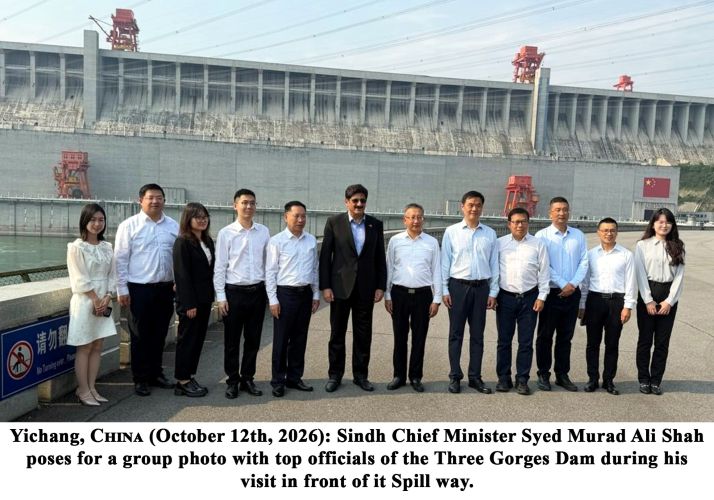
Mr. Shah led his delegation on an inspection tour of the world-renowned Three Gorges Dam on the Yangtze River. Touring the massive installation, which boasts an installed capacity of 22,500 megawatts and generates over 100 terawatt-hours of clean energy annually, the Chief Minister studied China’s integrated approach to flood regulation, real-time hydrological monitoring, and sediment management.
As an engineer by profession, Mr. Shah hailed the dam as an engineering marvel and emphasized that Sindh must adopt advanced reservoir operations and freshwater conservation techniques to protect the fragile ecology of the Indus Delta against seawater intrusion.
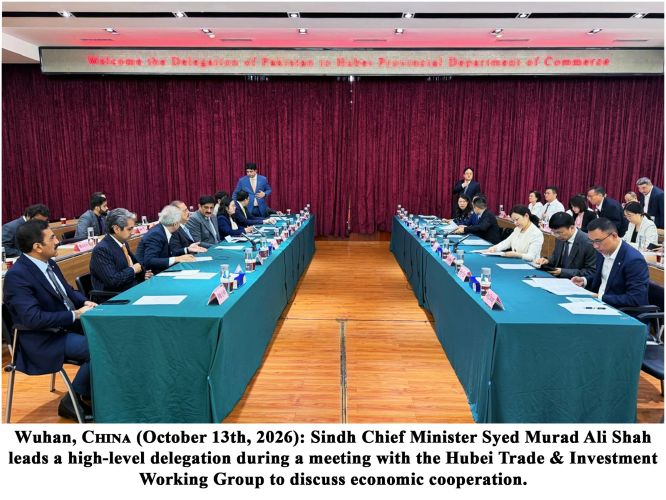
Building upon these infrastructural priorities, the delegation visited HBSZ Company in Wuhan’s Hanyang district to review vital water and irrigation projects. Discussions yielded a breakthrough agreement regarding Karachi’s long-standing water security needs: HBSZ expressed its willingness to construct the critical 100-kilometre K-IV water supply pipeline, prompting the Chief Minister to direct immediate project initiation.
Concurrently, progress on the Sukkur Barrage Improvement Project—being implemented via a joint venture between the China Road and Bridge Corporation and HBSZ, was reviewed in detail.
With 44 of the barrage’s 54 primary Indus River gates already replaced and made functional, officials confirmed that the remaining 10 massive gates, each weighing over 50 tons, are primed for shipment to Pakistan.
Furthermore, the fabrication of 110 canal gates is well underway, ensuring the structural integrity of Sindh’s economic lifeline ahead of its scheduled completion by June 30, 2027.
Recognizing agriculture as the backbone of Sindh’s economy, the Chief Minister sought robust Chinese partnerships to boost crop yields, eliminate post-harvest losses, and introduce climate-resilient farming technologies.
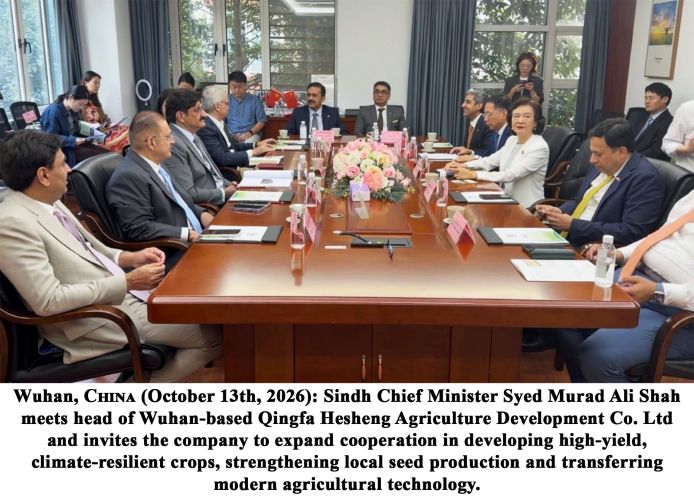
During a high-level meeting with Qingfa Hesheng Agriculture Development Co. Ltd, a Wuhan-based high-tech seed corporation, Mr. Shah proposed establishing joint research and testing facilities in Sindh. The collaboration aims to develop high-yield crop varieties capable of withstanding extreme heat, water shortages, and shifting weather patterns.
Qingfa Hesheng, renowned for hybrid rice varieties that achieve yield increases of 20 to 30 percent—shared its expertise in molecular seed-identification technology, which will be instrumental in curbing counterfeit seed distribution across provincial markets.
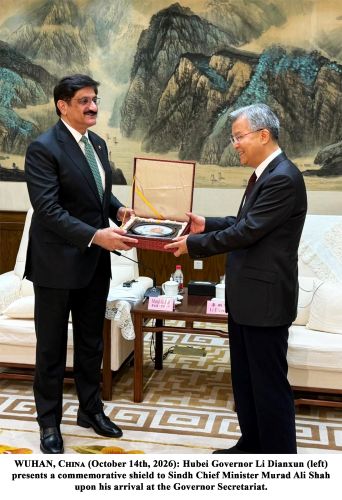
In discussions with Hubei provincial leaders, including Governor Li Dianxun and Provincial Communist Party Secretary Guan Xiaotao, the Chief Minister expressed profound gratitude for China’s initiative in training 1,000 Pakistani agricultural graduates.
Both provinces agreed to expand cooperation in agricultural mechanization, cold-chain logistics for perishable goods like fruits, vegetables, and fisheries, and the establishment of a joint laboratory for smart and digital agriculture.
Further, in a strategic push toward digital transformation and industrial diversification, the Sindh delegation visited cutting-edge technological and pharmaceutical institutions in Wuhan.
At Huawei’s Global Model Site for Digital-Driven Urban Governance and the Wuhan Artificial Intelligence Computing Centre, Mr. Shah explored data-driven solutions for urban management.
Noting that Karachi, with a population exceeding 20 million, faces complex municipal challenges, the Chief Minister proposed a pilot project focusing on flood early warning systems and urban operations management.
The partnership, slated to be formalized via an upcoming memorandum of understanding at the Shanghai conference, aims to establish a smart city platform, foster knowledge transfer, and provide local universities with advanced AI computing resources.
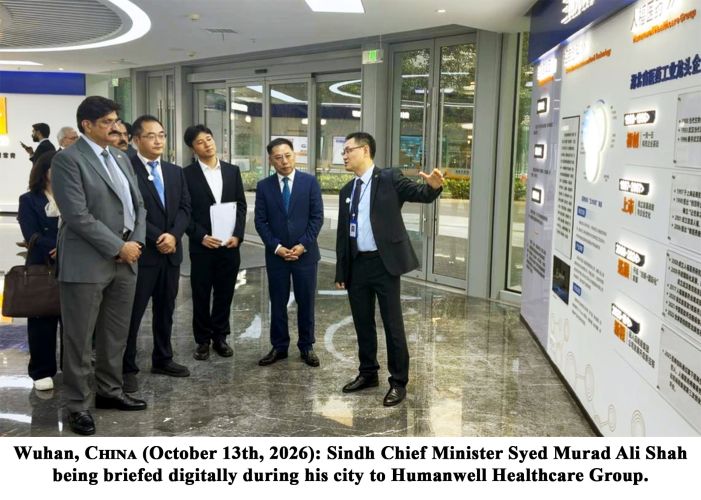
In the healthcare sector, Mr. Shah visited the headquarters of Humanwell Healthcare Group (Renfu Pharmaceutical Group).
Highlighting Sindh’s strategic advantages, including skilled pharmacists, established industrial infrastructure, and investor-friendly fiscal incentives within Special Economic Zones (SEZs), the Chief Minister invited the pharmaceutical giant to establish manufacturing facilities for active pharmaceutical ingredients (APIs) and finished medicines in the province, positioning Sindh as an export hub for Pakistan, the Middle East, Central Asia, and Africa.
Education and youth empowerment occupied center stage during the delegation’s visit to Central China Normal University (CCNU) in Wuhan. Addressing university leaders, faculty, and hundreds of Pakistani and Chinese students, Mr. Shah proposed a visionary four-point educational framework designed to deepen institutional linkages:
Teacher Training: Collaborating to elevate pedagogical standards, beginning with the preparation of master trainers from Sindh.
Academic Mobility: Expanding scholarship allocations, faculty exchanges, and research fellowships.
Mandarin Language Instruction: Inviting CCNU to support comprehensive Mandarin training programs across Sindh’s schools and universities to bolster economic and cultural connectivity.
Joint Research Initiatives: Establishing collaborative research projects addressing climate change, renewable energy, smart cities, and the comparative history of the Indus and Yangtze River civilizations.
As a token of cultural appreciation, traditional Sindhi Ajraks and caps were presented to CCNU President Prof. Peng Shuangjie and University Party Committee Secretary Mr. Xia Lixin, reinforcing the deep people-to-people bonds shared by the two regions.
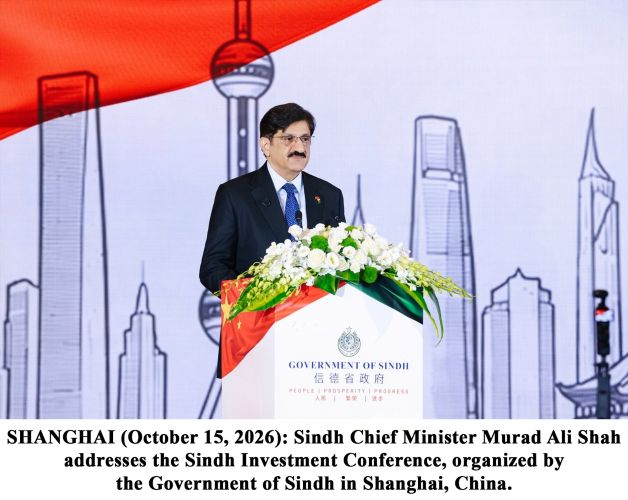
The culmination of the Chief Minister’s tour took place in Shanghai, where the Sindh Investment Conference drew approximately 400 delegates, investors, and corporate leaders. The conference served as a powerful showcase of Sindh’s economic potential, highlighting its strategic geographic location, extensive sea and air connectivity, and competitive labor dynamics.
Mr. Shah prominently featured the Dhabeji Special Economic Zone (SEZ), a high-priority project under the China-Pakistan Economic Corridor (CPEC) spanning 1,530 acres in Thatta district, as an ideal, cost-effective base for export-oriented manufacturing, automotive assembly, pharmaceuticals, and light engineering. Similarly, the 435-acre Education City Special Technology Zone was spotlighted as Pakistan’s premier hub for software services, biotechnology, and electronics.
To alleviate investor concerns, the provincial government reaffirmed its robust legal framework, offering attractive fiscal incentives including a 10-year income tax exemption, duty-free capital imports, and one-window facilitation through a dedicated China Desk established by the Sindh Investment Department.
Addressing the media following the conclusion of the conference, Chief Minister Murad Ali Shah expressed confidence in the province’s trajectory. Drawing inspiration from Shanghai’s economic metamorphosis, he asserted that Karachi is primed to replicate a similar model of growth and modernization.
“For us, the signing of these 34 agreements is the beginning of the work, not the end,” Mr. Shah declared. “With our strategic geography, youthful workforce, and unwavering government facilitation, we are opening new doors of prosperity. Insha’Allah, we will bring the best of Chinese investment home to serve the people of Sindh and Pakistan.”