
Four Months Before the Vote: Kyrgyzstan’s Procedural Bet at the United Nations
the president concentrated on the distance between decisions adopted and decisions implemented

By Kuban Abdymen
Centralasianlight, Kyrgyzstan
BISHKEK: President Sadyr Japarov’s address to the general debate of the 81st session of the UN General Assembly on September 22 in New York was his first from that podium since Kyrgyzstan was elected a non-permanent member of the Security Council for 2027–2028. It was also delivered four months before the country goes to the polls on January 27, 2027 – a coincidence of timing that gives the speech two audiences at once.
An agenda built on procedure
The core of the address was unusually technical, and that is what made it worth attention. Instead of restating principles on which nearly every member state already agrees, the president concentrated on the distance between decisions adopted and decisions implemented.
He proposed establishing a permanent public registry within the General Assembly to record how member states fulfil resolutions and commitments, with regular reporting according to agreed standards and analytical reviews by region and sector, maintained by the UN Secretariat with input from independent experts.
For persistent non-compliance he set out a graduated four-stage procedure: formal notification and consultations, a monitoring mission to identify genuine obstacles, consideration at a plenary session of the General Assembly, and referral to the Security Council for measures under the Charter.
Two further proposals followed. Permanent members were invited to exercise voluntary restraint in using the veto specifically on implementation questions, with an open working group to develop the model. And on the composition of the Council itself, the president supported two permanent seats for Africa and one for Latin America.
This is a recognisable approach for a country of Kyrgyzstan’s size. States without economic or military weight gain influence mainly through rules that apply predictably to everyone. Procedure is not bureaucracy for them; it is the instrument of equality.
Sanctions as a legal question
The second block concerned sanctions. The president argued that the authority to impose them should rest with the United Nations, and that any sanctions initiative should undergo prior assessment of humanitarian, economic and social consequences, with stated legal grounds, defined aims and clear criteria for lifting, alongside a single UN mechanism for monitoring and periodic review.
He also noted that the decision by US President Donald Trump to end funding for non-governmental organisations worldwide had, in his assessment, reduced external involvement in the internal affairs of developing states.
For Kyrgyzstan this is not an abstraction. Kyrgyz banks and companies operate under continuing exposure to secondary restrictions arising from decisions taken far from Bishkek. Moving sanctions authority into a multilateral framework would shift that exposure out of bilateral relations, where asymmetry decides outcomes, and into a legal setting where a small state can argue on comparable terms.
Issyk-Kul: a national concern becomes a shared project
The most concrete section was on climate. The president confirmed that Bishkek will host the Second Global Mountain Summit, “Bishkek+25,” on October 21–23, 2027, closing the five-year period of international action on mountain development, and invited broad participation.
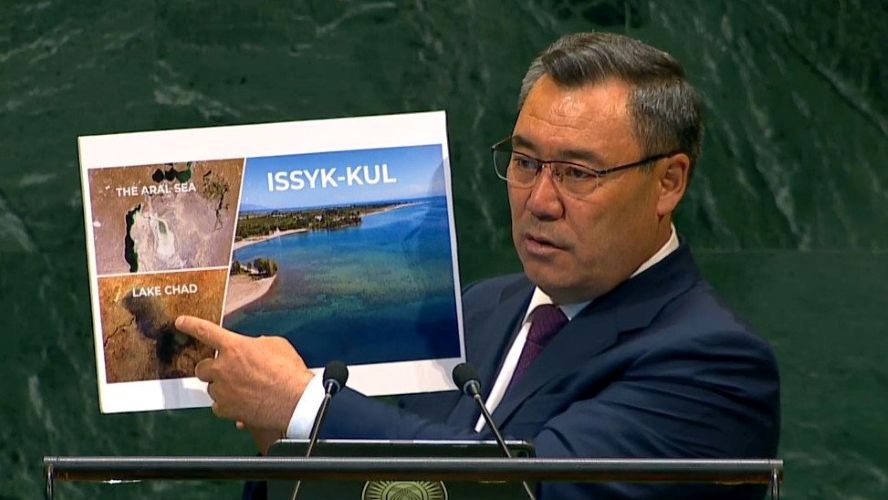
He then called for a dedicated trust fund under UN auspices for the conservation of Lake Issyk-Kul, with Kyrgyzstan ready to contribute $10 million from its own budget.
The supporting figures are serious: the lake’s level has fallen by nearly 14 metres over 170 years and the decline has accelerated to about seven centimetres a year over the past five; of 101 rivers that once fed it, roughly 30 now flow year-round; and Tien Shan glaciers have lost more than 30 percent of their mass in seven decades. The comparison the president drew with the Aral Sea and Lake Chad was a statement about trajectory rather than a rhetorical flourish.
Ten million dollars will not save a lake. What the pledge does is change Kyrgyzstan’s standing in the conversation – from a state requesting assistance to one co-founding an initiative. Together with the 2027 summit, it consolidates a niche few others are contesting: a consistent advocate for mountain countries inside the UN system.
The domestic dimension
The election on January 27 gives all of this a second reading. The president has announced his intention to seek a second term, and foreign policy will be part of the record he presents. A Security Council seat won with the support of 142 states – the first in 35 years of independence – is a result that needs no explanation to a domestic audience.
But the more interesting point is the reverse one. The proposals the president outlined are scheduled to be submitted to the relevant UN committee from January 1, 2027, three and a half weeks before the vote, and the Security Council term itself runs through 2028.
In other words, the agenda announced in New York is designed to outlast the campaign. It commits whoever occupies the office to a specific line of work rather than to a general orientation, and that is comparatively rare in the region.
What will measure success
Realistic expectations matter here. Discussion of veto restraint has a long history at the United Nations, and proposals in this area have repeatedly stalled. The genuine tests over the next two years will be narrower and more verifiable: whether the implementation mechanism advances to the stage of a draft resolution, and how many states and financial institutions actually join the Issyk-Kul fund.
For a country of seven million entering the Security Council for the first time, those are modest benchmarks. They are also the right ones.


