Natural Disasters: Insect Plagues and Crop Pests
FAO: a single square kilometre of locust swarm can consume as much food in a day as 35,000 people


By Dr. Hassan Humeida
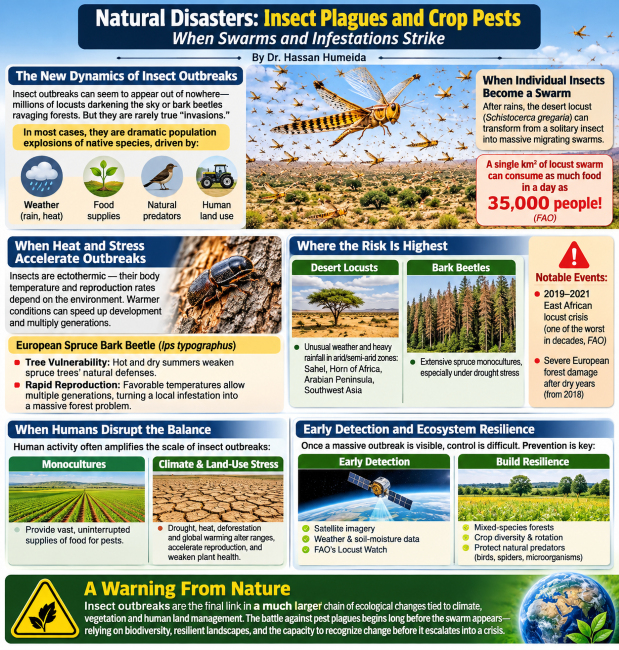
Kiel, Germany: The New Dynamics of Insect Outbreaks: When Swarms and Infestations Strike: Insect outbreaks can seem to appear out of nowhere—millions of locusts darkening the sky or bark beetles multiplying explosively to devastate woodland areas. However, these events are rarely true “invasions.” In most cases, they are dramatic population explosions of native or already established species driven by a combination of weather, food supplies, natural predators, and human land use.
A field can be stripped bare within hours, or drought-weakened trees can succumb to massive beetle populations. These outbreaks are not stories of insects suddenly taking over, but rather the result of ecological conditions aligning in unusually favorable ways.
When Individual Insects Become a Swarm: This dynamic is particularly striking in the desert locust (Schistocerca gregaria). After periods of rain in normally dry regions, vegetation increases rapidly and provides abundant food. As locust densities rise, their behavior and physiology transform from a solitary phase into a gregarious phase, attracting them to one another and forming massive migrating swarms.
According to the Food and Agriculture Organization (FAO), a single square kilometre of locust swarm can consume as much food in a day as 35,000 people.
When Heat and Stress Accelerate Outbreaks: Insects are ectothermic, meaning their body temperature and metabolic rates depend on their surroundings. Within an optimal range, warmer conditions accelerate development and reproduction. This is a critical factor for species like the European spruce bark beetle (Ips typographus):
- Tree Vulnerability: Hot and dry summers weaken spruce trees’ natural defense mechanisms.
- Rapid Reproduction: Favorable temperatures allow bark beetles to produce multiple generations within a single season, transforming a local infestation into a massive regional forest problem.
Where the Risk Is Highest – High-risk regions and vulnerability patterns vary distinctly by species:
- Desert Locusts: Driven by unusual weather patterns and heavy rainfall in arid or semi-arid zones, including the Sahel, the Horn of Africa, the Arabian Peninsula, and Southwest Asia.
- Bark Beetles: Particularly dangerous in extensive spruce monocultures, especially when trees are planted outside their natural range and suffer from acute drought stress.
Historical events underscore these risks, such as the 2019–2021 East African locust crisis—described by the FAO as one of the worst in decades—and severe European forest damage following dry years starting in 2018.
When Humans Disrupt the Balance: While insect outbreaks are natural components of ecosystems that clear out weakened vegetation, human activity often amplifies their scale:
- Monocultures: Providing vast, uninterrupted supplies of food for specialized pests.
- Climate and Land-Use Stress: Drought, heat, deforestation, and global warming alter geographical ranges, accelerate reproduction, and compromise plant health.
Early Detection and Ecosystem Resilience: Once a massive outbreak is visible from the ground, it is difficult to control. Modern management therefore focuses on proactive strategies:
- Early Detection: Utilizing satellite imagery, weather observations, soil-moisture data, and international monitoring frameworks like the FAO’s Locust Watch.
- Ecological Resilience: Shifting toward mixed-species forests, agricultural crop diversity, varied crop rotations, and protecting natural predators (birds, spiders, and microorganisms).
A Warning From Nature: Insect outbreaks are the final link in a much larger chain of ecological changes tied to climate, vegetation, and human land management. The battle against pest plagues begins long before the swarm appears—relying on biodiversity, resilient landscapes, and the capacity to recognize change before it escalates into a crisis.