
Transboundary Haze Tests Singapore-Indonesia Ties
Indonesian-Singapore relationship is mature enough to speak candidly

By Ivan Lim
Former AJA President, Contributor to AsiaN
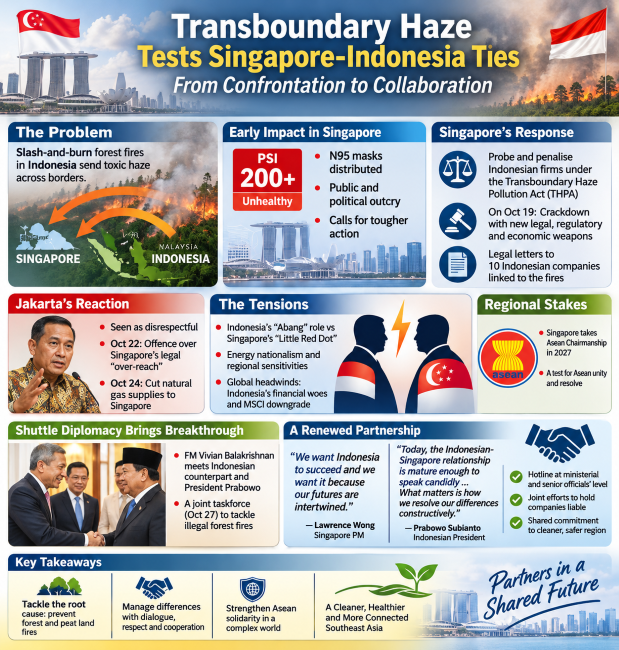
SINGAPORE: A new drive by Singapore to probe and penalise Indonesia-based firms behind the haze-inducing forest fires has drawn early ire from Jakarta which saw the unilateral move as disrespectful, bordering on territorial infringement.
It took a trip by foreign minister Vivian Balakrishnan to meet his Indonesian counterpart Arrmanatha Nasir and later President Prabowo Subianto to turn around a brewing spat and take a bi-lateral approach to tackling the perennial problem.
The slash-and burnt land- clearing operations by timber and oil-palm concessions in Indonesian provinces set off wild-fires that, fanned by seasonal monsoon winds, send toxic smog across to neighbouring Singapore and Malaysia.
The fracas exposed the touchy political cultures within the Asean fraternity even as it served early notice of Singapore’s assertive style as it takes over the rotating chairmanship of the 11-member regional bloc from the Philippines in 2027.
Analysts say within Asean ranks, Indonesia casts itself traditionally as “Abang” (Big brother) who expects to be shown due deference from “Adeks” (younger) members like Singapore, which a former President termed The Little Red Dot.
In early October, the Pollution Standards Index crossed 200 thresholds of unhealthy air quality, prompting the Singapore government to hand out N95 protective masks. The worsening haze sparked criticisms by restive Singaporeans, including an opposition party leader, and calls for tougher measures to stop the blight.
Over the years, efforts under Singapore’ Transboundary Haze Pollution Act (THPA) to prosecute Indonesian companies linked to the forest fires had proved futile owing to difficulties in collecting evidence and identifying the perpetrators.
In showing new resolve on Oct 19, the government announced it will crack down on the offending companies and their owners with new legal, regulatory and economic weapons. A stern-looking Home Affairs Minister and Co-ordinating Minister for National Security, K. Shanmugan told reporters: “Our people are suffering (from the haze) What do these experts think we are supposed to do?
“Shiver in our shoes before we take any action to protect our own people. That is not the Singapore approach.”
Acting under the ambit of THPA, the national environment agency sent out legal letters to 10 Indonesian companies linked to the fires demanding they act to extinguish fires and prevent their occurrence.
On Oct 22, Indonesian officials took offence at what they deemed was Singapore legal over-reach.
Indonesian Coordinating Minister for Downstreaming and Energy Transition, Bahlil Lahadalia warned that Jakarta would not hesitate to stop energy exports to nations that disrespect the country. While he did not name any nation, his message was clear as Singapore is a major importer of gas from Indonesia.
Coordinating Minister Zulkifli Hasan also warned neighbors against testing Indonesia’ patience also insulting its immense efforts in battling wild-fires…
On Oct 24 Jakarta acted to cut natural gas supplies to Singapore, citing priority to meet domestic needs over its contractual obligations to Singapore.
In response to the unexpected Indonesian move, Singapore Prime Minister Lawrence Wong said: “We expect all parties to honour their commitments, and Singapore’s gas importer will take the necessary steps to protect its rights and interests under these contracts.”
On Oct 26, Bahlil Ladadalia replied: “Do not lecture Indonesia about its commitment to honouring and respecting contracts, pointing out that the cut stayed within the minimum allowed under the agreement.
Asked by reporters whether there was a conflict (with Singapore), he said: Do you think there is a conflict? No, there isn’t.”
However, his opposite number Tan See Leng, Minister for Energy, Trade and Industry, characterised the Indonesia cut as a sign of energy nationalism, which will spur the city-state to diversify its energy sources.
Observers see the display of one-upmanship by the two close Asean neighbours as out of sync with the larger picture of global churning in energy supply chains, and particularly Indonesia’s financial woes over its credit rating and nation-wide student protests.
The global index provider MSCI had served notice of its decision to downgrade Indonesia from its status as an “emerging market” to a “stand-alone’ category, that would shake investors’ confidence.
It took shuttle diplomacy by Foreign Minister to heal frayed ties and bring the collaboration between Indonesian and Singapore back on track
A joint taskforce established on Oct 27 will now see the two countries focus on holding companies liable for the illegal practice of starting forest and peat land fires that cause the transboundary haze.
Tactful words replaced the earlier finger-pointing.
Noting that the two neighbours are partners in shared future, Arrmanatha said: “Today, the Indonesian-Singapore relationship is mature enough to speak candidly, especially when we differ. What matters is not what we differ but how we resolve our differences constructively, respectfully and openly.”
Balakrishnan responded: ”We want Indonesia to succeed and we want it because our futures are intertwined.”
With an eye on the future, both countries have agreed to set up a hotline at the ministerial and senior officials’ level to boost communication and manage any differences.
Such rapport – a salute to Asean brotherhood in need and deed.


