Global Ordeal: How Extreme Weather Blocks the Development of All Continents


By Dr. Hassan Humeida
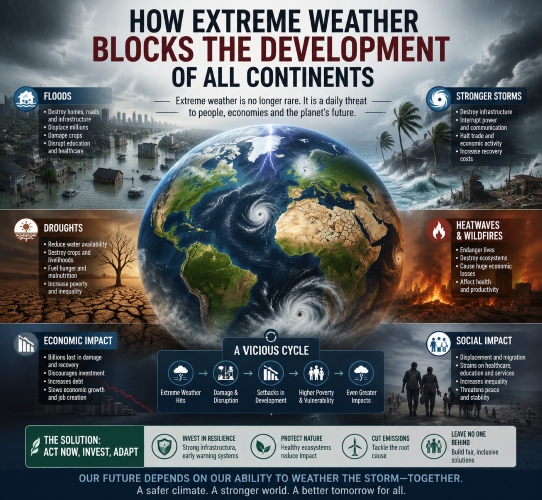
KIEL, GERMANY: Climate change knows no borders. What began as a physical alteration of the Earth’s atmosphere has evolved into an existential crisis for global sustainability. The devastating extreme weather events of recent years—from unprecedented heatwaves to once-in-a-century floods—affect every corner of the earth.
They directly threaten the United Nations’ 17 Sustainable Development Goals (SDGs) and force every continent into its very own battle for the future.
The Continental Theaters of the Climate Crisis:
- Africa (The Existential Crisis of the South): The African continent suffers most dramatically from the instability of the weather. In East Africa and the Sahel, prolonged mega-droughts are destroying the livelihoods of millions of smallholders. Since agriculture forms the economic backbone of many African nations, crop failures lead directly to acute hunger (SDG 2) and set poverty reduction back by decades.
- Asia (The Epicenter of Natural Forces): In South Asia, especially in Pakistan and Bangladesh, extreme heatwaves beyond the 50-degree mark alternate with deadly monsoon floods. The destruction of megacities and vital infrastructure (SDG 9) costs billions. At the same time, the Himalayan glaciers are melting, threatening the long-term water supply of over a billion people.
- Europe and North America (The Illusion of Safety Shatters): Wealthy industrialized nations long believed they could buy their way out of the consequences. But reality has caught up with them. North America battles apocalyptic wildfires and chronic water scarcity in the West. Europe is experiencing record heat, the drying up of major commercial rivers like the Rhine, and catastrophic flash floods. The economic damages heavily strain national budgets and jeopardize the goal of sustainable economic growth (SDG 8).
- South America and Australia (Ecosystems at the Limit): The Amazon rainforest, the green lungs of the Earth, is suffering from historic droughts, compromising global CO2 storage. Australia, meanwhile, is hit at increasingly shorter intervals by extreme bushfires and marine heatwaves that are irrecoverably destroying the Great Barrier Reef and wiping out biodiversity (SDG 15).
The Global Domino Effect on Sustainability:
Extreme weather events act like a system error in the global development plan. They destroy the infrastructure necessary for education, health, and clean water. When schools are washed away, hospitals are overwhelmed due to heat-related collapses, or drinking water wells become salinized, the social foundation breaks down.
The Greatest Threat: Displacement and Conflict When habitats become uninhabitable, gigantic migratory movements arise. Millions of people must leave their homes because they can find neither food nor water. This climate-induced migration leads to social tensions in destination regions and endangers the global goal for peace and justice (SDG 16).
Conclusion: No Development Without Climate Resilience:
Extreme weather events make us realize that global sustainability remains an illusion as long as we do not stabilize the climate system. Every continent must fundamentally rebuild its infrastructure and make it “climate-resilient”—meaning robust against extreme weather.
This requires unprecedented global cooperation. The wealthier nations of the North must significantly support the heat-stricken South both financially and technologically. Only if we understand climate protection as the foundation of all development do the Sustainable Development Goals have a chance of becoming a reality.